
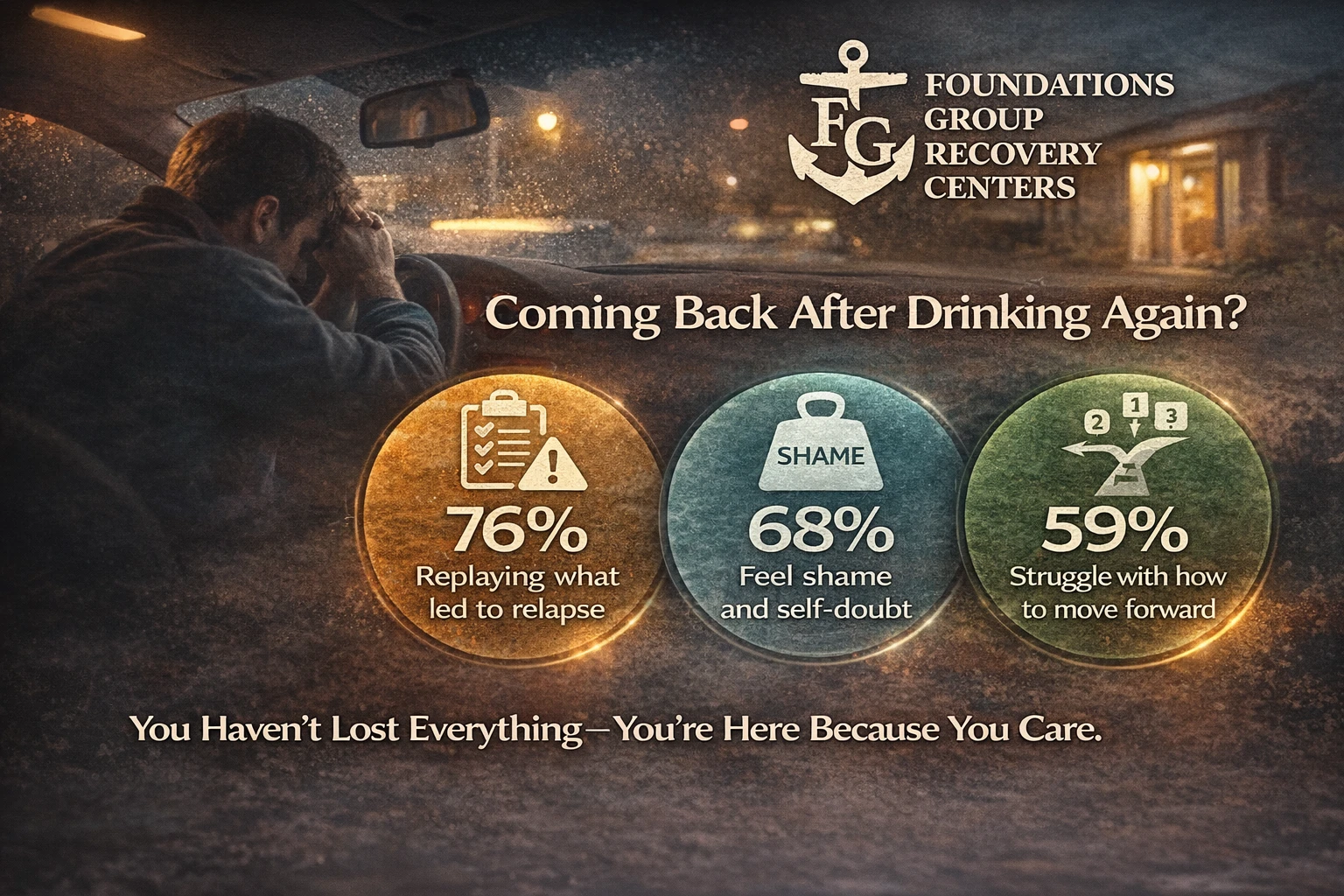
I sat in my car staring at the building, replaying everything.
Not just the relapse.
But the lead-up to it. The excuses. The quiet moments I ignored.
And the loudest thought of all:
“You already had your chance.”
If you’ve ever tried to come back after drinking again, you know this feeling. It’s not just fear—it’s heavier than that.
It’s like carrying proof of your own doubts.
But here’s something I didn’t understand then—and maybe you don’t fully believe yet:
Coming back isn’t harder because you failed.
It’s harder because you care.
And there are still ways forward, including alcohol addiction treatment that meet you exactly where you are now—not where you think you should’ve stayed.
The Second Time Isn’t Just a Restart—It’s a Reckoning
The first time I went into treatment, everything felt unknown.
There was fear, sure.
But also a weird kind of hope.
The second time?
Nothing was unknown anymore.
I knew what I had lost.
I knew what it felt like to build something—and watch it crack.
That awareness makes everything heavier.
Because now it’s not just, “Can I do this?”
It’s, “Why didn’t I keep it?”
Shame Gets Louder the More You Know
No one warns you about how loud shame gets after relapse.
It’s not subtle.
It sounds like:
- “You knew better.”
- “You said this wouldn’t happen.”
- “This proves who you really are.”
And the hardest part?
It feels convincing.
Because it’s built on real experience.
But shame doesn’t tell the full story.
It just tells the harshest version of it.
I Thought I Lost Everything—But I Didn’t See What Stayed
After I drank again, I told myself I was back at zero.
Like the last 90 days meant nothing.
But that wasn’t true.
I still had:
- Awareness I didn’t have before
- Triggers I could now recognize
- A clearer understanding of what I actually struggle with
I didn’t lose everything.
I just lost the illusion that I had it all figured out.
And weirdly, that made room for something more real.
The Pressure to “Do It Right This Time” Can Make It Harder
Coming back comes with pressure.
Not from other people—but from yourself.
You tell yourself:
- “You can’t mess this up again.”
- “You have to take it seriously this time.”
- “You need to prove this works.”
That pressure can make every step feel heavier.
Because now it’s not just about recovery.
It’s about redemption.
But recovery doesn’t work well under pressure.
It works under honesty.
Life Didn’t Pause While You Were Figuring This Out
One of the hardest parts?
Everything else kept going.
Work. Bills. Expectations.
You’re not just trying to get better—you’re trying to keep your life from falling apart at the same time.
For a lot of people, especially those exploring outpatient alcohol rehab Boston options, this becomes the biggest internal conflict:
“How do I get help without losing everything else?”
And that’s a valid question.
Because recovery has to fit into your life—not replace it entirely.
The Second Time, I Stopped Pretending I Was Fine
The first time, I tried to be the “good” version of someone in recovery.
Saying the right things.
Avoiding the uncomfortable parts.
The second time?
I didn’t have that energy.
I showed up tired.
Honest.
Not trying to impress anyone.
And that changed everything.
Because recovery stopped being something I performed—and became something I actually experienced.
I Expected Judgment—But Got Something Else
I thought walking back in meant facing disappointment.
People looking at me like I had failed.
That didn’t happen.
No one treated me like I didn’t belong.
No one made me feel like I had to earn my place back.
They treated me like someone who came back.
And that shift?
It gave me room to breathe again.
What I Learned About Relapse That No One Explained Clearly
Relapse doesn’t mean recovery didn’t work.
It means something in your life wasn’t fully supported yet.
That’s it.
Not failure.
Not proof you can’t do it.
Just information.
Hard, uncomfortable information—but still useful.
And if you use it, it can actually make your recovery stronger.
The Difference Between Starting Over and Starting Smarter
It feels like starting over.
I get that.
But it’s not.
You’re not the same person you were the first time.
You’ve learned things. Felt things. Seen what works—and what doesn’t.
Even this relapse?
It taught you something.
About your stress.
Your limits.
What kind of support you actually need.
That’s not starting over.
That’s starting smarter.
If You’re Stuck Between Going Back and Walking Away
That space is real.
Part of you knows you need something.
Another part of you feels like you’ve already used up your chance.
But recovery doesn’t work like that.
You don’t get one opportunity.
You get as many as you’re willing to take.
And the fact that you’re even considering coming back?
That means something in you is still fighting.
For Those Trying to Balance Work and Recovery
This part matters more than people admit.
You don’t just want help.
You want help that doesn’t cost you everything else.
If you’re working, managing responsibilities, or trying to hold your life together, finding flexible support matters.
That’s where options like outpatient alcohol rehab Boston come in—offering structure without pulling you completely out of your daily life.
It’s not about choosing between recovery and responsibility.
It’s about finding a way to support both.
What Coming Back Actually Means
It doesn’t mean you failed.
It doesn’t mean you’re back at the beginning.
It means you didn’t give up.
And that’s the part that matters most.
Because recovery isn’t about never falling.
It’s about not staying down longer than you have to.
Frequently Asked Questions
Is it normal for coming back after relapse to feel harder?
Yes.
It often feels heavier because of shame, self-doubt, and the pressure to “get it right” this time. That emotional weight can make returning feel more difficult than starting.
Does relapse mean treatment didn’t work?
No.
It usually means that some areas of support or coping weren’t strong enough yet. Treatment can still be effective—sometimes even more so after relapse.
Why do I feel like I don’t deserve to go back?
That’s a common response to shame.
But recovery isn’t something you earn—it’s something you return to, even after setbacks.
Can I still recover after relapsing?
Yes.
Many people build stronger, more sustainable recovery after relapse because they have more awareness and understanding of their needs.
What if I need help but can’t leave my job?
You’re not alone in that concern.
Flexible options exist that allow you to receive support while continuing to work and manage responsibilities.
Take the Next Step Without Starting Over
If you’re thinking about coming back, you don’t have to figure it out alone.
Call (844)763-4966 to learn more about our alcohol addiction treatment services in Mashpee, MA.
You’re not back at the beginning.
You’re just stepping forward—with more truth than before.