

You’ve never missed a meeting.
You pay your bills. You show up for your family. Your friends think you have it together.
And every night, you drink more than you planned to.
If that sounds familiar, you may have wondered whether the phrase high-functioning alcoholic applies to you. Maybe you’ve convinced yourself that because you’re still succeeding at work or maintaining relationships, your drinking can’t really be a problem. If you’re questioning your relationship with alcohol, learning more about alcohol addiction treatment can help you understand that recovery doesn’t have to begin after everything falls apart.
Here’s the truth that doesn’t get talked about enough:
Functioning isn’t the opposite of addiction.
Sometimes it’s what hides it.
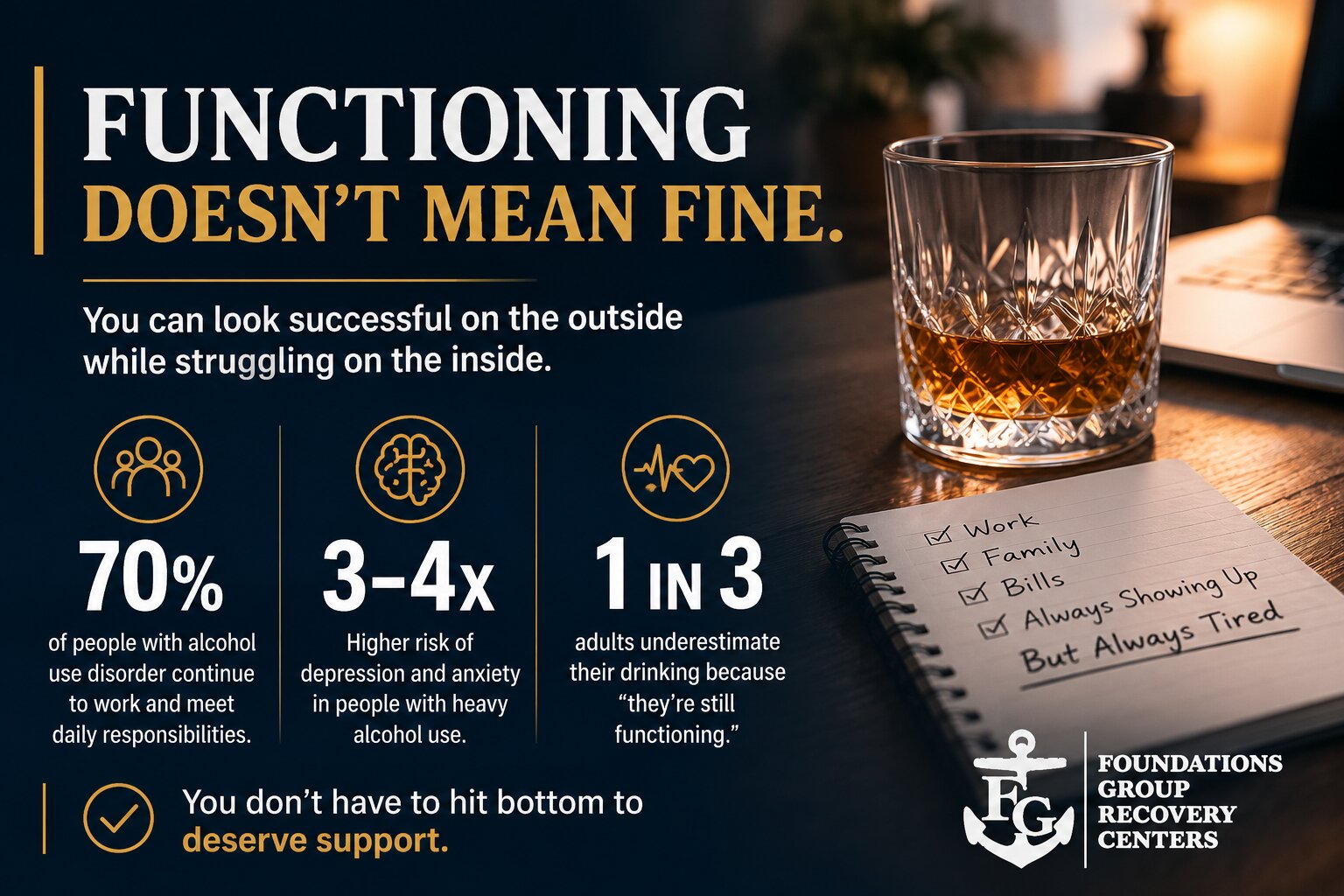
Many people living with alcohol use disorder don’t lose their careers overnight. They don’t wake up under bridges. They aren’t missing every responsibility.
Instead, they become experts at keeping everything looking normal while quietly carrying more and more of the weight that alcohol creates.
That invisible struggle is real.
What Is a High-Functioning Alcoholic?
“High-functioning alcoholic” isn’t an official medical diagnosis.
Clinicians diagnose alcohol use disorder (AUD) based on patterns of drinking and its impact—not on whether someone still has a job or appears successful.
The phrase high-functioning alcoholic generally describes someone whose alcohol use has not yet caused obvious external collapse.
From the outside, life may look stable.
They may have:
- A successful career
- A loving family
- Financial stability
- Professional accomplishments
- Active social lives
- A reputation for being dependable
But functioning describes the outside picture.
It doesn’t tell you what’s happening internally.
Many people with high-functioning alcohol use disorder are:
- Constantly thinking about drinking
- Planning their evenings around alcohol
- Hiding how much they consume
- Feeling ashamed after drinking
- Promising themselves they’ll cut back tomorrow
Functioning isn’t proof that alcohol isn’t causing harm.
Sometimes it’s simply proof that someone has become very good at hiding the cost.
Signs of a High-Functioning Alcoholic
Alcohol use disorder doesn’t always announce itself with dramatic consequences.
Often, the signs appear quietly.
Drinking More Than Planned
You intended to have one or two drinks.
Instead, you finish the bottle.
Again.
You tell yourself tomorrow will be different.
Tomorrow usually isn’t.
Repeatedly Trying to Cut Back
Many people with high-functioning alcohol use disorder have already tried moderation.
They’ve made rules like:
- Only on weekends.
- Never before dinner.
- No liquor.
- Only with friends.
- Only after work.
Those rules often work—for a while.
Then something stressful happens.
Or something worth celebrating.
And the rules quietly disappear.
Needing Alcohol to Relax
At first, drinking may feel like a reward.
Eventually, it begins feeling necessary.
You stop asking:
“Do I want a drink?”
Instead, your brain asks:
“How am I supposed to unwind without one?”
Always Keeping Alcohol Available
Running out feels uncomfortable.
Maybe there’s wine in the pantry.
Beer in the garage.
Liquor tucked away where guests won’t notice.
Not because you’re planning to binge.
Because knowing it’s there feels reassuring.
Planning Life Around Drinking
You start asking yourself questions like:
- Will alcohol be served?
- Who’s driving?
- Can I drink before I go?
- How early can I leave so I can drink at home?
The alcohol slowly becomes part of every plan—even if no one else notices.
Minimizing How Much You Drink
People ask how much you’ve had.
You automatically answer with a smaller number.
Maybe you genuinely don’t remember.
Maybe you’ve stopped counting.
Either way, honesty becomes surprisingly difficult.
Feeling Irritable Without Alcohol
When drinking isn’t possible, you may notice:
- Restlessness
- Irritability
- Anxiety
- Difficulty relaxing
- Trouble sleeping
Many people mistake these feelings for ordinary stress when they’re actually signs that alcohol has become part of the brain’s daily routine.
Managing Hangovers Instead of Avoiding Them
The hangovers don’t disappear.
You simply get better at working through them.
Coffee.
Pain relievers.
Greasy breakfast.
Extra water.
You show up anyway.
People praise your work ethic.
They don’t realize how much energy goes into looking fine.
Why “I’m Still Functioning” Is the Most Dangerous Part
Here’s the trap.
Functioning becomes the evidence you use against yourself.
“I still have my job.”
“I’m still paying my bills.”
“I’m still a good parent.”
“I’ve never gotten a DUI.”
“I’m not drinking in the morning.”
“I’m not like those people.”
Every one of those statements can delay getting help.
Because functioning becomes the alibi.
Not for everyone else.
For yourself.
Alcohol use disorder doesn’t need you to deny drinking.
It only needs you to believe things aren’t bad enough yet.
That’s one of the reasons high-functioning alcoholism can continue for years.
The outside keeps providing reassurance while the inside keeps changing.
Tolerance climbs.
Two drinks become four.
Four become six.
The amount that once helped you relax slowly stops working.
You drink more—not because you’re reckless, but because your brain has adapted.
Meanwhile, alcohol continues affecting your body whether anyone notices or not.
Heavy drinking increases the risk of:
- Liver disease
- High blood pressure
- Heart disease
- Memory problems
- Depression
- Anxiety
- Sleep disruption
- Certain cancers
None of those conditions require someone to lose their job first.
The damage often develops quietly.
The hardest part may not be the drinking itself.
It’s maintaining the appearance that everything is fine.
Because high-functioning alcoholism often feels like this:
You’re succeeding in public while negotiating with yourself in private every single day.
That’s exhausting.
And eventually, keeping up the appearance becomes harder than asking for help.
How to Talk to a High-Functioning Alcoholic in Your Life
If you’re reading this because you’re worried about someone else, it’s natural to want to convince them they’re drinking too much.
But confrontation alone rarely changes behavior.
In fact, it often increases defensiveness.
Instead of saying:
- “You’re an alcoholic.”
- “You need to stop.”
- “You’re ruining everything.”
Try focusing on specific observations.
For example:
- “I’ve noticed alcohol seems to be causing you a lot of stress lately.”
- “You mentioned wanting to cut back, but it sounds like that’s been difficult.”
- “I’m worried because I care about you.”
Avoid debating whether they’re “really” an alcoholic.
Instead, talk about what you’ve seen.
Keep the conversation grounded in concern rather than accusation.
Most importantly, remember that denial isn’t simply stubbornness.
When someone depends on alcohol, their brain often works hard to protect continued drinking.
Compassion doesn’t guarantee change.
But it usually creates more opportunity for honest conversation than shame ever will.
You Don’t Have to Hit Bottom
One of the biggest myths about alcohol recovery is that people need to lose everything before treatment makes sense.
That’s simply not true.
In fact, seeking help before alcohol causes catastrophic consequences often makes recovery easier.
You don’t have to wait until:
- Your health declines.
- Your relationships fall apart.
- Your career suffers.
- You receive a DUI.
- Your family gives you an ultimatum.
You can ask for help because you’re tired.
Because you’ve tried to cut back.
Because you’re spending too much energy pretending everything is under control.
Those are enough reasons.
Recovery isn’t reserved for people whose lives have completely unraveled.
It’s available for people who recognize they don’t want alcohol running the show anymore.
Frequently Asked Questions
What are the signs of a high-functioning alcoholic?
Common signs include drinking more than intended, repeated unsuccessful attempts to cut back, relying on alcohol to relax, hiding or minimizing drinking, planning activities around alcohol, increased tolerance, and continuing to meet responsibilities while experiencing growing internal distress.
Can you be an alcoholic if you still have a job?
Yes. Having a successful career does not rule out alcohol use disorder. Many people with high-functioning alcohol use disorder maintain jobs, relationships, and financial stability while still struggling with unhealthy patterns of alcohol use.
How do you help a high-functioning alcoholic?
Approach the conversation with compassion rather than judgment. Focus on specific behaviors you’ve observed instead of labels, listen without arguing, and encourage them to speak with a healthcare professional or addiction specialist if they’re concerned about their drinking.
You Don’t Have to Keep Carrying It Alone
If you’ve been telling yourself you’re “still functioning,” but alcohol is taking up more space in your life than you’d like to admit, you don’t have to wait for things to get worse before reaching out. Recovery isn’t about proving you’ve hit bottom—it’s about deciding you deserve something better. Get help that’s close to home, Proudly serving in Falmouth, Barnstable County, MA.
Call (844) 763-4966 or learn about alcohol addiction treatment at Foundations Recovery.