
If you’ve started exploring treatment for opioid addiction, you’ve probably come across two medications more than any others: Suboxone and methadone.
You may also have heard conflicting opinions. Some people say one works better than the other. Others worry that taking medication is simply “trading one addiction for another.” It can be difficult to separate myths from facts.
If you’re searching for Suboxone vs methadone, the good news is that both medications are evidence-based treatments that have helped millions of people recover from opioid use disorder. Learning more about medication-assisted treatment can help you understand how these medications fit into a comprehensive recovery plan.
The important question isn’t which medication is “better.”
It’s which one is the best fit for your individual needs, medical history, and recovery goals.
Understanding how they differ can help you have a more informed conversation with your healthcare provider.
Suboxone vs Methadone: At a Glance
Although both medications treat opioid use disorder, they work differently and are accessed in different ways.
Feature |
Suboxone |
Methadone |
|---|---|---|
| Active ingredient | Buprenorphine + naloxone | Methadone |
| How it works | Partial opioid agonist | Full opioid agonist |
| Where you receive it | Prescribed by qualified healthcare providers; often taken at home | Dispensed through licensed opioid treatment programs (OTPs) |
| Typical dosing | Daily or as prescribed, usually at home | Daily clinic dosing initially, with take-home doses possible over time |
| Abuse potential | Lower, though misuse is still possible | Higher due to full opioid effects |
| Ceiling effect | Yes, reducing overdose risk at higher doses | No ceiling effect |
| Typical candidates | People seeking flexibility and office-based treatment | Individuals who may benefit from greater structure or have very high opioid tolerance |
Both medications are supported by decades of research and can significantly reduce opioid use, cravings, overdose risk, and mortality when used appropriately.
Understanding Suboxone (Buprenorphine/Naloxone)
Suboxone combines two medications:
- Buprenorphine, a partial opioid agonist
- Naloxone, an opioid antagonist included to discourage misuse by injection
How It Works
Buprenorphine attaches to the same opioid receptors as drugs like heroin or fentanyl, but it activates them only partially.
This allows it to:
- Reduce cravings
- Prevent withdrawal symptoms
- Lower the risk of overdose
- Help stabilize brain chemistry
Because it doesn’t fully activate opioid receptors, many people experience relief from withdrawal without the intense euphoria associated with illicit opioid use.
The Ceiling Effect
One of Suboxone’s most important safety features is its ceiling effect.
After a certain dose, taking additional medication generally does not produce stronger opioid effects.
This significantly lowers—but does not eliminate—the risk of respiratory depression and overdose when taken as prescribed.
Access to Treatment
Today, many qualified healthcare providers can prescribe Suboxone in office-based settings, and telehealth may also be available depending on regulations and individual circumstances.
This often allows people to:
- Continue working
- Care for family
- Attend school
- Receive treatment without daily clinic visits
There are also buprenorphine-only medications, such as Subutex, which may be appropriate in certain clinical situations.
Understanding Methadone
Methadone has been used safely to treat opioid use disorder for decades.
Unlike Suboxone, methadone is a full opioid agonist.
How It Works
Methadone activates opioid receptors fully but does so in a controlled, long-acting way.
When carefully dosed, it can:
- Prevent withdrawal symptoms
- Reduce cravings
- Block the effects of other opioids
- Help stabilize daily functioning
For many individuals with severe opioid dependence, methadone remains an extremely effective treatment option.
Where Methadone Is Provided
Methadone for opioid use disorder is generally dispensed through licensed opioid treatment programs (OTPs), commonly called methadone clinics.
Many patients begin treatment with:
- Daily supervised dosing
- Regular medical monitoring
- Counseling services
- Routine follow-up appointments
As treatment progresses and stability is demonstrated, some individuals may become eligible for take-home doses under program guidelines.
No Ceiling Effect
Unlike buprenorphine, methadone does not have a ceiling effect.
Because it is a full opioid agonist, careful dosing and ongoing medical supervision are essential to reduce the risk of overdose, particularly during the early stages of treatment.
Key Differences: Access, Safety, and Who Each Medication May Suit
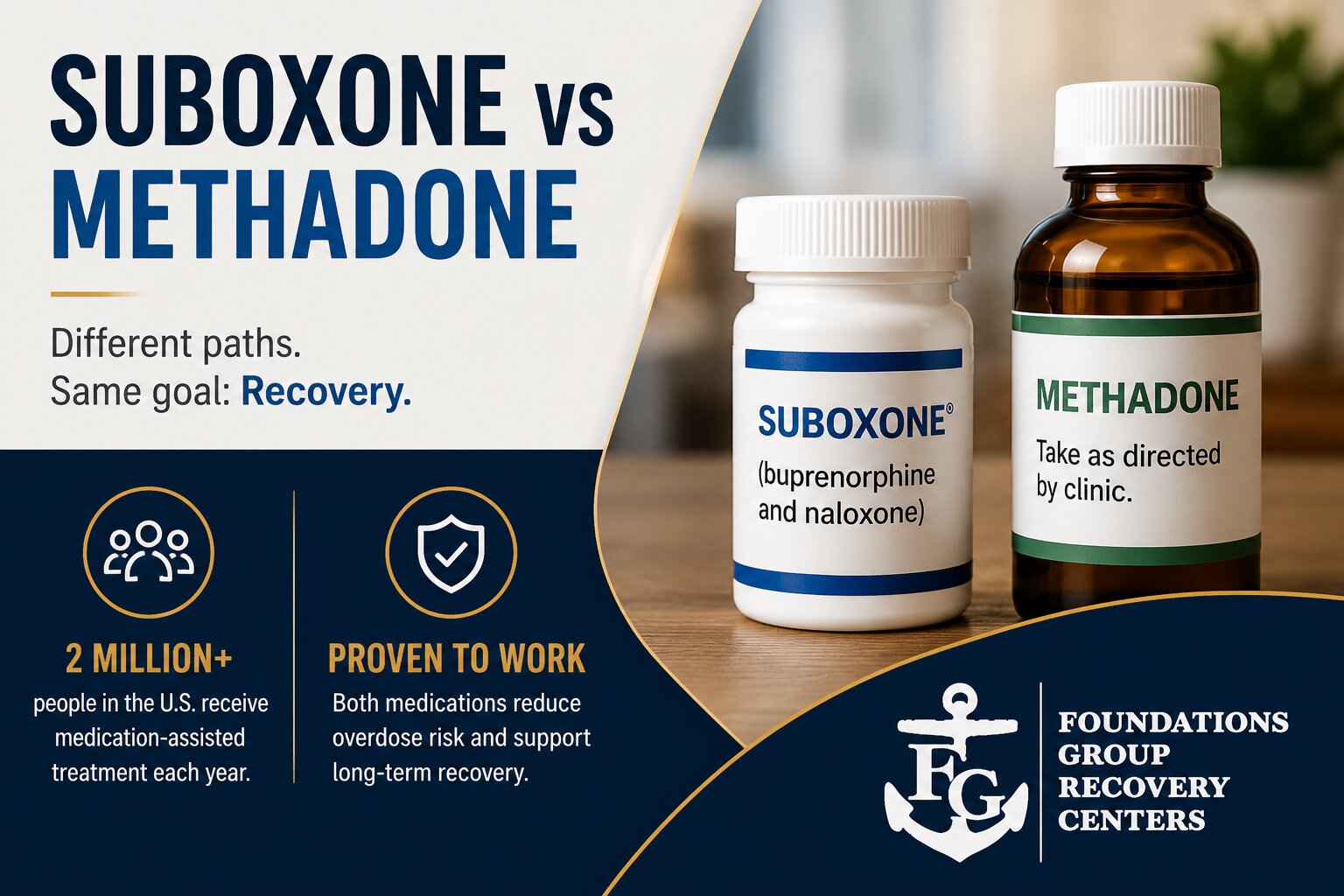
When comparing Suboxone vs methadone for opioid addiction, the biggest practical differences often involve how treatment is accessed, how the medications work, and which individuals may benefit most from each approach.
Access Model
One of the most noticeable differences is how each medication is obtained.
Suboxone is often prescribed in an office-based setting by qualified healthcare providers and may be appropriate for people who can safely manage medication at home.
Methadone is typically dispensed through licensed opioid treatment programs, where patients often begin with daily in-person visits before earning take-home privileges over time.
For someone balancing work, childcare, or other responsibilities, office-based treatment may offer greater flexibility.
For others, the structure of daily clinic visits provides valuable accountability and support.
Neither approach is inherently better—they simply meet different clinical needs.
Safety Profile
Both medications are considered safe and effective when prescribed and monitored appropriately.
However, they have different safety considerations.
Suboxone’s ceiling effect reduces the likelihood of respiratory depression at higher doses.
Methadone’s full opioid effects make careful dosing especially important, particularly during treatment initiation or when other sedating substances are involved.
Neither medication should be combined with alcohol, benzodiazepines, or other sedatives unless specifically directed and monitored by a healthcare provider.
Who May Benefit from Methadone?
A clinician may recommend methadone for individuals who:
- Have very high opioid tolerance
- Have not responded well to buprenorphine
- Require more structured daily monitoring
- Benefit from frequent clinical contact
Who May Benefit from Suboxone?
Suboxone may be appropriate for individuals who:
- Need greater scheduling flexibility
- Have stable housing
- Can manage medication responsibly
- Want office-based or telehealth treatment when appropriate
These are general considerations—not strict rules.
Only a qualified clinician can determine which medication is most appropriate after a comprehensive evaluation.
Addressing the Myth: “Am I Just Trading One Addiction for Another?”
This is one of the most common concerns people express.
The answer is no.
Medication-assisted treatment is not about replacing one addiction with another.
When used as prescribed, medications like Suboxone and methadone help stabilize brain chemistry, reduce cravings, prevent withdrawal, and support long-term recovery.
People taking these medications under medical supervision are receiving evidence-based treatment for a chronic medical condition—not continuing an addiction.
Research consistently shows that medication-assisted treatment reduces overdose deaths, improves treatment retention, and supports long-term recovery.
How to Choose Between Suboxone and Methadone
Choosing the right medication is not a decision anyone should make based solely on internet opinions or stories from friends.
Healthcare providers consider many factors, including:
- Current opioid use
- Level of physical dependence
- Previous treatment experiences
- Medical history
- Mental health conditions
- Daily responsibilities
- Transportation
- Access to treatment programs
- Personal recovery goals
Someone with significant fentanyl dependence and repeated unsuccessful treatment attempts may have different needs than someone seeking treatment early in opioid use disorder.
The goal isn’t choosing the “stronger” medication.
It’s choosing the medication that gives you the best opportunity to achieve long-term recovery.
Your treatment plan can also change over time.
Some individuals remain on one medication for years.
Others transition to different approaches as their recovery progresses.
Recovery is highly individualized, and treatment decisions should reflect that.
Recovery Is Not One-Size-Fits-All
There is no single medication that’s right for everyone.
Suboxone and methadone have both transformed the lives of countless people living with opioid use disorder.
Each offers unique advantages depending on individual circumstances.
If you’re feeling uncertain, remember that you don’t have to make this decision alone.
A qualified treatment provider can help evaluate your needs, answer your questions, and recommend the approach most likely to support your recovery.
The first step isn’t choosing the perfect medication.
It’s reaching out for help.
Frequently Asked Questions
What is the difference between Suboxone and methadone?
Suboxone contains buprenorphine and naloxone and works as a partial opioid agonist with a ceiling effect that lowers overdose risk. Methadone is a full opioid agonist dispensed through licensed opioid treatment programs. Both reduce withdrawal symptoms and cravings but differ in how they’re prescribed, monitored, and used.
Which is better for opioid addiction—Suboxone or methadone?
Neither medication is universally better. The most appropriate option depends on factors such as opioid tolerance, treatment history, medical needs, and daily responsibilities. A healthcare provider can help determine which medication best fits your situation.
Is methadone or Suboxone safer?
Both medications are considered safe when taken exactly as prescribed under medical supervision. Suboxone has a ceiling effect that lowers overdose risk, while methadone requires closer monitoring because it is a full opioid agonist. Safety depends on individual health, proper dosing, and ongoing clinical care.
Take the Next Step
If you’re considering medication-assisted treatment, you don’t have to decide between Suboxone and methadone on your own. A comprehensive evaluation can help determine which option best supports your recovery goals and personal circumstances. Get help that’s close to home, Proudly serving in Falmouth, Barnstable County, MA.
Call (844) 763-4966 or learn about medication-assisted treatment at Foundations Recovery.