
It often doesn’t start with something dramatic.
It’s quieter than that. A shift in tone. A pattern you can’t quite name—but can’t ignore either.
As a clinician, I’ve sat with many parents who say the same thing: “I don’t know if this is serious… but it doesn’t feel right.”
If that’s where you are, you’re not overreacting. You’re paying attention.
If you’re trying to make sense of what you’re seeing, this guide can help you understand what might be happening—and what support could look like, including alcohol addiction treatment options.
The Question That Keeps Coming Back
Sometimes it shows up in small ways.
You notice your child drinking more often. Maybe every night. Maybe alone. Maybe brushing it off as “normal.”
And then the question starts looping in your mind: is drinking every night normal?
That question isn’t really about the alcohol.
It’s about what your instincts are trying to tell you.
Parents rarely ask that unless something deeper feels off.
You might hear it in the way they explain their drinking.
You might feel it in the pauses, the defensiveness, or the way conversations end too quickly.
It’s not always about quantity.
Sometimes, it’s about the relationship they’re building with alcohol—and how it’s starting to shape their daily life.
Subtle Changes That Are Easy to Miss
Not every sign looks like a crisis. In fact, early warning signs are often easy to explain away.
You might notice:
- They seem more withdrawn or emotionally distant
- Small responsibilities start slipping through the cracks
- Sleep patterns change—late nights, heavy mornings
- Their tone feels sharper, more reactive, or unusually flat
- Social circles shift in ways you don’t fully understand
None of these alone “prove” anything. But together, they can tell a story.
And here’s something many parents share quietly:
You often feel the change before you can explain it.
There’s a difference between growing independence and quiet disconnection.
Between typical young adult behavior and something that feels heavier.
That difference can be hard to name—but it matters.
When Drinking Becomes a Coping Tool
At this age, drinking is often framed as social, temporary, or even expected.
And sometimes, it is.
But sometimes, it slowly becomes something else.
Alcohol can start to take on a role in your child’s life:
- Taking the edge off anxiety
- Easing social pressure or self-doubt
- Filling long, unstructured hours
- Avoiding difficult thoughts or emotions
From the outside, it may still look manageable.
From the inside, it can feel like the only reliable way to cope.
This is where things quietly shift.
It’s no longer just about having a drink.
It’s about needing it to feel okay.
And that need can grow without obvious warning signs.
The Emotional Weight Parents Carry
This is the part that doesn’t get talked about enough.
You might be asking yourself:
- Did I miss something earlier?
- Did I say the wrong thing?
- Why does it feel like I’m losing them?
That weight is real. And it’s heavy.
Parents often carry a quiet mix of guilt, fear, and confusion.
You want to help—but you don’t know how without pushing them away.
You might try to stay calm.
You might try to give space.
You might second-guess every conversation.
But here’s something important to hold onto:
Your child’s struggle is not a reflection of your failure.
And your concern is not something to silence—it’s something to trust.
Love is what makes this hurt.
It’s also what helps guide what comes next.
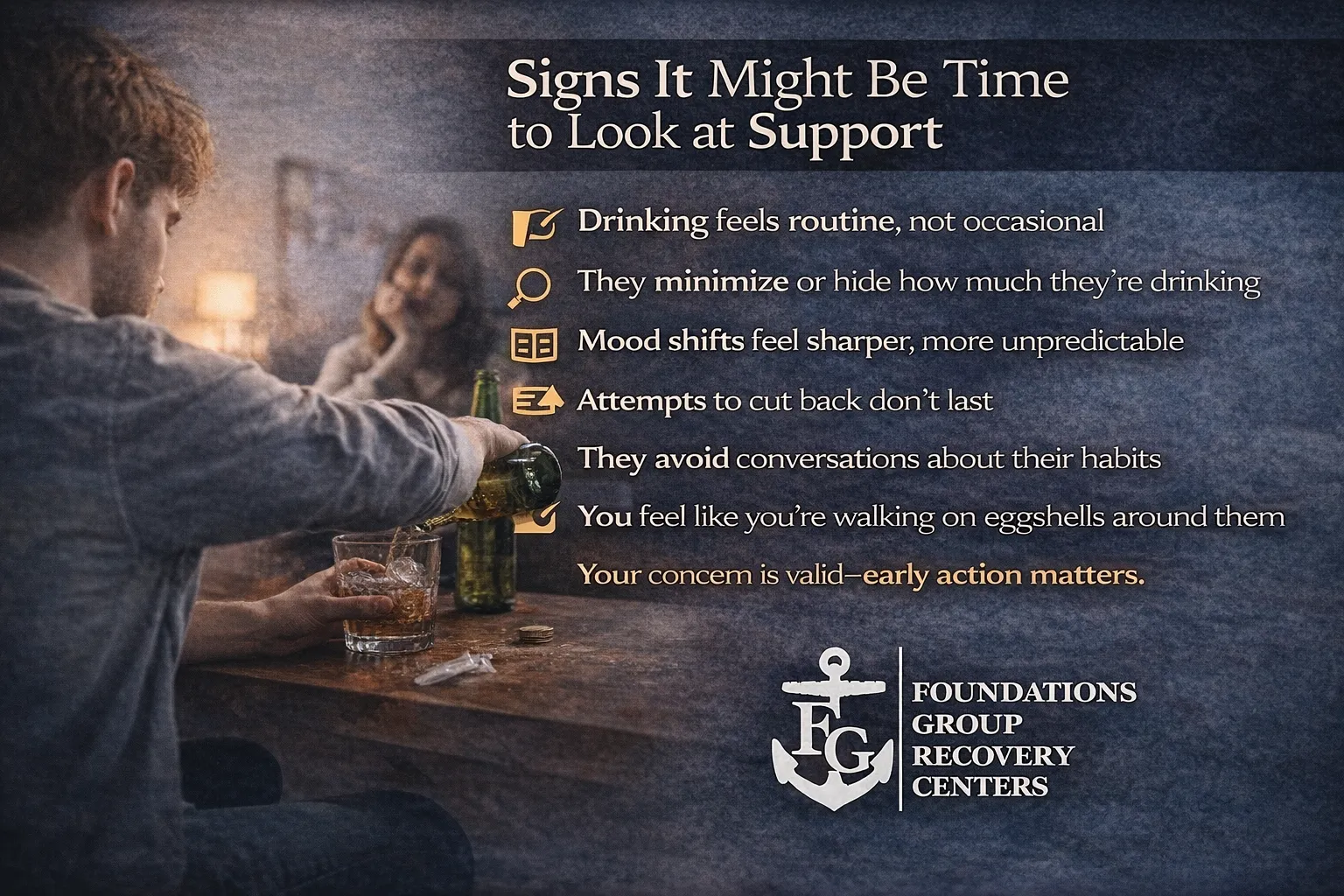
Signs It Might Be Time to Look at Support
There’s no perfect line where concern becomes certainty.
But there are moments when it’s worth exploring help more seriously.
Signs you might be seeing something more:
- Drinking feels routine, not occasional
- They minimize or hide how much they’re drinking
- Mood shifts feel sharper, more unpredictable
- Attempts to cut back don’t last
- They avoid conversations about their habits
- You feel like you’re walking on eggshells around them
Sometimes the clearest signal isn’t just their behavior—it’s how it’s affecting the home.
If the environment feels tense, uncertain, or emotionally fragile, that matters too.
You don’t need a diagnosis to seek guidance.
You just need enough concern to start paying closer attention.
What Help Can Actually Look Like
Support doesn’t always mean a dramatic intervention or immediate live-in care.
In many cases, it starts smaller—and more approachable.
It might look like:
- A calm, non-accusatory conversation
- Speaking with a clinician for guidance
- A structured schedule that introduces stability
- Multi-day weekly support that fits into daily life
- A space where your child can talk without feeling judged
For families in Barnstable County, Massachusetts, having access to local, compassionate care can make this step feel less overwhelming and more possible.
Treatment, at its core, isn’t about forcing change.
It’s about creating space where change can happen safely.
It gives your child a chance to understand what’s underneath their drinking.
And it gives you a way to step out of constant worry and into supported action.
You Don’t Have to Wait for It to Get Worse
One of the hardest parts of this experience is uncertainty.
You don’t know if this is a phase.
You don’t know if it will escalate.
You don’t know if now is “too early” to act.
But waiting for clarity often means waiting for things to get worse.
And most parents who look back will tell you this:
They wish they trusted their instincts sooner.
If you’re nearby Falmouth, Massachusetts, exploring local support options early can give you clarity without forcing immediate decisions.
You’re not committing to anything by asking questions.
You’re creating space for understanding.
And sometimes, that’s the most important first step.
A Quiet Truth Many Parents Share
There’s a moment many parents describe later.
Not the moment everything fell apart—
but the moment they felt something shift.
A moment where they thought,
“This isn’t just normal anymore.”
And then… they waited.
Not because they didn’t care.
But because they hoped it would pass.
Because they didn’t want to overreact.
Because they didn’t know what to do next.
If you’re in that moment now, you’re not alone.
And you don’t have to stay stuck in uncertainty.
Frequently Asked Questions
How can I tell the difference between normal drinking and something more serious?
It’s not always about how much or how often—it’s about the role alcohol plays.
If drinking becomes a way to cope, escape, or regulate emotions, it may signal something deeper.
Pay attention to patterns, not just isolated moments.
Should I confront my child about their drinking?
Direct confrontation can sometimes lead to defensiveness.
Instead, aim for a calm, open conversation.
Focus on what you’ve noticed and how you feel, rather than accusations.
For example: “I’ve noticed you seem more stressed lately, and I’m concerned.”
What if they deny there’s a problem?
Denial is common, especially in young adults.
Even if they’re not ready to acknowledge it, your awareness still matters.
You can still seek guidance, set boundaries, and stay present without forcing agreement.
Am I overreacting by being concerned this early?
Concern doesn’t require proof.
If something feels off, it’s worth paying attention to.
Early awareness often leads to better outcomes—not worse ones.
What kind of support is available if they don’t need full-time care?
Not everyone needs round-the-clock support.
Options can include structured daytime care, therapy, or multi-day weekly programs that allow them to stay connected to daily life while receiving help.
Can families be involved in the process?
Yes, and it’s often encouraged.
Family involvement can help improve communication, rebuild trust, and create a more supportive environment for recovery.
Take the Next Step—Gently
If you’re noticing changes, asking hard questions, or carrying that quiet concern, it’s okay to reach out.
Call (844)763-4966 or visit our Alcohol Addiction Treatment services in Mashpee, MA to learn more.