
I really believed I was past it.
Not in a loud, overconfident way.
More like a quiet certainty that settled in after a while.
Things weren’t chaotic anymore.
I wasn’t waking up with regret.
I wasn’t constantly fighting cravings.
So I told myself something that felt harmless at the time:
“I think I’m okay now.”
And that’s where it started.
Not the relapse itself.
Just the shift.
It Didn’t Start With Using Again—It Started With Letting Go
If you’re here, you probably know this part.
Relapse doesn’t begin with the drink.
It begins way earlier.
For me, it looked like:
- Skipping check-ins because I felt “busy”
- Letting routines slide because I felt “stable”
- Not reaching out because I thought, “I’ve got this”
None of those felt like warning signs.
They felt like progress.
That’s what made them easy to ignore.
Feeling “Better” Made Me Pay Less Attention
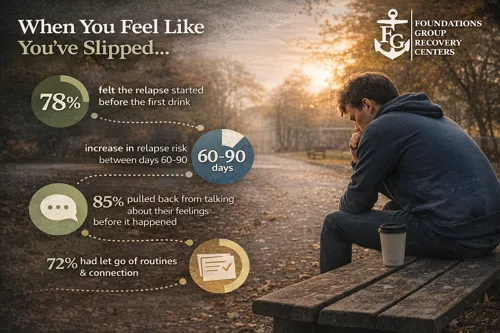
There’s something tricky about that 60–90 day mark.
Things calm down.
You’re not in survival mode anymore.
Your thoughts aren’t as loud.
Life starts to feel… manageable.
And instead of seeing that as a time to stay close to support, I treated it like a graduation.
Like I had earned independence.
But recovery isn’t something you graduate from.
It’s something you stay connected to.
I Stopped Talking About the Stuff That Felt Small
At first, nothing seemed big enough to bring up.
I wasn’t in crisis.
I wasn’t spiraling.
I was just… off.
A little restless.
A little disconnected.
A little less present than I had been.
But instead of saying that out loud, I told myself:
“It’s nothing.”
And that “nothing” slowly became distance.
The Distance Is What Actually Led Me Back
Looking back, the relapse itself wasn’t surprising.
The distance was.
Distance from:
- The routines that grounded me
- The people who understood me
- The version of myself that was paying attention
It didn’t happen overnight.
It happened quietly.
Like drifting just far enough that I didn’t notice how far I’d gone.
The Moment It Happened Felt Familiar—Not Dramatic
There wasn’t a rock bottom.
No big explosion.
Just a moment that felt… familiar.
And that’s what hit me.
Not the action—but the recognition.
“I know this version of myself.”
That realization carries a different kind of weight.
Because it’s not about shock.
It’s about awareness.
I Thought I Lost Everything—But I Didn’t
Afterward, my first thought wasn’t, “I need help.”
It was:
“I just erased everything I worked for.”
That feeling is heavy.
Like all the effort, all the progress, all the time… didn’t count.
But that’s not actually true.
I didn’t lose:
- The awareness I had built
- The tools I had learned
- The understanding of what works and what doesn’t
If anything, I came back with more honesty than I had before.
Less illusion.
More clarity.
One Conversation Changed How I Saw It
I remember talking to someone after I came back.
I expected disappointment.
Instead, they said something simple:
“You didn’t start over. You just learned something you didn’t know before.”
And that stuck.
Because it shifted everything.
This wasn’t failure.
It was information.
Hard-earned, uncomfortable, but real.
Being Back Didn’t Feel Like Going Backwards
It felt different the second time.
Not easier—but more grounded.
I wasn’t trying to prove anything anymore.
I wasn’t pretending I had it all figured out.
I was just… honest.
About what I missed.
About where I drifted.
About what I actually need to stay steady.
And that honesty changed how I showed up.
A Moment That Made It Real for Me
I remember walking one day, trying to process everything, not far from Falmouth, Massachusetts.
Nothing dramatic was happening.
But I felt the weight of it.
Not just the relapse—but the realization of how quietly I had disconnected from myself.
And for the first time, I didn’t try to fix it immediately.
I just noticed it.
That moment didn’t solve everything.
But it grounded me.
What I Missed the First Time
I thought recovery was about stopping.
Stopping the behavior.
Stopping the cycle.
Stopping the damage.
But what I missed was this:
It’s also about staying connected.
To people.
To structure.
To yourself.
Not perfectly. Not constantly.
But consistently.
If You’re Sitting in That Same Place Right Now
If you’re thinking:
“I had it… and I lost it.”
I get that.
That thought can feel final.
Like you crossed a line you can’t come back from.
But that’s not how this works.
You didn’t lose everything.
You just saw something more clearly than you did before.
And that matters.
You’re Not the Only One Who Thought “I’m Good Now”
This happens more than people talk about.
That point where:
- Things feel easier
- The urgency fades
- You trust yourself a little more
And then slowly, things loosen.
Not because you don’t care.
But because it feels like you don’t need the same level of support anymore.
That’s not failure.
That’s a pattern a lot of people go through.
What’s Different When You Come Back
The second time isn’t about starting over.
It’s about starting with more awareness.
You know:
- Where things started to shift
- What you stopped doing
- What actually helps you stay steady
That doesn’t make it simple.
But it makes it real.
And real is what creates change.
FAQs: If You’ve Slipped After Time Away
Does this mean I failed?
No. It means something in your process needed more support or attention. That’s information—not failure.
Did I lose all my progress?
No. Everything you learned still exists. You’re building on it, not erasing it.
Why did it feel so easy to slip back?
Because the shift happens before the action. Small changes in connection and routine add up over time.
Is it harder to come back the second time?
Emotionally, it can feel heavier. But you also come back with more clarity and awareness.
What if I feel ashamed to return?
That feeling is common—but it’s also what keeps people stuck. Support doesn’t require perfection.
If You’re Thinking About Coming Back
You don’t need to explain everything.
You don’t need to justify it.
You don’t even need to feel ready.
You just need to take one step back toward something that helped you before.
Even if it feels small.
Even if it feels late.
It’s not.
If you’re ready to reconnect—or even just explore what support could look like now—you don’t have to do it alone.
Call (844)763-4966 or visit our page to learn more about our Alcohol Addiction Treatment in Mashpee, Massachusetts.