
Maybe you’re not using every day. Maybe you are. But here’s what you do know: something doesn’t feel right anymore.
You’re questioning the role opiates play in your life. Maybe you’ve tried cutting back. Maybe you’ve Googled “am I addicted?” more than once. You’re not in denial—you’re in the in-between.
If that’s where you are, you’re not alone. At Foundations Group Recovery Center, we meet people who aren’t sure how to label their experience—but who want something different. Opiate addiction treatment can offer clarity before you commit to big, scary, or permanent-sounding decisions.
Here’s how treatment helps you figure things out without pressure, labels, or fear of being “too much” or “not enough.”
1. Learn to Look at Your Patterns—Without Judging Them
Most people don’t walk into treatment after one bad night. They come in after months (or years) of wondering quietly:
- “Why do I need this just to get through the day?”
- “Is this still recreational… or am I leaning on it?”
- “Do other people think about pills this much?”
You don’t need a definitive answer before you seek support. In fact, good treatment creates space for you to ask better questions, not get instant diagnoses.
At Foundations, we start with conversation, not conclusions. We help you:
- Slow down your thought spirals
- Notice what’s beneath the habits
- Get curious instead of self-critical
This is how change begins—not with shame, but with honest attention.
2. Try Sobriety in a Safe, Supported Environment
If you’ve ever tried quitting alone, you know how fast it can backfire. Withdrawals, anxiety, second-guessing—it’s enough to make anyone say, “Forget it.”
But in treatment, that looks different.
Here’s what it means to explore sobriety with support:
- Medical care if withdrawal is a factor
- Emotional support during the first few days of clarity
- Tools to help you tolerate discomfort without reaching for a fix
- Daily structure so you’re not sitting alone with panic
You don’t have to decide your whole future on day one. But you can see what life looks like without the constant background noise of use. That experiment alone is often the first breakthrough.
3. Find the Root, Not Just the Habit
One of the most powerful things about treatment is what happens when the substance isn’t center stage.
When you take opiates out of the equation—even temporarily—you’re left with the deeper questions:
- What have I been avoiding?
- What pain is still living in my body?
- What part of me still thinks I need this to function?
Good treatment isn’t about control—it’s about discovery. When the dust settles, when the cravings quiet, that’s when you finally hear the part of yourself that’s been whispering for years.
And for many of our clients from Falmouth, Massachusetts, that whisper was what brought them through the door.
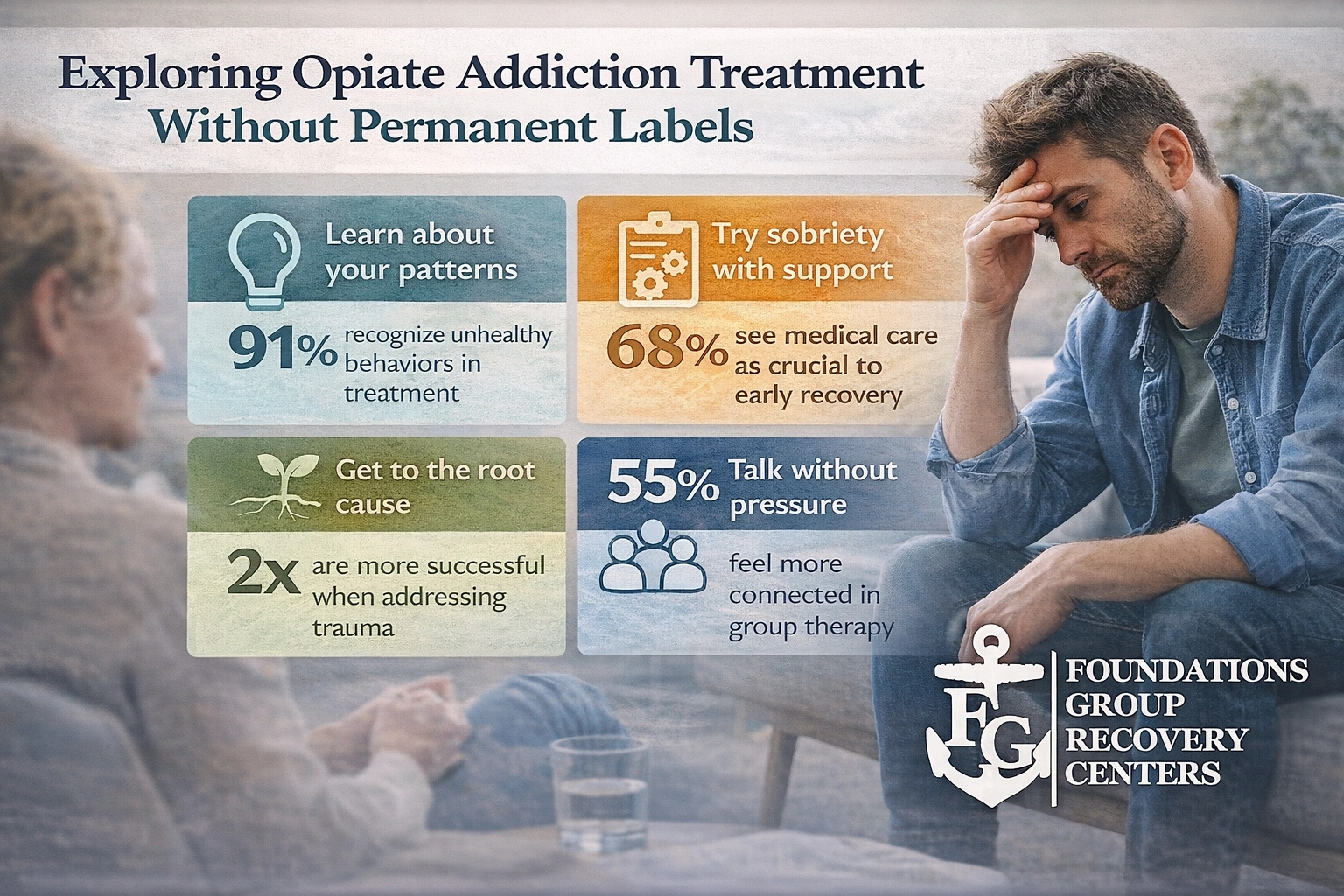
4. Talk to People Who Get It (Even If You’re Not Sure You Belong Yet)
“I didn’t think I’d fit in here.”
“I didn’t lose everything, so I didn’t think I had the right.”
“I thought treatment was for people worse off than me.”
We hear this all the time.
But the people sitting in our groups? They’re accountants, parents, creatives, caretakers. They’re not always the stereotype. They’re just people who got tired of feeling like something was off and wanted to know what else was possible.
In group settings, you’ll hear:
- Honest stories with no fluff
- Questions you’ve been asking yourself, out loud
- Different recovery paths—not just one way to heal
Treatment doesn’t give you a new identity. It helps you shed the old mask and remember what your real one feels like.
5. Decide What’s Next—From a Place of Clarity, Not Panic
If you’re sober curious, you don’t need someone to tell you what to do. You need a clear head, a steady space, and the right people around you to help you decide for yourself.
Here’s what opiate addiction treatment doesn’t do:
- Force you into lifelong labels
- Demand overnight decisions
- Shame you for “not being bad enough”
Here’s what it does:
- Help you understand your own brain
- Equip you with coping tools (even if you keep using for now)
- Let you practice sobriety in a way that feels grounded, not pressured
- Give you options—real, informed, agency-affirming options
Whether you decide to stop, slow down, or try again later, the goal is the same: more honesty. Less hiding. And freedom from the “am I or aren’t I?” loop that eats you alive.
FAQs: Opiate Addiction Treatment for Sober Curious People
I don’t think I’m addicted. Can I still come to treatment?
Absolutely. Many people explore treatment without identifying as “addicted.” You don’t have to claim a label to ask for help. We meet you where you are.
Will I be forced to commit to lifelong sobriety?
No. Our goal is to help you get clear, not lock you into a decision you’re not ready for. You can explore options without pressure.
What if I’ve tried quitting on my own and failed?
That’s common—and not a failure. Quitting alone doesn’t work for most people, especially when the root issues haven’t been addressed. Treatment gives you a foundation to try again with support.
Can I do this without checking into inpatient?
Yes. Many clients start with outpatient programs, therapy, or a clinical assessment. We’ll help you find a format that fits your lifestyle and emotional readiness.
Is this confidential?
Always. Your privacy matters. Everything we discuss, explore, or decide is protected by clinical and legal confidentiality protocols.
You don’t need all the answers to start asking better questions.
Call (844)763-4966 to learn more about our opiate addiction treatment in Mashpee, Massachusetts.