
Loving someone who is struggling with alcohol can feel like living two lives at once.
In one life, you see the person you fell in love with — the version of them that laughs easily, keeps promises, and feels present with you. In the other life, you’re watching the drinking slowly change things. Conversations get tense. Plans fall apart. You start wondering whether the person you love is slipping away.
If you’ve begun searching for answers or exploring options like alcohol addiction treatment, you’re not overreacting. Many partners begin looking for information long before the person drinking is ready to admit there’s a problem.
And that place — loving someone while quietly worrying about them — can be incredibly lonely.
When Concern Starts Showing Up in Everyday Moments
Most relationships affected by alcohol don’t begin with a crisis.
Instead, the changes show up slowly in everyday life. You might notice small things first:
A drink that turns into several.
An argument that starts from nowhere.
A promise to cut back that lasts a week — or a day.
At first, many partners try to adjust. You may avoid certain topics, smooth over awkward moments, or quietly take on more responsibility at home.
But over time, concern starts to creep into places it didn’t used to exist.
You might feel uneasy when they say they’re “just going out for one.”
You might start scanning their mood when they walk through the door.
You might catch yourself wondering what version of them you’ll get tonight.
These are exhausting mental calculations to carry every day.
Why Partners Often Feel Confused About What’s Happening
Alcohol problems can be difficult to recognize clearly inside a relationship.
From the outside, someone might still appear successful or functional. They may go to work, socialize, and maintain responsibilities. Because of that, partners often question their own instincts.
You might think:
- Maybe this is normal.
- Maybe I’m being too sensitive.
- Maybe it’s just stress.
But relationships tend to reveal the truth more quickly than public life does.
Partners often see the parts others don’t — the mood swings, the broken agreements, the emotional distance, or the way alcohol seems to come first more often than it used to.
Trusting those observations can feel scary, but they matter.
The Emotional Rollercoaster of Loving Someone Who’s Drinking
One of the hardest parts of loving someone who struggles with alcohol is the emotional push and pull.
There are moments of hope — days when things feel normal again, when they say they’ll slow down or try to change.
And then there are moments when the cycle starts again.
Many partners describe feeling stuck between loyalty and self-protection.
You may feel:
- Deep love and compassion for them
- Frustration about the repeated patterns
- Guilt for feeling angry
- Fear about what the future might look like
These emotions can exist at the same time. That doesn’t make you weak or confused. It makes you human.
A helpful way to think about it is this:
Loving someone with a drinking problem is like standing on shifting sand. You’re trying to stay steady while the ground keeps moving.
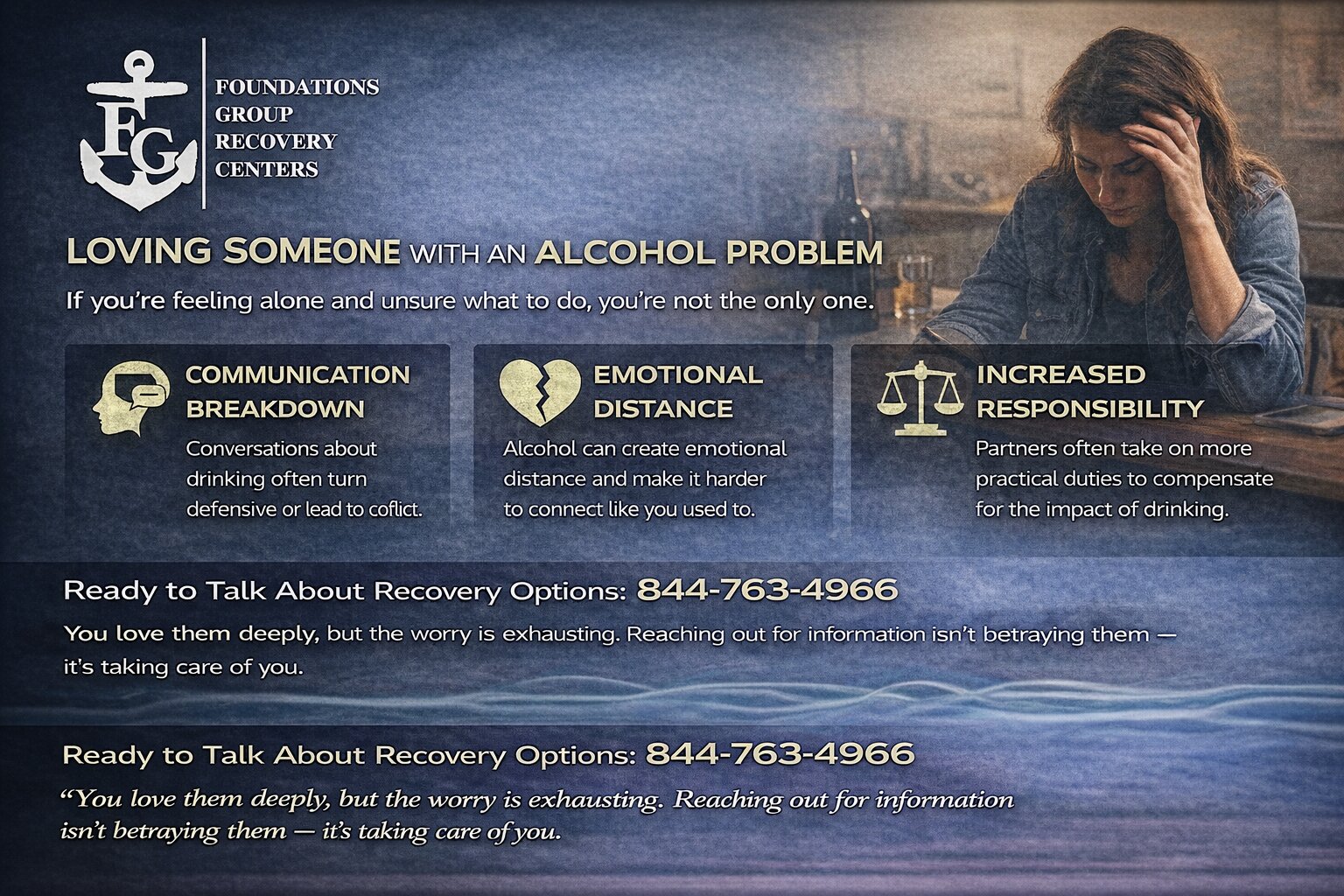
The Quiet Ways Alcohol Affects Relationships
Alcohol struggles don’t just affect the person drinking. They ripple outward into the entire relationship.
Partners often experience changes such as:
Communication breakdown
Conversations about drinking may quickly turn defensive or argumentative.
Emotional distance
The person you love may seem less present, less open, or less connected.
Increased responsibility
You might find yourself handling more practical tasks — finances, scheduling, or social obligations.
Walking on eggshells
Some partners start carefully managing their words or behavior to avoid triggering conflict.
Over time, these patterns can wear down even strong relationships.
But recognizing them can also be the first step toward something different.
What Support and Recovery Often Involve
When someone begins getting professional support for alcohol use, the goal is not to shame or control them.
Instead, the process focuses on helping people understand what alcohol has been doing for them emotionally — and building healthier ways to cope, connect, and manage stress.
Different levels of care exist depending on what someone needs. Some people benefit from structured daytime programs where they receive intensive therapeutic support. Others attend multi-day weekly treatment while continuing work or family responsibilities.
Recovery often includes:
- Individual counseling
- Group therapy and peer connection
- learning healthier coping strategies
- rebuilding trust and communication within relationships
The goal is not simply to stop drinking.
The goal is to help someone rebuild a life where alcohol no longer needs to carry so much weight.
What If the Person You Love Isn’t Ready Yet?
This may be the most painful situation partners face.
You can see the problem clearly, but the person you love may minimize it or avoid talking about it altogether.
That gap between what you see and what they’re willing to acknowledge can feel heartbreaking.
But even when someone isn’t ready to seek help, partners are not powerless.
You can still:
- Speak with professionals who understand addiction and family dynamics
- Learn about recovery options and how they work
- Develop healthier boundaries to protect your emotional wellbeing
- Find support for yourself through counseling or support groups
Sometimes the most important shift begins with one person gaining clarity.
When partners understand the situation more fully, they often communicate differently — and that can create new possibilities for change.
Hope Often Begins With a Conversation
Many families assume help only becomes possible after a dramatic crisis.
In reality, many people begin recovery after quieter turning points: a heartfelt conversation, a moment of self-reflection, or the realization that their drinking is hurting someone they love.
If you’re worried about someone’s relationship with alcohol, learning about options like alcohol addiction treatment can be a meaningful first step.
You don’t have to force change or solve everything alone.
Sometimes simply understanding the path forward makes the situation feel less overwhelming.
Frequently Asked Questions
How do I know if my partner’s drinking is a real problem?
Many partners notice patterns before the person drinking does. Signs that alcohol may be affecting someone’s life include repeated broken promises about cutting back, mood changes connected to drinking, or conflict in relationships related to alcohol. If drinking is regularly causing stress, tension, or concern in your relationship, it may be worth seeking guidance from a professional.
Should I confront my partner about their drinking?
Direct conversations can sometimes be helpful, but the way they happen matters. Approaching the conversation calmly, focusing on how the situation affects you, and avoiding accusations can make it more productive. Many partners find it helpful to speak with a counselor first to learn how to approach the discussion in a supportive way.
Can someone recover even if they’ve struggled for years?
Yes. Many people begin meaningful recovery after years of alcohol use.
Recovery is not a single moment — it’s a process of learning new ways to cope, connect, and live. With the right support and environment, change is absolutely possible.
Is it normal to feel guilty for being angry or exhausted?
Very normal. Partners often feel a mix of love, frustration, sadness, and anger. These emotions can exist together. Feeling overwhelmed doesn’t mean you’ve stopped caring — it often means you’ve been carrying the situation for a long time.
Can partners or spouses get support too?
Yes, and it can be incredibly helpful. Many treatment programs and therapists work with families as well as individuals. Support for partners can help you process your emotions, set healthy boundaries, and learn how to navigate the situation more confidently.
You Don’t Have to Carry This Alone
Loving someone who struggles with alcohol can feel isolating, especially when you’re unsure who to talk to or what the next step should be.
But there are professionals who work with partners and families every day. They understand the complicated mix of loyalty, fear, exhaustion, and hope that people carry in these situations.
Even one conversation can bring clarity. Get help that’s close to home, Proudly serving in Falmouth, Barnstable County, MA.
Call 844-763-4966 or visit our alcohol addiction treatment services to learn more about our alcohol addiction treatment services in Massachusetts.
And if you’re reading this while wondering whether things can get better — that question alone shows how much you care. Sometimes hope begins right there.