
There’s a very specific kind of silence that happens before you ask for help.
It’s not dramatic. It’s not rock bottom. It’s you in your room, or your car, or your bed at 1 a.m., thinking, I don’t think this is working anymore.
If you’ve found yourself quietly researching options like alcohol addiction treatment in Massachusetts, chances are you’ve had at least a few of these thoughts.
I know I did.
And I also know how easy it is to feel like the only 22- or 25-year-old on earth even considering this.
You’re not. You’re just the one brave enough to question it.
1. “Am I too young to have this problem?”
When you’re young, drinking is everywhere.
Birthdays. Tailgates. Weddings. Random Tuesdays.
It feels less like a choice and more like a default setting.
So when you start wondering if alcohol is becoming a problem, it can feel embarrassing. Like you skipped ahead to a chapter you weren’t supposed to read yet.
But addiction doesn’t check your birth certificate first. It doesn’t care how old you are or how good your GPA was.
If alcohol is messing with your mood, your sleep, your relationships, or your self-respect, that’s enough. You don’t need decades of chaos to justify wanting something better.
2. “What if I’m just being dramatic?”
You compare yourself constantly.
“I don’t drink every day.”
“I’ve never gotten arrested.”
“I still have my job.”
You stack your story up against extreme examples and convince yourself you don’t qualify for help.
But here’s the thing no one says out loud: suffering isn’t a competition.
If alcohol is taking up more space in your brain than you’d like… if you’ve tried to cut back and couldn’t… if you wake up with anxiety and regret more often than you want to admit — that matters.
You don’t have to hit someone else’s version of bottom to take your own discomfort seriously.
3. “What will my friends think?”
This one can feel suffocating.
You imagine telling your friends you’re not drinking anymore and immediately picture:
- The jokes
- The pressure
- The awkwardness
- The “just one won’t hurt” comments
When you’re young, drinking is often tied to belonging. So choosing not to drink can feel like stepping outside the group.
But here’s what I learned: the people who truly care about you adjust. Maybe not perfectly. Maybe not immediately. But they adjust.
And the friendships that only worked when you were drinking? Those weren’t as solid as they felt.
It’s scary to be the “weird sober one.”
But it’s lonelier to feel out of control and pretend you’re fine.
4. “I don’t want to be labeled.”
The word “treatment” can feel intense.
Like it stamps something permanent on you. Like it changes how people see you — or how you see yourself.
You might think:
If I go, that means I’m really an alcoholic.
That means this is serious.
Here’s a softer truth: getting help doesn’t define you. It supports you.
You are not your worst night. You are not your coping mechanism. You are not a label.
Getting support for alcohol is a decision — not an identity.
5. “What if I can’t actually stop?”
This thought keeps so many people frozen.
Because if you don’t try, you can still tell yourself you could quit anytime.
But once you try, it gets real.
You might be scared of withdrawal. Scared of cravings. Scared of sitting with feelings without numbing them.
That’s exactly why structured support exists. You don’t have to white-knuckle this alone. Programs today range from live-in care to multi-day weekly treatment that lets you keep working or going to school while getting real support.
You don’t have to be superhuman. You just have to be willing.
6. “Will I lose my personality?”
If alcohol has been your social glue, your confidence booster, or your creative spark, it can feel like removing it will flatten you.
Like you’ll become boring. Less funny. Less bold. Less you.
This fear is real.
But here’s what often happens instead: the parts of you that alcohol amplified were already there.
The humor? Still yours.
The depth? Still yours.
The courage? Definitely yours.
Sobriety doesn’t erase your personality. It reveals it without distortion.
It may feel awkward at first — like walking into a party without armor — but awkward isn’t the same as wrong.
7. “I don’t want to sit in a room full of people who don’t get me.”
You might picture a room of people much older than you, talking about experiences that feel far away from your life.
But recovery spaces today often include young adults navigating the same things you are — dating sober, going to concerts sober, figuring out careers without numbing out.
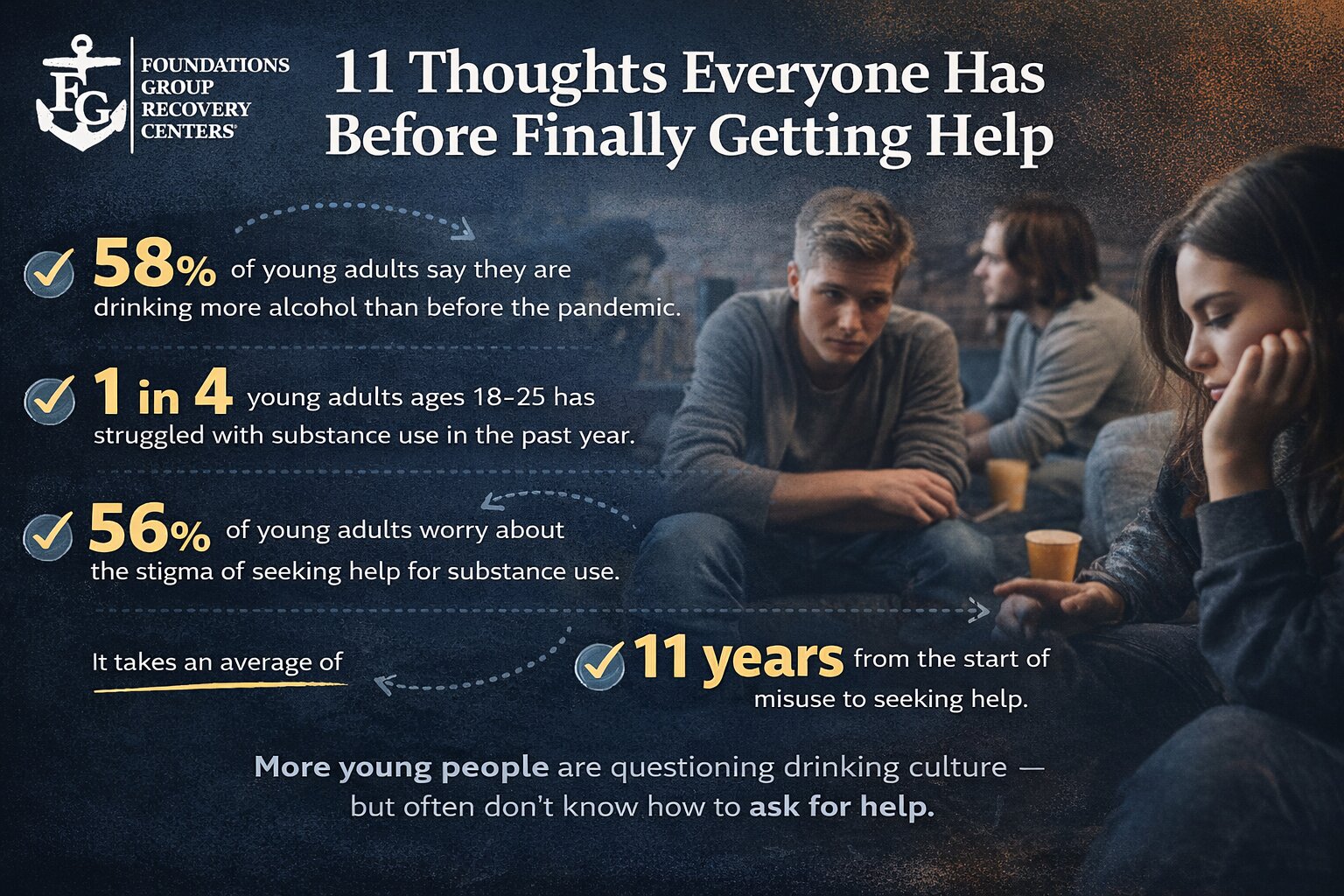
You’re not alone in this generation shift. More young people are questioning drinking culture than ever before.
It just feels lonely because we don’t always talk about it publicly.
8. “What if this messes up my career or school?”
You might worry about taking time off.
About what professors, bosses, or coworkers will think.
But untreated alcohol issues quietly affect performance in ways we don’t always notice at first:
- Brain fog
- Missed deadlines
- Calling out sick
- Emotional burnout
- Risky decisions
Getting help is often protective — not destructive — to your future.
It’s an investment in your clarity, not a setback.
9. “I should be able to fix this myself.”
This one hits deep for high-achievers.
You’ve handled everything else. Why not this?
Because alcohol isn’t a productivity problem. It’s not something you can out-organize or out-discipline forever.
Support doesn’t mean you failed at independence. It means you recognize when something requires backup.
We don’t shame people for seeing a therapist. Or a trainer. Or a doctor.
Why should this be different?
10. “Maybe I’ll wait until it’s worse.”
Almost everyone thinks this.
We tell ourselves we’ll draw the line at:
- A DUI
- A lost relationship
- A medical scare
- A public meltdown
But waiting for a bigger disaster doesn’t make you stronger. It just makes the repair work heavier.
You don’t have to wait for your life to fall apart to decide you want it to feel better.
11. “What if I actually feel better?”
This is the quiet one.
It sneaks in between the fear and the doubt.
What if I sleep through the night?
What if my anxiety eases up?
What if I don’t wake up embarrassed?
That small hopeful thought deserves as much attention as the loud fearful ones.
Exploring alcohol addiction treatment doesn’t mean you’ve failed. It means you’re considering the possibility that your life could feel steadier, clearer, and more honest.
And that’s not weird.
That’s brave.
FAQ: Questions Young People Ask Before Getting Help
Do I have to call myself an alcoholic?
No. You don’t have to adopt any label to get support. You can simply say, “Alcohol isn’t working for me anymore.” That’s enough to start a conversation.
What if I’m not as “bad” as other people?
Severity looks different for everyone.
If alcohol is affecting your mental health, relationships, school, or work — even subtly — it’s valid to seek help. You don’t need a dramatic story to deserve care.
Will I have to stop drinking forever?
That’s a big question — and it doesn’t have to be answered all at once.
Early conversations often focus on safety, stability, and understanding your relationship with alcohol. Long-term decisions unfold over time with guidance and support.
Can I still work or go to school?
In many cases, yes. There are flexible levels of care designed to fit around real life. Some people need immersive support. Others participate in structured daytime or evening programming while maintaining responsibilities.
You can talk through options without committing to anything immediately.
What if I’m embarrassed to ask for help?
Most people are.
Reaching out doesn’t require a dramatic speech. It can be a simple phone call. A short message. A quiet, “I think I need help.”
You don’t have to perform strength. You just have to take one step.
If you’re in Massachusetts and these thoughts sound familiar, you don’t have to keep circling them alone. There are real people who understand the social pressure, the awkwardness, and the fear that comes with getting sober young.
Call 844-763-4966 or visit our alcohol addiction treatment services in Massachusetts to learn more about our alcohol addiction treatment services in Massachusetts.