
When someone you love is drinking heavily but doesn’t seem ready to change, it can feel like being trapped in a waiting game where you’re losing time, energy, and hope. They may downplay the problem, resist help, or insist they’re fine—even when the consequences are mounting. And yet, you stay. You care. You want to believe there’s a path forward that doesn’t start with them hitting rock bottom.
At Foundations Group Recovery Center, we work with families in this space every day—the uncertain middle ground where love and fear live side by side. And here’s the truth: alcohol addiction treatment can begin even when motivation is low. The willingness to stop doesn’t have to be fully formed for healing to start. In fact, it’s often something that grows inside the process—not before it.
Learn more about our alcohol addiction treatment services in Massachusetts
Treatment Doesn’t Require Readiness—Just a Door Opened a Crack
One of the most common myths we encounter is the idea that someone must be completely ready, committed, and motivated before treatment can work. That’s simply not true.
Many people enter treatment:
- Because a spouse asked them to
- To avoid legal or job-related consequences
- Out of guilt or curiosity—not necessarily clarity
And that’s okay. Readiness is not a prerequisite. It’s a process.
Clinicians often use evidence-based techniques like motivational interviewing, which helps people explore their own ambivalence without shame. This method invites self-reflection, not forced change. It doesn’t push—it gently peels back layers until someone begins to connect the dots for themselves.
Why Motivation Is Often Low in Alcohol Use Disorders
It’s easy to assume low motivation means a person “doesn’t care” or isn’t trying. But for many people struggling with alcohol, low motivation is a symptom—not a flaw.
Here’s why:
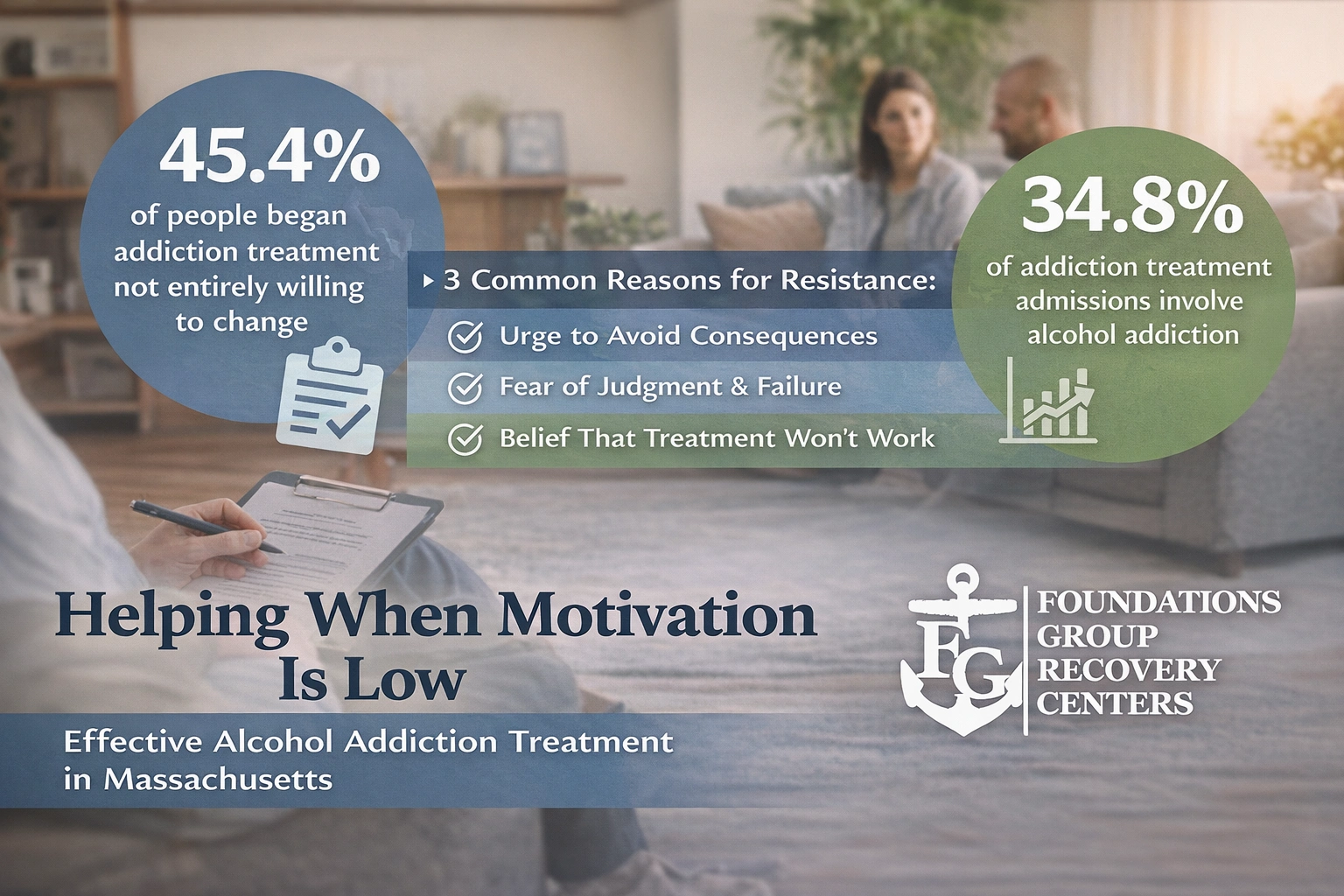
- Alcohol affects decision-making: Chronic use can impair the brain’s ability to assess risk, feel future-focused, or manage emotions.
- Fear and shame block action: If someone believes they’ve failed or disappointed their loved ones, they may pull away to avoid that reflection.
- It might still “work”—until it doesn’t: If alcohol still provides emotional relief or social comfort, the urgency to stop may not have landed yet.
We approach these patterns clinically, not critically. Our job isn’t to demand motivation—it’s to create a space where it can safely emerge.
Treatment Isn’t One Size Fits All—Especially Early On
When a person enters treatment with low motivation, we don’t expect overnight change. In fact, we adjust our approach based on where they are emotionally and psychologically.
Some common first-phase goals include:
- Building rapport and trust with a therapist
- Stabilizing routines (sleep, nutrition, stress management)
- Gently exploring the function of alcohol in their life
- Supporting harm reduction (cutting back vs. quitting cold turkey)
In these early weeks, the wins are subtle but powerful:
- They come to group on time
- They admit a difficult truth out loud
- They ask a question that shows curiosity
These moments matter. They’re the roots of recovery—not just its surface-level signs.
What If They Start Treatment But Aren’t Taking It Seriously?
This is a fear many partners have: “What if I finally get them to go… and they just go through the motions?”
Here’s what we see: sometimes people do start passively. They sit with arms crossed. They shrug in group. They say, “I don’t know” a lot.
And then… something shifts. A story shared in group hits home. A therapist reflects something they haven’t admitted before. A consequence they brushed off suddenly feels real.
Progress doesn’t always look like full commitment from day one. It often looks like tension giving way to curiosity—and curiosity becoming care.
You Can Support Change Without Controlling It
If you’re in love with someone who’s drinking too much, you’re probably exhausted. You might be balancing love with resentment, patience with urgency. You may feel like you’re constantly trying to say the right thing—the thing that will finally get through.
But here’s something we want you to hear: It’s not all on you.
Your role matters, but so does your rest. You can support without over-functioning. You can hold boundaries while still holding hope.
Ways to support someone with low motivation:
- Frame treatment as an opportunity, not an ultimatum
- Use “I” language: “I’m scared” instead of “You need to stop”
- Share real stories of people who started unsure and found their way
- Offer to go with them to the first appointment or help with logistics
And most importantly, get support for yourself. This isn’t a one-person burden. Al-Anon, therapy, or loved-one groups can help you stay grounded.
Clinical Approaches That Work When Motivation Is Low
At Foundations Group Recovery Center, our team is trained in several treatment modalities that are especially effective for ambivalent or resistant clients:
Motivational Interviewing (MI)
This technique meets people where they are emotionally. It’s non-confrontational and allows clients to explore their relationship with alcohol without pressure or shame.
Cognitive Behavioral Therapy (CBT)
CBT helps individuals examine the thoughts and beliefs that lead to drinking—even when they don’t feel ready to quit. It encourages curiosity over criticism.
Harm Reduction Strategies
For clients not ready for abstinence, we help them reduce harm first—drinking less frequently, more safely, or tracking use to increase awareness.
Family Involvement (with Consent)
With the right boundaries, involving loved ones can gently boost insight and accountability—especially when shame is high and motivation is low.
These methods aren’t about forcing sobriety. They’re about making space for it to become possible.
Healing Isn’t Linear. But It Is Possible.
You may already know this: people rarely get sober in a straight line. There’s often back-and-forth, emotional shutdown, breakthroughs followed by steps back.
But we’ve seen time and again that even the most resistant clients can change. That motivation can grow in unexpected ways. That love—even love that’s been stretched thin—can coexist with progress.
We believe in those changes because we’ve witnessed them. And we’ll keep showing up—calmly, consistently, without judgment—until your loved one is ready to join us.
FAQs: Alcohol Addiction Treatment When Motivation Is Low
Do people ever succeed in treatment if they don’t want to be there?
Yes. Many clients begin treatment out of pressure from loved ones or external circumstances. What matters is how we engage with them once they arrive. Motivation often builds during treatment—not before it.
What if they say they don’t have a problem?
Denial is common, especially when shame is high or consequences haven’t fully hit. We work with people who are ambivalent or unsure every day. Treatment isn’t just for those who’ve already decided to quit—it’s for those who are willing to explore the idea.
Should I give them an ultimatum?
Every relationship is different. Sometimes clear boundaries are necessary for your safety or wellbeing. But ultimatums work best when they’re grounded in care, not punishment. Framing treatment as something that could help both of you is often more effective than a “now or never” approach.
What if they relapse or quit early?
Relapse and early dropout happen—but they’re not the end. We view them as data, not failure. People often return more ready than before. Our door is always open.
Can I reach out even if they won’t?
Absolutely. Many partners call us first. We can help you understand your options, explore how to approach the conversation, and support you whether or not your loved one is ready yet.
You’re Not Powerless. And You’re Not Alone.
If you’re reading this, you’re already doing one of the hardest things: staying open, even while hurting. And you’re not alone in that. We see you. We support you. And we want to help.
At Foundations Group Recovery Center in Falmouth, MA, we meet people at every stage of readiness—with compassion, clinical skill, and zero judgment. Whether your loved one is ready to talk, resistant, or somewhere in between, we can walk alongside you both.
Ready to talk about options?
Call (844)763-4966 to learn more about our alcohol addiction treatment services in Cape Cod, MA.