
You never wanted to Google this again.
But here you are.
Maybe your son is drinking again at school. Maybe your daughter just moved home and things don’t feel right. Maybe you swore to yourself the last round of treatment would be the last time.
Now the familiar signs are back—and so is the heartbreak.
If you’re a parent watching your 20-something spiral again, you’re likely caught in the tug-of-war between “I can’t do this again” and “I can’t not help.”
We understand. And at Foundations Group Recovery Center in Mashpee, MA, we work with families navigating this exact moment: the second (or third) round of alcohol addiction treatment for a young adult who promised things would be different.
You are not alone. And this does not mean you failed.
Why Your 20-Something Might Need Treatment Again
Relapse in young adults isn’t uncommon—it’s part of the story for many people in early recovery.
Why?
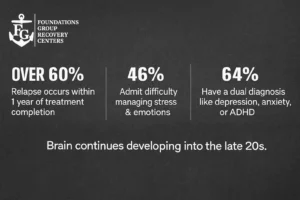
Because brain development continues well into the late 20s. Emotional regulation, impulse control, and stress management skills are still forming. So even after completing treatment, your child may struggle when life gets hard, peers pressure them, or anxiety resurfaces.
It doesn’t mean treatment didn’t work. It means this stage of life needs ongoing support.
Think of it like this: if someone broke a leg and started walking too soon, you wouldn’t say physical therapy failed. You’d say they returned to full weight-bearing too quickly.
The same applies here.
What Alcohol Addiction Treatment Looks Like the Second (or Third) Time
A second round of treatment isn’t a carbon copy of the first. It’s a chance to go deeper.
At Foundations, we help young adults and their families:
- Re-assess their needs: A 20-year-old needs different care than an 18-year-old did. Treatment evolves with them.
- Address co-occurring issues: Anxiety, depression, ADHD, or trauma may have been missed or untreated before.
- Build life skills: We help young adults connect sobriety with purpose—jobs, goals, identity—so it’s sustainable.
Treatment may include:
- Medical detox (if needed)
- Individual and group therapy
- Medication support when appropriate
- Relapse prevention planning
- Family therapy and education
- Aftercare coordination (including sober living and outpatient)
And importantly: your young adult helps shape their plan. They’re not just a patient—they’re a partner in the process.
What Parents Often Feel (But Rarely Say Out Loud)
You may be angry.
Exhausted.
Grieving a future that’s now uncertain.
Or ashamed that you’re back in this place again.
These feelings don’t make you a bad parent. They make you a human one.
At Foundations, we hold space for your experience too. Our family support model gives you access to:
- Communication coaching
- Boundary-setting strategies
- Emotional support groups for parents
- Help navigating complex feelings like guilt and resentment
Because you matter in this process. And you deserve support that doesn’t just focus on “fixing” your child—but on sustaining your own well-being too.
Common Barriers Parents Face (And How to Work Through Them)
You might be wondering…
- Will they even agree to go?
- Can I afford this again?
- What if this just ends the same way?
- Am I enabling them or supporting them?
These are normal concerns. Let’s address them.
Barrier 1: “They don’t think they need help.”
Denial, fear, and shame are strong. But your concern is valid, and you can still act.
Our team can support you with:
- Intervention guidance
- Motivational interviewing techniques
- Family-first conversations that keep the door open
Even if your young adult isn’t ready now, your preparation can make all the difference when they are.
Barrier 2: “We’ve already spent so much on treatment.”
Cost matters. But so does the cost of not treating the issue—emotional, financial, and even legal.
Foundations works with most major insurances, and our team can walk you through coverage options, payment plans, and financial aid.
Let’s find a way forward that doesn’t stretch you beyond your limits.
Barrier 3: “What if this doesn’t work either?”
What if it does?
Yes, relapse is possible. But so is long-term recovery. Many people get sober for good after multiple attempts—because each round teaches them more about what they need.
At Foundations, we don’t treat this like a failure. We treat it like a progression. A continuation of the story, not a repeat.
How Foundations Group Tailors Treatment for Young Adults
Young adults need more than lectures and rules—they need belonging, identity work, and community.
Here’s what we focus on:
Autonomy and accountability
We help them make their own choices within structure. They’re not “told what to do”—they’re coached into healthy decisions.
Mental health integration
Anxiety. Depression. Self-harm. These can fuel drinking. We provide dual diagnosis treatment that addresses both addiction and mental health.
Peer community
We connect your child with others in their age range who understand their experience. Recovery is easier when you’re not the only 23-year-old in the room.
Real-life recovery
Whether it’s applying for jobs, returning to school, or repairing family relationships—we walk with them through the transitions that follow treatment.
If you’re looking for alcohol addiction treatment in Barnstable County MA, our programs are rooted in this developmental, future-focused approach.
What Parents Can Expect from the Journey Ahead
Recovery isn’t linear. But it’s possible.
Here’s what to prepare for:
- Ups and downs: Progress may be slow. That’s okay. Healing takes time.
- Moments of doubt: You may question if you’re doing the right thing. That’s okay too.
- New conversations: Treatment changes your child. And you. You’ll learn how to talk again—with honesty, respect, and boundaries.
And maybe, eventually… moments of peace. Of pride. Of connection you thought you lost.
We’ve seen it happen. Even after a second or third try.
FAQs: When Your Young Adult Needs Treatment Again
Do you treat relapse differently than first-time treatment?
Yes. We use your child’s history to build a tailored approach. We focus on what was missing, and how to build deeper resilience.
What if they’re refusing to talk to us?
We offer intervention and communication support for families in this situation. You don’t have to navigate it alone.
Is there family therapy involved?
Yes. You’ll have access to therapists, groups, and resources just for parents—if and when you’re ready.
How quickly can treatment start?
Often within 24–48 hours. Call us and we’ll walk you through next steps based on your family’s needs.
Do you support local families in Falmouth or the Cape?
Absolutely. If you’re looking for alcohol addiction treatment in Falmouth MA, Foundations serves families throughout Cape Cod and Barnstable County with local, trusted care.
Call (844)763-4966 or visit our alcohol addiction treatment page to speak with someone who understands relapse, recovery, and the strength it takes to keep showing up—for them and for yourself.