
It wasn’t supposed to happen. Not after 90 days. Not after everything you fought for.
You knew the early days would be hard. You knew the cravings would whisper. You even prepared for them. But you weren’t prepared for this—the wave of shame, the weight of disappointment, the voice in your head telling you, “You blew it.”
That voice is lying.
If you’ve relapsed after heroin recovery, this isn’t the end of your story. It’s a chapter—maybe a hard one, maybe a messy one—but it’s not the last. At Foundations Group Recovery Center in Mashpee, MA, we walk with people through all of it—the first breakthrough, the relapses, the returns. You’re not alone. And you’re not out of chances.
Shame Is Loud—but It’s Not the Truth
Relapse doesn’t just bring you back to the drug—it pulls you into an emotional spiral that can feel even heavier than withdrawal. The guilt. The silence. The fear of telling anyone.
You start rewriting the story:
“I never really got better.”
“I must not have been serious.”
“They’ll never take me back.”
Pause.
Those are shame’s lines—not yours.
Here’s what’s true: You stayed sober for 90 days. You built new habits. You took real steps. That matters. Those days weren’t fake. They weren’t wasted.
Relapse doesn’t erase recovery. It reveals where support needs to grow. And that growth is still available to you.
Why Relapse Happens—Even When You’re “Doing Well”
The outside might’ve looked okay. A job. A routine. A few sober friends. But recovery isn’t only about the outside. It’s about what’s going on inside—and sometimes that part doesn’t get enough attention.
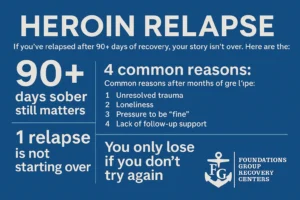
Here are some common reasons heroin relapse shows up—even after months of being clean:
- Unresolved trauma: The root pain comes back, and you’re not equipped (yet) to face it without numbing.
- Loneliness: You’re physically sober but emotionally isolated.
- Pressure to be “fine”: The farther you get from day one, the harder it feels to say you’re struggling.
- Lack of follow-up support: You completed your program… then what? Without structure, old patterns can sneak back in.
You’re not weak. You’re not broken. You’re someone whose recovery needs more—more care, more structure, more community. You deserve that.
The Hardest Call Is the Second One—Make It Anyway
The first time you asked for help, you were scared. But there was hope.
The second time? It’s heavier. Because now you think you should’ve known better. But here’s the secret: the second call is the stronger one. It’s not naive—it’s brave. It’s informed. It’s earned.
When alumni call us after relapse, they often whisper it:
“I don’t know if I’m allowed to come back.”
You are.
Whether you’re near Barnstable County or Falmouth, MA, our heroin addiction treatment team will never shame you for coming back. You don’t need a perfect plan. You don’t need to “prove” anything. You just need to show up and let us help with the next step.
You Don’t Lose Everything in a Relapse—You Learn from It
Relapse isn’t the same as starting over. You’re not the same person who walked in on day one.
Now you know:
- What triggered you
- What support you actually need
- What parts of your old plan worked—and what didn’t
- That recovery isn’t about perfection—it’s about return
This isn’t a full reset. It’s a recalibration.
The next phase of heroin addiction treatment can be smarter because of what you’ve learned.
You don’t have to lose your progress. You just have to be willing to evolve.
What Returning to Heroin Addiction Treatment Looks Like
Coming back doesn’t mean doing the same exact thing again. In fact, if that didn’t hold, you shouldn’t do the same thing again.
Here’s what we look at when alumni return after relapse:
1. Clinical Fit
Do you need a different therapist? A group that dives deeper into trauma? A focus on grief work or family dynamics?
2. Medication Options
Would Medication-Assisted Treatment (MAT) make detox safer or long-term sobriety more manageable?
3. Structure & Accountability
Do you need more support during transitions—like weekends, work stress, or holidays?
4. Aftercare Upgrades
Are there gaps in your alumni network or peer connection that we can help rebuild?
At Foundations Group Recovery Center, we tailor your next step—not recycle your last one. That’s how change becomes sustainable.
One Relapse Doesn’t Define Your Story
You’ve seen those stories—people with 3, 7, 10 years sober. And maybe you thought you were on your way there. Maybe you’re mourning that timeline now.
But here’s the truth: Every long-term recovery has turns, dips, and yes—relapses.
What makes someone���s story powerful isn’t the straight line. It’s the decision to keep walking after the stumble.
And this is yours.
You may not believe it yet. But you will.
Because there’s still more for you. More healing. More life. More connection. And it’s not too far gone to reach.
FAQs: Relapsing After Heroin Recovery
Is relapse normal during heroin recovery?
Yes. It’s unfortunately common—and never something to be ashamed of. Many people relapse before finding long-term stability. It’s part of the process, not proof of failure.
Will I be judged if I go back to treatment?
A good treatment center won’t judge you—they’ll welcome you. At Foundations, we treat relapse with compassion and curiosity, not criticism.
Do I need detox again if I’ve used recently?
That depends on how long you used, how much, and how your body responds. We’ll help assess that safely and respectfully—no scare tactics, no pressure.
What’s different about treatment after a relapse?
The difference is you. You come in with more insight, more data, and (believe it or not) more strength. Your treatment will reflect that with smarter goals and new tools.
Can I return to the same program I left?
Yes, especially if you’re returning to Foundations Group in Mashpee, MA. We help alumni re-engage with support, even after time away.
Is it even worth trying again?
Absolutely. You’re still here, still trying. That alone means it’s worth it. Sobriety isn’t about being perfect—it’s about choosing the next right thing, again and again.
You’re Not Behind—You’re Brave
You didn’t fall back to zero. You reached a limit. And now you get to reach for what’s next—with honesty, not shame.
Recovery isn’t a performance. It’s a relationship—with yourself, your people, your support system. You’re allowed to repair it. You’re allowed to keep going.
If you’re near Mashpee or surrounding towns in Massachusetts and looking for real, human-centered heroin addiction treatment, we’re here. Not to judge—but to help carry what’s heavy, and remind you: this is still your story.
Ready to Come Back?
Call (844)763-4966 or visit our Heroin Addiction Treatment services in Mashpee, MA to learn more. This isn’t the end—it’s just a new chapter.