
You can feel it before you even have the words for it.
Your child—the one you stayed up with through fevers, who danced barefoot in the kitchen, who used to tell you everything—has become…different. The light in their eyes is dimmer. They’re up all night. Their moods swing like a wrecking ball. You ask questions and get hollow answers. Something’s wrong. Deeply wrong.
Then you start noticing things: missing money, burnt foil, long sleeves in summer. You Google symptoms you hoped you’d never need to know. And your stomach turns with every search result.
Could it really be heroin?
If you’re asking that question, even silently, you’re not alone. And you’re not crazy. Heroin addiction in young adults can feel like watching your child get kidnapped in slow motion. They’re still there—but not really.
This blog isn’t here to terrify you. You’re already terrified. It’s here to ground you. To give you real language, real options, and a way forward that doesn’t rely on waiting for disaster.
Heroin Addiction Isn’t Just “Hard Drugs” Anymore
Let’s start with something many parents don’t realize: today’s heroin use often doesn’t look like what you saw in movies or old PSAs.
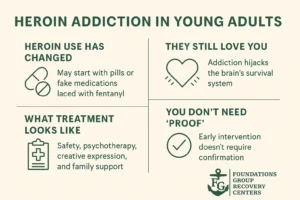
Young adults may not even start with heroin. They may begin with pain pills, recreational oxycodone, or fake Percocets laced with fentanyl. And by the time heroin enters the picture, it may feel—to them—like just another step in the same direction.
But chemically and neurologically, heroin (and fentanyl) take over fast. This is not a “bad choice” or a phase. It’s a brain-altering addiction with real physical dependence, and it can spiral before anyone realizes what’s happening.
If you suspect heroin is involved, trust your gut. You don’t need a confirmed overdose to seek heroin addiction treatment in Mashpee, MA. You just need the courage to reach out.
Addiction Doesn’t Mean They Don’t Love You
Here’s the heartbreak of addiction: your child can love you and lie to you. They can be deeply ashamed and still steal from your purse. That contradiction doesn’t mean they’re evil. It means they’re sick.
Heroin hijacks the brain’s survival system. It convinces your child that using is as essential as breathing. That’s why even kind, brilliant, deeply connected young people can spiral.
This doesn’t make you a bad parent. And it doesn’t make them a lost cause. It means both of you are navigating something that requires more than willpower. It requires medical treatment, therapeutic support, and a safe place to begin again.
That’s exactly what we offer at Foundations Group Recovery Center.
What Real Heroin Addiction Treatment Looks Like
Forget the boot camps and tough love shows. Real treatment for heroin addiction—especially for young adults—looks like structure, yes, but also safety.
Our programs in Mashpee are designed to meet young people where they are emotionally, developmentally, and psychologically. That means:
- Medically-supported detox if needed
- Therapists trained in trauma, family systems, and youth development
- Group sessions where they’re not the only young person in the room
- Creative expression therapies for clients who process through music, art, or movement
- Family support programming to help you understand what’s happening and how to set boundaries without withdrawing love
Looking for heroin addiction treatment in Barnstable County, MA? Our team supports clients and families across the Cape and beyond.
You Don’t Need “Proof” to Get Support
One of the most paralyzing myths parents face is this: I can’t do anything unless they admit it.
Here’s the truth: you don’t need a confession. You don’t need to catch them with a needle. You need support. For yourself and your family.
In fact, early intervention is often the difference between outpatient success and a full crisis later on. If your child is showing signs—emotional volatility, weight changes, academic decline, borrowing money, and isolation—don’t wait.
Looking for heroin addiction treatment in Falmouth, MA? We can help you assess what’s happening and talk through the next steps, even if your child isn’t ready to walk through the door yet.
Hope Isn’t Just a Feeling—It’s a Treatment Outcome
You might be afraid to hope right now. Maybe you’ve already tried getting them into a program. Maybe they’ve relapsed, ghosted therapy, or gotten arrested. That feeling—that pit-of-your-stomach sense that it’s too late—is common.
But hope isn’t blind optimism. It’s a strategy.
Our heroin addiction treatment model doesn’t expect perfect progress. We expect real human struggle—and we build our programming around that. We help young adults find stability, rediscover purpose, and reconnect with themselves and their families.
We don’t just offer hope as a slogan. We help you build it, session by session.
FAQs: Parents & Heroin Addiction
How can I tell the difference between typical teen behavior and drug use?
Trust your instincts. While some moodiness and secrecy are normal, signs like nodding off, missing valuables, small burn marks, dramatic behavioral changes, or signs of withdrawal (vomiting, sweating, chills) point to something deeper.
What should I do if my child denies everything?
Denial is part of addiction, not a reflection of truth. Stay calm, document what you observe, and seek professional guidance. You can still initiate a clinical assessment or family support services—even if they refuse treatment at first.
How does heroin addiction treatment actually work?
It depends on the level of care. Treatment may start with detox (if there’s withdrawal risk), followed by outpatient therapy, day programs, or structured intensive outpatient care. At Foundations, we personalize the approach based on age, severity, and co-occurring mental health needs.
Is outpatient treatment enough?
For some young adults, yes. Especially if caught early. We assess each case individually. If your child is still functioning but showing signs of use, outpatient care may be a powerful starting point.
What if they’ve already been to treatment and relapsed?
Then they already showed courage once. Relapse isn’t failure. It’s data. We help you and your child learn from past treatment gaps and offer fresh, compassionate re-entry into care.
How do I support them without enabling them?
The line between love and enabling is razor-thin—and constantly moving. We work with families to build healthy boundaries, including how to say “I love you, and no” with clarity, not cruelty.
What if I’m just not ready to confront them yet?
Then start with you. Call us. Let us help you build clarity, language, and a plan. You don’t have to lead with confrontation. Sometimes the most powerful first step is simply talking to someone who understands.
You’re Not Alone—And You Don’t Have to Wait
Call (844) 763-4966 or visit our Heroin Addiction Treatment program in Mashpee, MA to learn how we support families and young adults in crisis.
You may feel like you’re standing on the edge of a cliff, shouting into silence. But there is a rope. There is a path back. And you don’t have to find it alone.