
There is a particular fear that doesn’t get talked about enough.
It’s not the fear of withdrawal.
It’s not the fear of treatment.
It’s not even the fear of failing.
It’s the fear of disappearing.
We’ve spoken with musicians who worried they would lose their ability to create.
Artists who worried they would lose their imagination.
Writers who feared they would lose their voice.
People who built entire identities around being spontaneous, rebellious, funny, unconventional, or different and worried that recovery would somehow sand away every edge that made them who they are.
If you’re searching for help right now, perhaps even looking for immediate options through medication-assisted treatment support, there’s a chance you’re carrying a question you haven’t said out loud.
“If I get sober, who will I become?”
It’s a deeply personal question.
And it’s one we believe deserves an honest answer.
Because many people enter recovery afraid they’ll lose themselves.
What often surprises them is that they begin finding themselves again.
The Version of You That Existed Before Survival Mode
Addiction has a way of shrinking life.
Not all at once.
Gradually.
At first, it may feel like nothing has changed.
You’re still yourself.
Still creative.
Still social.
Still functioning.
Then little pieces start disappearing.
You stop showing up for certain people.
You stop pursuing certain goals.
You stop creating as often.
You stop dreaming as broadly.
Life slowly becomes organized around one central task:
Getting through the day.
The tragedy is that survival mode can become so familiar that it starts feeling like your identity.
People tell us things like:
“This is just who I am.”
“This is how I’ve always been.”
“This is part of my personality.”
Sometimes they’re right.
But often, addiction has been making decisions for so long that it’s difficult to remember where the person ends and the struggle begins.
Recovery doesn’t remove identity.
It creates room for identity to breathe.
Creativity Is Often Stronger Than Addiction
One of the most common concerns we hear comes from creative people.
They fear that sobriety will flatten them.
That they’ll become boring.
Predictable.
Ordinary.
The fear makes sense.
For generations, society has romanticized the connection between suffering, substance use, and creativity.
We’ve heard stories about artists, musicians, and writers who seemed inseparable from their addictions.
What those stories often leave out is the cost.
The missed opportunities.
The unfinished projects.
The broken relationships.
The exhaustion.
The years spent trying to create while carrying a weight that became heavier and heavier.
Addiction doesn’t usually strengthen creativity.
It interrupts it.
It distracts it.
It consumes time, attention, energy, and emotional bandwidth.
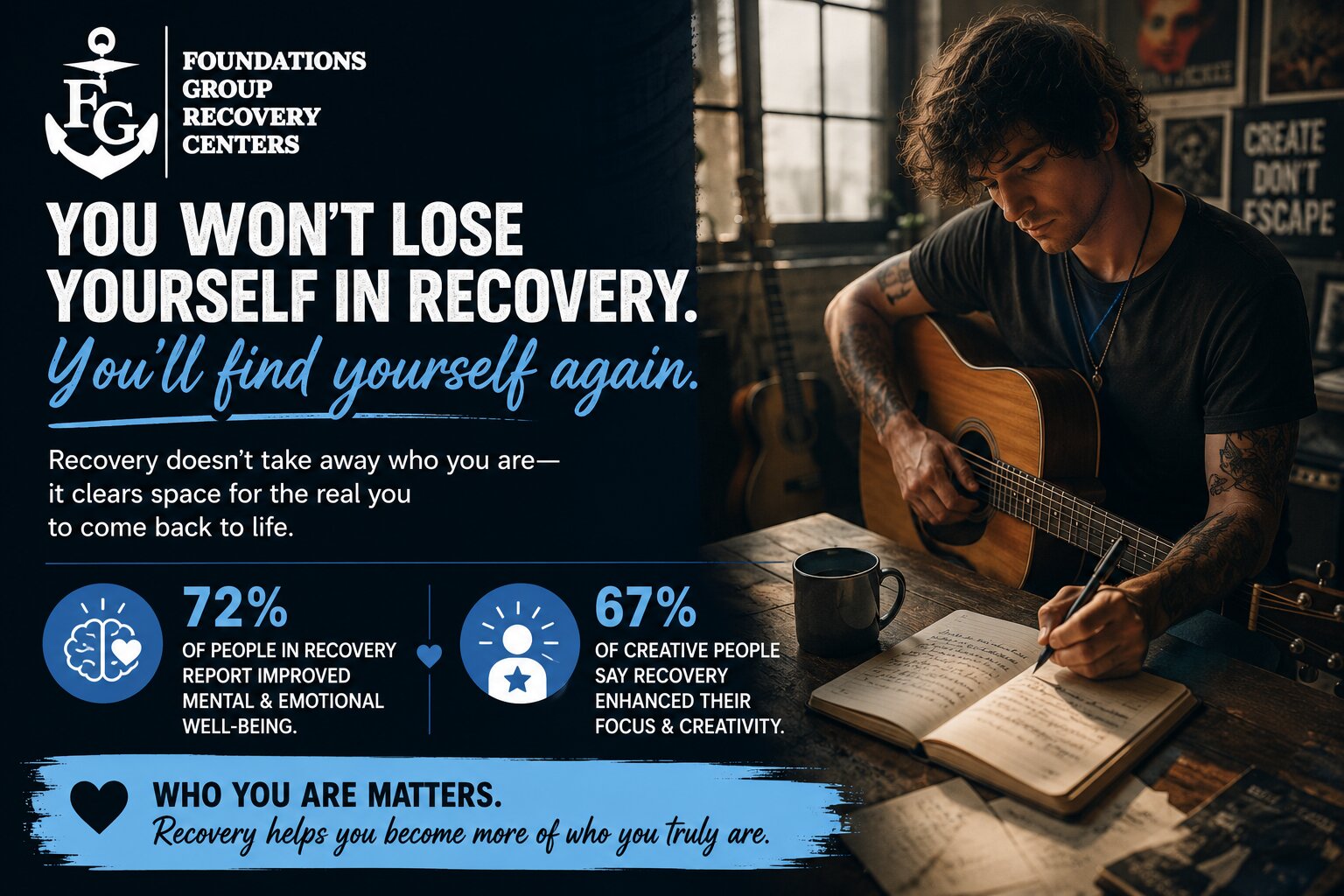
Many people discover that recovery doesn’t take away creativity.
It gives creativity more space to exist.
The song is still there.
The imagination is still there.
The talent is still there.
There is simply less chaos standing in the way.
The Fear Hidden Behind the Search
When someone searches for help, they often focus on practical questions.
Can I get an appointment quickly?
Will someone answer the phone?
Can I start today?
What are my options?
But underneath those questions is often a quieter concern.
“What if treatment changes me?”
It’s understandable.
Change feels uncertain.
Even positive change can feel intimidating.
Many people have spent years adapting to life with addiction.
The routines become familiar.
The coping mechanisms become familiar.
Even the pain becomes familiar.
Stepping into recovery can feel like stepping into unknown territory.
And unknown territory makes people wonder whether they’ll recognize themselves on the other side.
The answer is usually yes.
In fact, many people describe feeling more familiar to themselves than they have in years.
What Recovery Actually Takes Away
There are things recovery often removes.
Constant panic.
The fear of running out.
The daily calculations.
The lies.
The secrecy.
The emotional roller coaster.
The exhausting cycle of promising yourself tomorrow will be different.
Those things frequently begin to lose their power.
What remains is often much more meaningful.
Your sense of humor.
Your values.
Your interests.
Your relationships.
Your ability to focus.
Your ability to dream.
Your ability to create.
One former client described it perfectly.
“I thought recovery would take away color. Instead, it removed the fog.”
That image has stayed with us for years.
Because that’s often what people describe.
Not becoming someone new.
Simply seeing themselves more clearly.
Why Waiting Feels Safer Than Acting
Many people know they need help long before they reach out.
The challenge isn’t always recognizing the problem.
The challenge is making a decision.
They tell themselves:
“I’ll figure it out myself.”
“I just need more discipline.”
“I need one good week.”
“I’ll call next month.”
Unfortunately, addiction is very comfortable with delay.
Every postponed conversation feels reasonable in the moment.
Meanwhile, life continues narrowing.
Opportunities continue passing.
Relationships continue straining.
The person continues carrying everything alone.
That’s why immediate access to support can matter so much.
Not because every situation is an emergency.
Because readiness often arrives unexpectedly.
And when someone finally reaches a moment where they are willing to ask for help, waiting weeks can feel overwhelming.
The Moment People Realize They’re Tired
Many people don’t reach out because they suddenly become hopeful.
They reach out because they become exhausted.
Exhausted from trying to manage everything alone.
Exhausted from making promises they can’t keep.
Exhausted from wondering whether life will always feel this difficult.
There comes a moment where the effort required to stay stuck becomes greater than the effort required to seek support.
That’s often when change begins.
Not with certainty.
Not with confidence.
With exhaustion.
And surprisingly, that’s enough.
Because people don’t need perfect motivation to begin.
They simply need a reason to take the next step.
Medication Doesn’t Define the Person Using It
Another fear we frequently hear involves medication itself.
People worry that accepting support somehow changes their identity.
As though needing assistance means becoming dependent on treatment rather than becoming independent from addiction.
The reality is far more nuanced.
No one’s personality is defined by wearing glasses.
Or using insulin.
Or receiving treatment for a health condition.
Similarly, receiving support for opioid addiction does not erase individuality.
It does not erase ambition.
It does not erase creativity.
It does not erase character.
Many individuals who search for a Suboxone doctor Cape Cod are not looking for a new identity.
They’re looking for stability.
They’re looking for relief.
They’re looking for enough breathing room to start rebuilding the parts of life that matter most.
Trust Is Built Through Small Moments
We understand that trust may not come immediately.
Many people have been disappointed before.
They’ve tried quitting.
They’ve tried treatment.
They’ve tried handling things on their own.
Some have experienced judgment.
Others have experienced shame.
Trust often begins much smaller than people expect.
A conversation.
A question.
A phone call.
An appointment.
One honest moment where someone realizes they don’t have to carry everything alone anymore.
Those small moments matter.
Because they often become the foundation for much larger changes.
The Person You’re Afraid of Losing May Be Waiting for You
One of the most powerful moments we witness is when someone realizes recovery isn’t taking away who they are.
It’s helping them reconnect with who they’ve always been.
The musician begins writing again.
The artist begins creating again.
The parent becomes present again.
The friend reconnects.
The dreamer starts making plans.
None of those qualities disappeared.
They were simply buried beneath survival mode.
Addiction often convinces people they must choose between recovery and identity.
In reality, the goal is not choosing one over the other.
The goal is protecting both.
You Don’t Need Every Answer Today
If you’re reading this because you’re considering help, remember this:
You don’t need complete certainty.
You don’t need a five-year plan.
You don’t need to know exactly what recovery will look like.
You only need enough willingness to start a conversation.
Many people begin by searching for practical information.
What they eventually discover is something much more important.
Recovery is not about becoming someone else.
It’s about having the opportunity to become yourself without addiction making every decision.
And that journey often starts with a single step.
Frequently Asked Questions
Will I lose my personality if I get sober?
Most people report feeling more like themselves over time. Recovery is designed to help reduce the impact of addiction, not erase your identity.
Can creative people stay creative in recovery?
Absolutely. Many artists, musicians, writers, and other creative individuals find they have more consistency, focus, and energy for their work after beginning recovery.
What if I don’t feel ready for treatment?
Many people begin treatment feeling uncertain. Readiness is often built through action rather than arriving beforehand.
Can I receive help quickly if I’m ready now?
Many treatment providers understand that motivation can be time-sensitive and offer prompt assessments to help people begin exploring their options.
Is medication-assisted treatment only for severe opioid addiction?
Treatment recommendations vary based on individual needs. A professional assessment can help determine whether medication-assisted support is appropriate.
Will medication change who I am?
Medication is intended to support recovery and stability, not alter your personality or values.
Why do people search for same-day appointments?
Often because they have reached a point where they are ready to talk. Access to support during that window can make a meaningful difference.
How do I know if I need professional help?
If opioid use is affecting your relationships, responsibilities, emotional well-being, or ability to function, it may be worth speaking with a professional about available options.
The First Conversation Can Change More Than You Think
The version of you that loves music, art, adventure, connection, and possibility doesn’t disappear when recovery begins.
If anything, recovery creates more room for those parts of you to exist.
You don’t need to have everything figured out.
You don’t need certainty.
You don’t need perfection.
You simply need the willingness to take one honest step forward.
Call (844)763-4966 or visit our medication-assisted treatment services page to learn more about our treatment programs Massachusetts, medication assisted treatment services Barnstable County, MA.