
You haven’t said it out loud. You haven’t checked into a program. You haven’t even Googled “Am I addicted?” yet. But something inside you is shifting.
Maybe it’s subtle—just a thought that pops up on a slow morning. Maybe it’s a conversation you overheard, a reel you saved, or a quiet moment where you realized: this isn’t working anymore.
You don’t need a rock bottom to be ready for change. You don’t even need a plan.
You just need to stop doing it alone.
This guide is for the in-between. For the sober curious. For the people rethinking heroin but not ready to call it addiction. For those asking, “What would support even look like if I’m not all-in yet?”
We’ll walk you through how to build a sober support team—before you enter heroin addiction treatment, and without pressure to label yourself or commit before you’re ready.
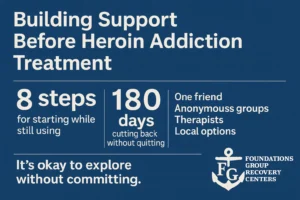
1. Redefine What “Support” Actually Means
Before you start reaching out, reset your expectations. Support doesn’t mean having a full circle of sober best friends. It doesn’t mean joining a group chat full of daily check-ins or tearful confessions.
Support can be quieter.
It can look like:
- A friend who knows you’re cutting back and never asks twice
- A coworker who covers for you so you can go to therapy
- A sibling who doesn’t panic when you say you’re struggling
- A group you follow online that feels like they’re reading your mind
If it makes you feel less alone, less judged, or less stuck—it counts.
2. Start with One Person Who Feels Emotionally Safe
Forget building a team right away. Start with just one person.
Ask yourself:
- Who do I feel calm around?
- Who listens without rushing to fix?
- Who already knows a little of what I’m carrying?
You don’t have to tell them everything. You can even start with:
“I’m thinking about cutting back. I don’t know what that means yet, but can I just talk this through with you?”
If no one comes to mind, that’s okay. Keep reading—there are other entry points.
3. Lurk in Anonymous, Judgment-Free Spaces
You don’t have to announce your curiosity to the world. You can tiptoe in.
Try:
- Reddit (r/OpiatesRecovery, r/StopUsing, r/SoberCurious)
- The Luckiest Club (LGBTQIA+ and inclusive sober community)
- Tempest or Loosid (app-based recovery spaces)
- Following sober voices on Instagram, TikTok, or YouTube
You don’t even have to post. Just seeing someone say what you’re thinking can make you feel less broken. It helps you realize: this isn’t just me.
And from there, maybe you ask a question. Maybe you reply. Maybe you DM someone who’s been where you are.
That’s community—on your terms.
4. Use a Therapist (Even if You’re Not in “Addiction Treatment” Yet)
Not every therapist specializes in addiction. But many are trained in motivational interviewing and harm-reduction models. That means they won’t force you to “quit cold turkey” or tell you you’re an addict.
Instead, they’ll ask:
- What does this substance do for you?
- What would change look like—if you wanted it?
- What’s getting in the way of that?
This is emotional scaffolding. You’re building a framework before you take a leap.
Even just a few sessions can help you get clear about why you use—and what else could meet those needs. And that clarity makes it easier to find people who can walk it with you.
5. If You’re Not Ready to Quit—Say That
Being honest about your ambivalence is powerful. You don’t have to pretend you’re ready for full sobriety to start talking about heroin addiction treatment.
You can say:
- “I’m curious about what treatment looks like, but I’m not committing to anything yet.”
- “I’ve been thinking about cutting back, but I don’t know if I’m done.”
- “I’m scared that if I call a place, they’ll push me too hard.”
Any reputable program—like Foundations Group Recovery Center in Mashpee, MA—will meet you with conversation, not coercion.
You can ask questions. You can express fear. You can ask about outpatient options, harm reduction, MAT, or just get a feel for the vibe.
That counts as building your team.
6. Make a List Called “If I Ever Need to Reach Out…”
This isn’t a to-do list. It’s a quiet permission slip. It lives in your Notes app, your journal, or wherever feels private.
Title it:
If I Ever Need to Reach Out…
Underneath, list:
- Names of people you trust
- Numbers of local IOPs or outpatient programs
- An online group or podcast you found useful
- A therapist’s name you’ve been thinking about
- The Heroin Addiction Treatment page for Foundations
Even if you never call, it’s a net. It shows you that options exist. That if the day ever comes, you’re not starting from scratch. You’re starting from prepared.
7. Let Location Work in Your Favor
If you’re local to Barnstable County or Falmouth, MA, your support team can include real, local professionals—even before you enter heroin addiction treatment.
Our outpatient services at Foundations in Mashpee are designed to meet people where they are—emotionally, geographically, and logistically. You can live at home, keep your job, and start building structure with professional support.
Even if you’re “not sure yet.” Even if you’re still using.
8. Remind Yourself: You’re Allowed to Want More—Before You Hit Bottom
There’s this myth that treatment is only for people in crisis. That you have to hit a wall before you can get help.
But what if you didn’t wait?
What if you let curiosity be enough?
Curiosity doesn’t make you weak. It makes you awake. And wanting something gentler, freer, more peaceful—that’s not dramatic. That’s wise.
You’re allowed to want more. And you don’t have to want it alone.
FAQs: Sober Curiosity and Heroin Addiction Treatment
Can I talk to someone about heroin addiction treatment even if I’m not sure I want to stop yet?
Yes. Many people start with questions before commitment. Our team at Foundations is trained to meet you with compassion and clarity—not pressure.
How do I build support if no one in my life is sober?
Start online. Join forums, follow voices in recovery, or explore virtual support groups. Connection can begin quietly—and grow from there.
Will people take me seriously if I’m “just curious”?
Yes. Being sober curious is valid. You don’t need a diagnosis or a crisis to explore support. We believe that curiosity is a powerful form of self-awareness.
Do I have to go inpatient if I want help for heroin use?
No. Many people begin with outpatient heroin addiction treatment, which allows them to live at home while receiving structured care and community support.
What’s the first step if I want to explore treatment without pressure?
You can start by visiting our Heroin Addiction Treatment page, calling our team to ask questions, or even just writing your own reflections about what you want.
What if I build a support team but then change my mind?
That’s okay. Change is not a straight line. Having people who understand makes it easier to come back to the idea when you’re ready.
Ready to Explore, Not Commit?
You don’t have to be sure. You don’t have to be sober. You just have to be willing to reach out.
Call (844)763-4966 or visit Heroin Addiction Treatment in Mashpee, MA to learn about outpatient services. Let your curiosity be the start of something real.