
“I just want to know which one actually works.”
As a clinician, I’ve heard some version of that sentence hundreds of times.
Usually it comes from someone sitting across from me after weeks, months, or even years of trying to manage heroin use on their own.
They’re exhausted.
They’re scared.
They’re finally willing to consider treatment.
And now they’re stuck on a new problem.
They’ve been researching online.
Reading forums.
Watching videos.
Listening to stories from friends.
Everyone seems to have an opinion.
One person says one medication saved their life.
Another says something completely different.
Suddenly what started as a search for help becomes a maze of conflicting information.
If that’s where you are right now, I want you to know something important:
The fact that you’re asking questions is not a problem.
It’s a sign that you care about making a good decision.
Many people exploring heroin addiction treatment options spend a significant amount of time trying to understand their choices before taking action.
The challenge is making sure research helps you move forward instead of keeping you stuck.
Most People Think They’re Comparing Medications
But They’re Really Comparing Futures
When someone asks about treatment options, they’re rarely talking only about medication.
What they’re really asking is:
“Which path gives me the best chance of getting my life back?”
They want to know:
Will I be able to work?
Will I still feel like myself?
Will I be able to rebuild relationships?
Will I have fewer cravings?
Will I be able to focus on my future?
Will recovery actually last?
These questions make perfect sense.
Because treatment is not simply about reducing symptoms.
It’s about rebuilding a life that addiction has gradually narrowed.
Many people spend so much time comparing medications that they forget the larger goal.
The goal isn’t choosing a winner.
The goal is finding a path toward stability.
Why There Isn’t One Universal Answer
This is often the most frustrating thing people hear.
They want certainty.
A clear recommendation.
A simple answer.
Instead, they’re told that treatment should be individualized.
At first that can sound like a non-answer.
In reality, it’s one of the most important truths in addiction treatment.
Every person’s history is different.
Every person’s physical health is different.
Every person’s support system is different.
Every person’s recovery goals are different.
The same treatment plan that works beautifully for one individual may not be the ideal fit for another.
That’s why the conversation isn’t simply about medications.
It’s about the person receiving care.
Recovery is personal.
Treatment should be too.
The Trap of Looking for the Perfect Choice
Many first-time treatment seekers become trapped in comparison mode.
They research endlessly.
Read every article.
Watch every video.
Search every forum.
Ask everyone they know.
What they’re often looking for is certainty.
But certainty rarely arrives through more research.
Eventually, information reaches a point of diminishing returns.
The problem isn’t lack of knowledge.
The problem is fear.
Fear of making the wrong choice.
Fear of failing.
Fear of being disappointed.
Fear of getting their hopes up.
I’ve seen people spend months researching while continuing to suffer because they were afraid of choosing incorrectly.
The truth is that recovery usually begins before certainty arrives.
Action often creates clarity.
Not the other way around.
The Bigger Question Nobody Talks About
There’s another concern hidden beneath many treatment conversations.
People worry treatment will somehow change who they are.
Not physically.
Personally.
They worry they’ll lose independence.
Lose control.
Lose part of themselves.
This fear is especially common among people entering treatment for the first time.
They imagine recovery as something that happens to them rather than something they participate in.
But treatment isn’t about replacing your identity.
It’s about helping you regain control of your life.
Most people don’t emerge from treatment feeling less like themselves.
They often feel more like themselves than they have in years.
Addiction can slowly take over decision-making.
Recovery helps return those decisions to you.
What Actually Predicts Long-Term Success?
Here’s something that surprises many people.
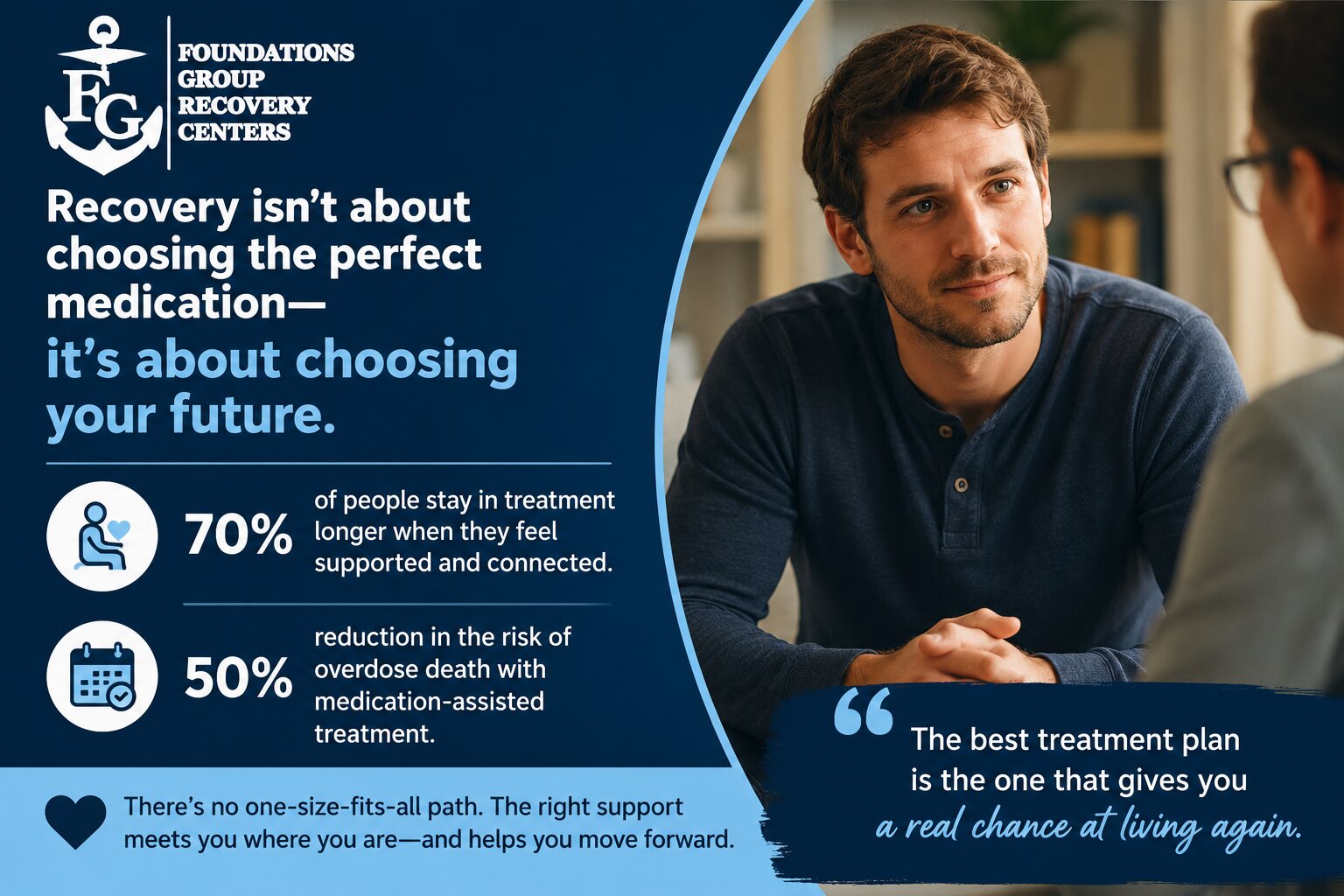
The most important factor is often not which medication someone chooses.
It’s whether they remain engaged in recovery.
Connection matters.
Support matters.
Consistency matters.
Accountability matters.
Treatment works best when people stay connected to the process.
Many individuals become so focused on choosing the perfect option that they overlook the importance of participation.
Imagine choosing the perfect gym membership and never going.
The membership isn’t the determining factor.
The engagement is.
Recovery works similarly.
The strongest treatment plan is one you can realistically participate in and sustain.
Why Early Support Matters
One thing I’ve learned after years of working with individuals seeking treatment is this:
Momentum matters.
The decision to seek help often develops slowly.
People spend weeks, months, or years thinking about it.
Then one day something shifts.
A difficult conversation.
A frightening experience.
A moment of honesty.
A realization that life isn’t moving in the direction they want.
That moment creates an opportunity.
The sooner support enters the picture, the easier it can be to build on that momentum.
Waiting for complete certainty often allows fear to regain control.
Taking action while motivation exists can be incredibly powerful.
Understanding the Conversation Around Medication
Many people researching suboxone vs methadone expect the discussion to focus exclusively on which medication is stronger, better, or more effective.
The reality is more nuanced.
Clinicians consider multiple factors when helping someone evaluate treatment options.
Medical history.
Substance use history.
Current needs.
Lifestyle factors.
Recovery goals.
Safety considerations.
The conversation is much broader than most people realize.
That’s one reason professional guidance matters.
Online information can provide education.
It cannot provide individualized recommendations.
Only a qualified assessment can do that.
The First Appointment Is Usually Different Than People Expect
Many individuals avoid treatment because they imagine the first appointment will feel intimidating.
They picture judgment.
Pressure.
Interrogation.
In reality, most first conversations are far simpler.
A clinician asks questions.
Listens.
Learns about your situation.
Explains available options.
Answers concerns.
The goal is not convincing someone to make a specific choice.
The goal is helping someone understand what options exist.
For many people, that conversation immediately reduces anxiety.
Because uncertainty is often scarier than information.
If You’re Still Unsure, You’re Normal
One of the most reassuring things I can tell first-time treatment seekers is this:
Almost nobody feels completely confident.
Most people arrive with questions.
Doubts.
Concerns.
Skepticism.
Hope.
Fear.
And curiosity.
Often all at the same time.
Those emotions do not mean you’re doing something wrong.
They mean you’re making an important decision.
Very few life-changing choices come with complete certainty.
Recovery is no different.
You don’t need to eliminate uncertainty before moving forward.
You simply need enough willingness to continue the conversation.
Frequently Asked Questions
Which medication is more effective for heroin addiction?
Treatment effectiveness varies from person to person. Individual needs, health history, and recovery goals all play an important role in determining the most appropriate option.
How do professionals help determine the right treatment?
A clinical assessment typically considers medical history, substance use patterns, current symptoms, treatment goals, and other personal factors.
Is medication enough on its own?
Medication can be an important component of recovery, but many people also benefit from counseling, peer support, recovery planning, and ongoing treatment services.
Why do people spend so much time comparing options?
Many individuals want reassurance they’re making the right decision. Comparison can sometimes feel safer than taking action.
What if I’ve never been in treatment before?
Many people entering treatment are first-time treatment seekers. Providers are accustomed to helping individuals understand their options and navigate the process.
Can treatment plans change over time?
Yes. Recovery needs can evolve, and treatment plans may be adjusted as circumstances change.
Is it normal to feel nervous about medication-assisted treatment?
Absolutely. Concerns and questions are extremely common, especially for individuals entering treatment for the first time.
What if I’m still unsure which option I want?
That’s okay. You don’t need every answer before reaching out. A professional conversation can help provide clarity and guidance.
You Don’t Have to Solve Recovery Alone
If you’re comparing options because you want the best chance of success, that makes sense.
But remember:
You don’t need to become an addiction expert before asking for help.
You don’t need perfect certainty before taking action.
And you don’t need to carry the burden of every decision by yourself.
Many people spend so much time trying to choose the right path that they forget something important:
Recovery rarely begins when all the questions are answered.
It begins when someone decides they’re willing to keep asking them.
Call (844)763-4966 or visit our Heroin Addiction Treatment services page to learn more about our Heroin Addiction Treatment services Barnstable County, MA.