
There is a moment many people remember clearly.
Usually, it happens before sunrise.
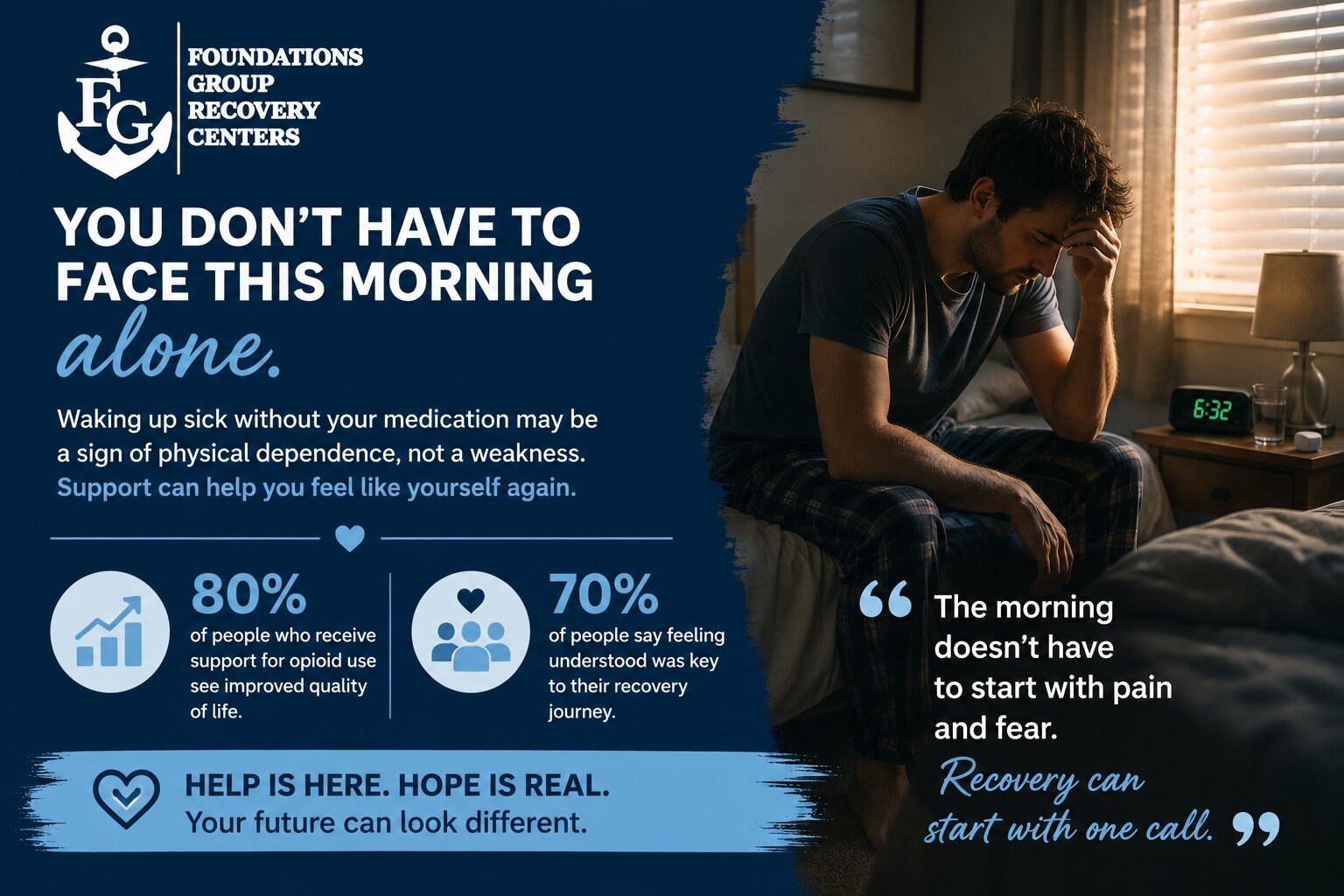
You wake up feeling awful.
Your stomach is unsettled. Your muscles ache. Anxiety seems to appear out of nowhere. You feel restless, uncomfortable, and strangely desperate for the day to start.
Then you take your pain medication.
Within a little while, the discomfort eases.
The nausea fades.
Your body relaxes.
You start feeling like yourself again.
At first, most people explain it away.
Maybe you’re stressed.
Maybe you didn’t sleep well.
Maybe you’re fighting off a virus.
But after enough mornings, another possibility starts creeping into your thoughts.
“What if this has something to do with my medication?”
If you’ve found yourself searching that question online, you’re far from alone.
Many people eventually begin exploring medication-assisted treatment support because they realize their body may be responding differently to pain medication than it once did.
What makes this experience especially difficult is that many people never intended to end up here.
They weren’t looking for a high.
They weren’t trying to misuse medication.
They were trying to manage pain.
And somewhere along the way, the relationship changed.
The Morning Doesn’t Feel Like Morning Anymore
One thing we hear often is this:
“I don’t even know if I feel pain anymore. I just know I feel terrible when I don’t take my pills.”
That statement carries a lot of weight.
Because for many people, there comes a point where it becomes difficult to distinguish between the original reason for taking medication and the discomfort that appears when medication levels drop.
The day starts feeling less like a normal morning and more like a race against symptoms.
Before coffee.
Before breakfast.
Before checking messages.
The first priority becomes feeling okay.
Many people don’t recognize how much emotional energy this consumes until they step back and look at the pattern.
The medication is no longer helping them move through life.
Life is increasingly organized around the medication.
Most People Don’t Notice the Shift Right Away
Dependence rarely arrives dramatically.
There isn’t usually a single moment where someone suddenly realizes something has changed.
Instead, it happens gradually.
A refill becomes more important than it used to be.
A missed dose feels worse than expected.
Travel requires more planning.
Anxiety appears when medication availability becomes uncertain.
Months later, people look back and realize the signs had been there for a long time.
The challenge is that gradual changes are difficult to notice while they’re happening.
It’s like watching the tide come in.
You don’t see the movement minute by minute.
Then suddenly the shoreline looks completely different.
The Question Isn’t Whether You’re a Good Person
One reason people wait so long to seek answers is because they immediately turn the situation into a moral question.
They ask:
“How did I let this happen?”
“What’s wrong with me?”
“Does this mean I’m addicted?”
“What will people think?”
These questions often create more fear than clarity.
The reality is that the human body adapts.
That’s what bodies do.
When opioid medications are taken consistently, physical dependence can develop.
That reality doesn’t care whether someone is creative, intelligent, successful, responsible, or disciplined.
It happens to all kinds of people.
Teachers.
Parents.
Artists.
Business owners.
Students.
Retirees.
Good people develop physical dependence every day.
The question is not whether you’re a good person.
The question is whether your body is telling you something important.
Sometimes the Symptoms Speak Before We Listen
People often describe the experience in nearly identical ways.
They wake up sweating.
Their stomach feels uneasy.
Their anxiety feels disproportionate to anything happening around them.
They feel restless and uncomfortable in their own skin.
Then medication enters the picture and the symptoms improve.
For many individuals, learning about opioid withdrawal symptoms provides an explanation that finally makes sense of what they’ve been experiencing.
The realization can feel frightening.
But it can also feel strangely relieving.
Because uncertainty is exhausting.
When people finally understand why they feel the way they do, they can begin making informed decisions instead of guessing.
And understanding is often the first step toward change.
Creative People Often Carry a Different Fear
For some people, the concern isn’t just physical.
It’s personal.
Especially among individuals who strongly identify with their creativity, independence, or individuality.
We’ve spoken with musicians who worried recovery would change their artistic process.
Writers who feared losing inspiration.
Creative professionals who believed their edge came from struggle.
The fear isn’t only about stopping medication.
It’s about identity.
People begin asking:
“If I change this part of my life, will I still be me?”
It’s an understandable question.
When something has been part of your daily routine for years, imagining life without it can feel disorienting.
But we’ve seen something remarkable happen repeatedly.
People don’t lose themselves in recovery.
They often rediscover themselves.
The energy spent managing medication.
The anxiety.
The planning.
The physical discomfort.
The emotional burden.
All of that takes up space.
When that space begins opening up, many people find parts of themselves they thought had disappeared.
Why So Many People Try to Handle It Alone
Most people don’t keep quiet because they don’t care.
They keep quiet because they care deeply.
They’re worried about consequences.
Worried about judgment.
Worried about disappointing people.
Worried about hearing something they don’t want to hear.
So they try solving the problem privately.
They adjust schedules.
They make new promises to themselves.
They convince themselves they’ll figure it out eventually.
Sometimes this continues for months.
Sometimes years.
The problem is that isolation rarely makes situations easier.
It usually makes them heavier.
The burden grows because there is nobody helping carry it.
And eventually the effort required to maintain silence becomes exhausting.
There Is a Difference Between Dependence and Identity
One of the most important perspective shifts we hope people experience is understanding this:
Dependence is something happening.
It is not who you are.
People often merge the two.
The symptoms become part of their identity.
The struggle becomes part of their identity.
The fear becomes part of their identity.
But needing support is not a personality trait.
Experiencing withdrawal is not a character flaw.
Seeking treatment is not an admission of failure.
It’s a response to a health concern.
Nothing more.
Nothing less.
Separating the person from the problem can be incredibly freeing.
Because once you stop seeing yourself as the problem, solutions become easier to imagine.
Hope Usually Arrives Before Confidence
Many people assume they need confidence before taking action.
In reality, most people begin with hope.
Just a small amount.
Enough to ask a question.
Enough to read an article.
Enough to make a phone call.
Enough to learn more.
Confidence often comes later.
After conversations.
After support.
After understanding what’s happening.
If you’re reading this, perhaps hope has already started.
Not because everything is clear.
Because you’re looking for answers.
And people rarely search for answers unless part of them believes change is possible.
The Question Beneath the Question
When someone types:
“Why do I feel so sick in the morning if I don’t take my pain pills?”
They’re often asking several questions at once.
What’s happening to me?
Can this get worse?
Am I alone?
Is there a way out?
Can I still be myself if things change?
Those are deeply human questions.
And they deserve thoughtful answers.
The encouraging reality is that many people have stood exactly where you are standing now.
Confused.
Concerned.
Unsure what to do next.
Many of them eventually found clarity.
Support.
Relief.
And a future that looked different than they expected.
Not because their problems disappeared overnight.
Because they stopped carrying them alone.
Frequently Asked Questions
Why do I feel sick in the morning until I take my pain medication?
Some individuals experience discomfort when medication levels decrease in their body. If symptoms improve after taking medication, it may be helpful to discuss the pattern with a healthcare professional.
Does this mean I have an addiction?
Not necessarily. Physical dependence and addiction are related but distinct concepts. A professional evaluation can help determine what may be happening.
Can physical dependence develop even when medication is taken correctly?
Yes. Physical dependence can occur during legitimate medical use when opioid medications are taken consistently over time.
What symptoms might suggest withdrawal?
Symptoms can include anxiety, restlessness, body aches, sweating, stomach discomfort, irritability, sleep disturbances, and feeling better after taking medication.
Is it safe to stop taking pain medication on my own?
Suddenly stopping opioid medications can be uncomfortable and, in some situations, risky. Always consult a qualified medical professional before making changes.
Why does the medication seem to help immediately?
If symptoms are related to decreasing medication levels, taking the medication may temporarily relieve the discomfort.
Does needing help mean I’ve done something wrong?
No. Many people develop physical dependence after using prescribed medication. Seeking support is a responsible step, not a sign of failure.
What should I do if I’m worried about withdrawal?
Speaking with a healthcare provider can help you better understand your symptoms, evaluate your options, and determine the safest path forward.
You Don’t Need to Figure This Out Alone
If you’ve been waking up feeling sick, anxious, or uncomfortable and wondering whether your body is trying to tell you something, you’re not weak.
You’re paying attention.
And paying attention is often where healing begins.
You don’t need every answer today.
You don’t need a perfect plan.
You don’t even need certainty.
You simply need the willingness to explore what’s happening and learn what options exist.
Sometimes that first conversation changes everything.
Call (844)763-4966 or visit our medication-assisted treatment Massachusetts page to learn more about our treatment programs Massachusetts, medication assisted treatment services Falmouth, MA.