

There are moments that stay with parents forever.
Not because something dramatic happened.
Because nothing happened at all.
Your 20-year-old didn’t go to class.
They didn’t answer texts.
They didn’t show up for work.
The meal you left outside their bedroom door sat untouched for hours. Another day passed without a plan, without progress, without any sign that things were moving in the right direction.
And somewhere in the middle of all that silence, you found yourself asking a question that many parents quietly carry:
“If they’re not suicidal, is it really serious enough to need treatment?”
As a clinician, I’ve had this conversation with countless families.
Many are relieved that their child isn’t in immediate danger. At the same time, they cannot ignore what they’re seeing. Their son or daughter is technically safe, yet life seems to have stopped.
The routines that once gave structure to their day have disappeared.
Motivation is gone.
Goals feel distant.
Relationships are fading.
Sometimes substance use has returned, making everything even harder to understand.
If any of this sounds familiar, I want you to know something important:
A person does not need to be experiencing a psychiatric emergency before they deserve meaningful support.
In fact, many families begin exploring structured daytime mental health treatment because they recognize that functioning has declined long before a crisis ever appears.
Depression Is Not Measured Only by Safety
One of the biggest misunderstandings surrounding depression is the idea that risk is the only thing that matters.
Families often evaluate the situation by asking a single question:
“Are they suicidal?”
That’s an important question.
But it isn’t the only one.
There are many young adults who are not actively suicidal yet are still struggling profoundly.
They may spend most of the day sleeping.
They may stop attending school.
They may lose jobs.
They may withdraw from family and friends.
They may stop taking care of themselves.
Their world becomes smaller and smaller until life is reduced to surviving one day at a time.
When this happens, depression is affecting much more than mood.
It is affecting function.
And function matters.
A person can be safe while still suffering tremendously.
The Version of Depression Most People Never Expect
Popular culture often portrays depression as obvious sadness.
People imagine someone crying constantly or openly talking about feeling hopeless.
Sometimes depression looks like that.
Many times it doesn’t.
Instead, parents describe something different.
Their child seems emotionally flat.
Disconnected.
Uninterested.
Exhausted.
They sleep for twelve hours and still seem tired.
Activities they once loved no longer matter.
Conversations become shorter.
Future plans disappear.
It’s as if someone slowly turned down the volume on their entire personality.
This version of depression can be particularly confusing because it doesn’t always look dramatic from the outside.
Yet internally, the individual may feel overwhelmed by even the smallest responsibilities.
What appears to be laziness is often emotional exhaustion.
What appears to be a lack of effort is often a lack of energy.
And what appears to be indifference is often a person struggling to carry a weight nobody else can see.
When Substance Use Clouds the Picture
Many parents arrive feeling uncertain because another factor has entered the equation.
Their child has started using substances again.
Now the questions multiply.
Is the depression causing the substance use?
Is the substance use causing the depression?
Which problem should be addressed first?
The reality is that these struggles frequently become intertwined.
A young adult may begin using substances to escape emotional pain.
Over time, substance use can worsen depression symptoms.
Depression then increases the urge to continue using.
What started as two separate issues becomes a cycle.
Trying to determine which problem came first can sometimes distract families from a more important question:
How do we help our child break the cycle?
When mental health symptoms and substance use begin feeding each other, additional support often becomes necessary.
Why Parents Often Wait Longer Than They Should
Most parents are not ignoring the problem.
They’re hoping.
Hoping things improve.
Hoping their child wakes up motivated.
Hoping next week looks different than this week.
Hoping the difficult phase eventually passes on its own.
Hope is understandable.
But hope can sometimes become a reason to delay action.
I’ve met many parents who spent months waiting for clarity.
Waiting for proof.
Waiting for a moment that would finally justify seeking additional support.
Meanwhile, their child continued withdrawing from life.
One of the hardest truths for parents to accept is that treatment is not reserved for worst-case scenarios.
You do not need to wait for a psychiatric emergency before exploring options.
You do not need to wait until your child loses everything.
And you do not need to wait until you’re absolutely certain.
Concern itself is often enough reason to start asking questions.
Weekly Therapy Isn’t Always Designed for This Level of Struggle
Therapy can be incredibly valuable.
For many people, weekly counseling provides exactly the support they need.
But some young adults reach a point where one hour per week simply isn’t enough.
Imagine trying to learn a new language for one hour every seven days.
Progress would be possible, but slow.
Now imagine trying to rebuild your mental health while struggling with depression, isolation, substance use, and a lack of daily structure.
The challenge becomes even greater.
Some individuals need more frequent support.
More accountability.
More opportunities to practice coping skills.
More time addressing the underlying issues contributing to their symptoms.
This is often when families begin researching severe depression help without hospitalization because they realize there may be options between traditional outpatient care and inpatient treatment.
There Is a Middle Ground Many Families Don’t Know Exists
One of the most common things I hear from parents is:
“We don’t think our child needs a hospital.”
Immediately followed by:
“But they clearly need more than what they’re getting now.”
This is where many families feel stuck.
Fortunately, mental health treatment is not limited to two extremes.
There are different levels of care designed for different levels of need.
Some people benefit from weekly therapy.
Others need multi-day weekly treatment.
Some need structured daytime care that provides several hours of therapeutic support throughout the week while allowing them to return home each evening.
The goal isn’t finding the most intensive option.
The goal is finding the most appropriate one.
When families discover there are meaningful options between outpatient therapy and hospitalization, many feel an immediate sense of relief.
The Signs Parents Notice Before Anyone Says “Depression”
Long before a diagnosis enters the conversation, parents often notice changes.
Small changes at first.
Then larger ones.
Common signs include:
- Sleeping excessively
- Avoiding social interaction
- Loss of motivation
- Missing work or classes
- Declining grades
- Increased irritability
- Emotional numbness
- Poor self-care
- Isolation from family
- Returning to substance use
- Difficulty completing basic daily tasks
Any one of these signs may not indicate severe depression.
Together, however, they often tell a story.
And parents usually recognize that story before anyone else does.
Trusting your observations matters.
You know your child.
You know what is normal for them.
And you know when something feels different.
Recovery Often Starts Before Motivation Returns
One of the biggest misconceptions about treatment is the belief that people must become motivated before support can help.
Parents frequently say:
“I’ll help when they’re ready.”
The problem is that depression often steals readiness.
Motivation is one of the very things depression attacks.
Waiting for someone to feel inspired before seeking support can be like waiting for a broken leg to heal before seeing a doctor.
In many cases, motivation doesn’t come first.
Structure comes first.
Connection comes first.
Support comes first.
Then motivation slowly begins to return.
I’ve seen young adults who seemed completely disconnected begin engaging again once they received consistent support and guidance.
Progress rarely starts with excitement.
More often, it starts with showing up.
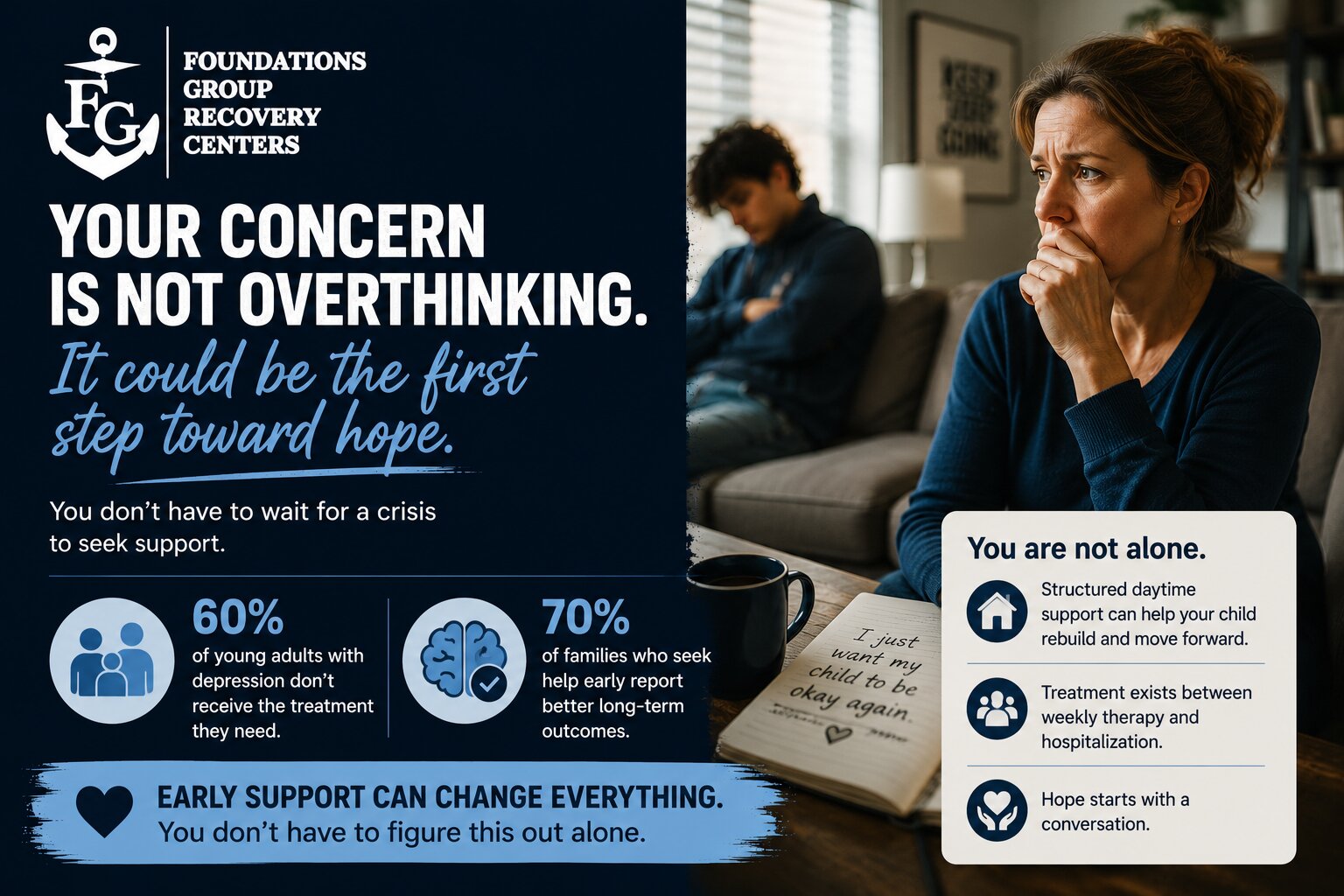
Your Concern Is Telling You Something
Parents often worry they’re being dramatic.
Too involved.
Too concerned.
What I’ve noticed is that parents rarely spend hours researching treatment options because everything is fine.
They search because they’ve been noticing changes for a long time.
They search because they feel stuck.
They search because they’re trying to help someone they love.
If your child is no longer functioning the way they once did, that concern deserves attention.
Not panic.
Not blame.
Not shame.
Attention.
Sometimes the biggest mistake families make is assuming things must become worse before they seek help.
Many times, the best outcomes happen when support enters the picture sooner rather than later.
Frequently Asked Questions
Can someone need depression treatment if they are not suicidal?
Yes. Depression can significantly affect a person’s ability to function, maintain relationships, attend school, work, or care for themselves even when suicidal thoughts are not present.
How can I tell if my child’s depression is becoming serious?
Loss of daily functioning is often one of the clearest indicators. Sleeping excessively, isolation, neglecting responsibilities, and difficulty completing basic tasks may all signal a need for additional support.
What if my child is also using substances?
Depression and substance use often influence one another. Addressing both concerns simultaneously can help improve overall outcomes and provide a clearer path toward recovery.
Is hospitalization the only option when depression becomes severe?
No. Many individuals benefit from treatment options that provide more structure than weekly therapy without requiring overnight hospitalization.
How do I know if weekly therapy is enough?
If symptoms continue worsening, daily functioning continues declining, or progress has stalled despite ongoing therapy, it may be worth discussing additional levels of support.
Can structured daytime treatment help young adults?
For many individuals, structured daytime care provides therapeutic support, accountability, skill-building, and routine while allowing them to return home each evening.
What should I do if my child refuses help?
Focus on maintaining communication, expressing concern without judgment, and consulting with professionals who can help guide next steps. Resistance does not necessarily mean support is impossible.
Hope Doesn’t Require a Crisis
One of the most important things I want parents to hear is this:
You do not need to wait for a psychiatric emergency before taking depression seriously.
You do not need proof that things are at their absolute worst.
And you do not need to justify your concern.
If your child seems stuck, disconnected, exhausted, and unable to function the way they once could, there may be support available that bridges the gap between weekly therapy and hospitalization.
Sometimes hope begins not when everything gets better.
Sometimes it begins the moment a family realizes they don’t have to navigate the situation alone.
Call (844)763-4966 or visit our day treatment program Massachusetts page to learn more about our treatment programs Massachusetts, day treatment program services Barnstable County, MA.