
You show up.
You perform.
You take care of what needs to be taken care of.
From the outside, your life might look fine—even enviable. You have routines. You meet deadlines. You still smile when it counts.
But behind that polish is a pattern that’s starting to scare you. Quietly. Slowly. Privately.
You’re drinking more than you used to. More than you tell anyone. Maybe even more than you admit to yourself.
This blog isn’t about shaming you. It’s about honoring what you’re already carrying—and naming the weight you don’t have to hold alone anymore.
As clinicians who work with high-functioning clients at Foundations Group Recovery Center in Mashpee, we know what it looks like when someone is holding it all together on the surface while slowly unraveling underneath. And we know how to help without judgment, labels, or assumptions.
“High-Functioning” Doesn’t Mean Healthy
The term “high-functioning alcoholic” can be misleading. It suggests that because you’re not crashing cars, losing jobs, or facing legal trouble, things must not be that bad.
But let’s be honest:
- How many mornings have you felt shaky, anxious, or guilty—and still made it to work on time?
- How many “just one” nights turned into three glasses… four… the whole bottle?
- How many times have you wondered, in the quiet moments, Am I okay?
If your answer is “more than I want to admit,” you’re not alone. And you’re not weak.
You’re just someone who’s been managing for a long time—and who might be ready to start healing.
The Signs We See (Even When You’re Hiding Them)
As clinicians, we’re not looking for drama or rock bottoms. We’re looking for the real stuff—signs you’ve likely felt in your own body long before anyone else noticed.
Here’s what we pay attention to:
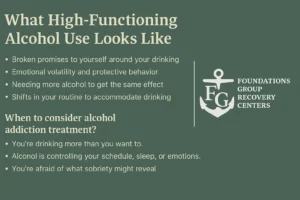
- Broken promises to yourself: “I won’t drink during the week.” “I’ll stop after this weekend.” If you keep negotiating with yourself and losing, that’s a red flag.
- Emotional volatility: Anxiety, irritability, and depression that don’t match your external life. Mood swings can be alcohol withdrawal symptoms in disguise.
- Protective behavior: Hiding bottles, downplaying your drinking, or feeling defensive when someone mentions alcohol.
- Increased tolerance: Needing more alcohol to get the same effect—and noticing that your “normal” is creeping higher.
- Shifts in routine: Skipping workouts, avoiding morning plans, or planning your day around when you can drink.
These patterns don’t always scream “alcohol addiction.” But they whisper it. Constantly.
And those whispers are often what bring people through our doors.
Why Smart, Capable People Struggle With This
High-functioning adults—especially professionals, parents, caregivers, and achievers—are often the last to seek help.
Why?
Because you’re the one people lean on. Because you’ve solved harder problems. Because alcohol was supposed to be your relief, not your downfall.
You might even tell yourself:
- “I can stop anytime.”
- “It’s just stress.”
- “Everyone drinks.”
But those rationalizations lose their power when you’re alone at night, wondering if you’re starting to lose yourself.
We’re not here to argue with your intelligence. We’re here to tell you that even intelligent, successful people can get stuck—and still deserve freedom.
When to Consider Alcohol Addiction Treatment
So how do you know when it’s time to do something more than just think about quitting?
Here’s what we tell clients:
- If you’re drinking more than you want to, more often than you mean to, that’s enough.
- If alcohol is controlling your schedule, your sleep, your emotions, or your choices, that’s enough.
- If you’re scared of what sobriety might reveal, that’s a sign there’s something worth finding.
Alcohol addiction treatment isn’t about judgment. It’s about helping you live without the secret tug of alcohol pulling at you every day.
At Foundations, we don’t treat clients like cautionary tales. We treat them like the brave, exhausted, honest humans they are—finally ready to choose something better.
What Treatment Can Actually Look Like (Without Blowing Up Your Life)
If you’re imagining some dramatic scene—checking into rehab, quitting your job, telling your boss—it’s okay to exhale.
That’s not the only way this works.
Our alcohol addiction treatment in Mashpee, MA offers:
- Outpatient treatment options for clients who need flexibility
- Individual and group therapy that respects your pace
- Clinicians who understand achievement-driven stress
- Confidential care coordination so you don’t have to broadcast your situation to the world
You can keep your life—and rebuild your health.
You can keep your job—and still let someone take care of you for once.
You can even stay anonymous if that’s what you need right now.
For those near Falmouth or Barnstable County, in-person support is close and accessible.
What If You’re Still Not Sure It’s “Bad Enough”?
Let’s flip the question.
What if it could be better than this?
- Better than hiding bottles or recycling early
- Better than hangxiety
- Better than secretly counting units or Googling “am I drinking too much?”
- Better than living a double life
If there’s even a part of you whispering “I don’t want to keep doing this,” that’s enough.
You don’t need your life to fall apart to want more from it. You just need to say yes to something healthier.
Real Questions High-Functioning Clients Ask Us
“Do I really need treatment if I’m still functioning?”
Functioning isn’t the same as thriving. If alcohol is draining your energy, focus, joy, or health, treatment can help—even if no one else sees the problem yet.
“Will I have to stop drinking forever?”
That’s a conversation, not a command. We meet you where you are. Many clients come in unsure—and leave with a clarity they couldn’t find alone.
“What if I don’t want anyone to know?”
You’re not required to tell anyone. Our program is confidential and respectful of your privacy. We’ll work with your comfort level.
“What if I tried before and it didn’t stick?”
You’re not broken. You’re learning. Sometimes it takes the right kind of support, not just willpower. We’ll help you build a different foundation.
“What happens in outpatient treatment?”
You’ll attend structured sessions (group and individual) during the week, but return home each day. You keep your job, your space, and your dignity.
This Doesn’t Have to Be a Secret Anymore
You’ve carried it quietly. Competently. For a long time.
But carrying it alone doesn’t make you strong. It just makes you tired.
It’s okay to want peace. It’s okay to want to stop pretending. It’s okay to want help—even if you’re the one who usually gives it.
Want to Talk to Someone Who Gets It?
You’re not broken. You’re just burned out on hiding. And you don’t have to figure this out on your own.
Call (844)763-4966 or visit Foundations’ Alcohol Addiction Treatment in Mashpee, MA to explore private, respectful options for care.
No spotlight. No lectures. Just a conversation. When you’re ready.