

You’ve done the hardest thing—stopped drinking—and somehow it feels worse.
If you’re newly sober and wondering why everything feels emptier, quieter, and lonelier than you imagined, you’re not broken. You’re healing. It just doesn’t feel like it yet.
At Foundations Group Recovery Center in Mashpee, MA, we hear this all the time from people in their first weeks of alcohol addiction treatment:
“I thought I’d feel better once I stopped drinking. Why do I feel so alone instead?”
That ache you’re feeling isn’t a failure of treatment. It’s a sign that your brain, body, and heart are finally waking up after years of emotional anesthesia. And it’s okay to feel overwhelmed by that.
Here’s what we want you to know—and what can help you keep going when early recovery feels like an echo chamber.
Why Do I Feel So Alone Now That I’m Sober?
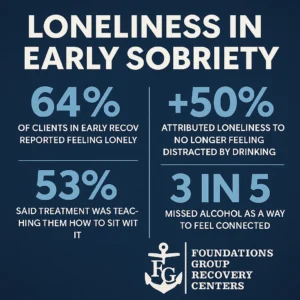
Because alcohol was filling a lot of empty spaces.
Before treatment, drinking may have been how you connected, coped, or distracted yourself. It gave you something to do, something to reach for when the silence got loud. When you remove that, you’re left with the raw version of life—the parts that were blurred before.
The loneliness you feel now isn’t new. It’s just uncovered.
In alcohol addiction treatment, those feelings are finally given air to breathe. And while that can feel painful, it’s also the beginning of real connection—because connection can’t happen when you’re numbed out.
Does This Mean Alcohol Addiction Treatment Isn’t Working?
No. It means it’s working exactly as it should.
Healing from addiction isn’t just physical—it’s emotional. And emotional healing often starts with grief. You might be grieving the person you were when you drank, the relationships that revolved around it, or the life that felt easier when you didn’t feel so much.
Treatment doesn’t erase loneliness; it teaches you what to do with it.
It gives you space to name it, understand it, and eventually, move through it. It may not feel like progress, but it is.
Why Does Everyone Else in Recovery Seem Happier Than Me?
Because recovery looks different on everyone—and appearances can lie.
In group settings, you might see people laughing, connecting, or talking about hope, and think, What’s wrong with me? The truth is, you’re only seeing part of their story. What you can’t see are the tears, the doubts, the nights they question if they’ll make it.
You’re not behind. You’re just being honest.
Loneliness isn’t a sign of weakness—it’s a sign you’ve stopped pretending. And that’s one of the bravest parts of recovery.
Why Do I Miss Drinking Even Though I Don’t Want to Go Back?
Because alcohol wasn’t just a substance—it was a companion.
It was there at every birthday, every heartbreak, every night you didn’t know how to be with yourself. Of course you miss it. Even when you know it hurt you, part of you might still long for that false comfort.
In alcohol addiction treatment, we often remind clients that missing drinking doesn’t mean you want to relapse—it means you’re grieving. You’re letting go of something that felt like safety, even though it wasn’t. And grieving is human.
The goal isn’t to stop missing it right away—it’s to start building a life that feels full enough you won’t need it anymore.
Why Do I Feel Disconnected from People I Love?
Because sobriety shifts the ground beneath every relationship.
Maybe your friends still drink, and being around them feels painful or complicated. Maybe your family doesn’t know what to say. Or maybe you feel disconnected because you’re changing—and not everyone understands that yet.
Early recovery is often a season of recalibration.
You’re learning who you are without alcohol, and that means some relationships will change. But it also means new ones will begin—ones built on truth, not escape.
And if you’re in treatment near Barnstable County or Falmouth, MA, you can connect with others going through the same stage. These aren’t just support groups—they’re lifelines. Learn more about alcohol addiction treatment in Barnstable County, MA and discover that connection is still possible, even here, even now.
What Can I Do When the Loneliness Feels Unbearable?
Sometimes, the goal isn’t to make the loneliness disappear—it’s to make it bearable.
Here are small things that actually help when you’re deep in it:
- Speak it aloud. Shame thrives in silence. Tell your therapist, your counselor, or someone in group: “I feel alone.” You’ll be surprised how many people nod back.
- Don’t isolate. Even if you don’t want to talk, be around others. Sit in the lounge. Join a meeting. Be where the people are, even if you’re quiet.
- Do one small kind thing for yourself. Fold your laundry. Make tea. Brush your teeth. Tiny acts of care remind your body you still matter.
- Let nature ground you. Early recovery can make the world feel too bright. Let something simple—a walk outside, the sound of waves, the smell of rain—remind you that you’re still here.
- Remember: connection takes time. Just because you haven’t found “your people” yet doesn’t mean they don’t exist. You’re still building the version of yourself who can meet them.
You don’t have to “be strong.” You just have to keep showing up.
What If I Regret Getting Sober?
That’s more common than anyone admits.
Regret often hits in the middle—not because sobriety is bad, but because it’s real. When alcohol is gone, the emotions come back, and you suddenly see the full picture—your choices, your pain, your possibilities. That clarity can hurt.
You might think, Life was easier when I drank.
But “easier” isn’t the same as better. That ache you’re feeling now? It’s the discomfort of growth. It’s what it feels like to rebuild something from the ground up—yourself.
How Long Will This Loneliness Last?
Not forever.
It eases slowly, like your eyes adjusting to sunlight after being in the dark. The first few months are often the hardest. But with each week, each conversation, each new connection, something inside you begins to thaw.
We’ve seen it happen hundreds of times at Foundations.
The person who once said, “I don’t belong anywhere,” ends up laughing with new friends over dinner, realizing they do. The one who said, “I don’t feel anything,” starts to feel again—joy, grief, hope. All of it.
That’s when you know the loneliness has started to lift.
What About the Friends I Used to Drink With?
This part can be heartbreaking.
Some friends might not understand why you had to change. Some might quietly drift away. Others may say, “You’re not fun anymore.” And that stings.
But here’s the truth: if a relationship can’t exist without alcohol, it wasn’t built on you—it was built on the drink.
Sobriety reveals which connections were real and which were routines. And while losing that circle hurts, it makes space for something better: community rooted in truth, not intoxication.
At Foundations Group Recovery Center, we help clients build that community through peer groups, sober activities, and ongoing alumni connections—because recovery is a team sport.
Is It Normal to Feel Angry or Irritable Instead of Sad?
Yes—and it’s actually a sign of progress.
In early sobriety, anger often hides underneath loneliness. It’s easier to say “I’m frustrated” than “I’m hurting.” Anger can be grief in disguise.
The next time you feel that heat, try to notice what’s underneath it. What does it feel like you’ve lost? What are you craving? Let therapy or group help you unpack that. You don’t need to push it down—just give it words.
What If I Don’t Believe This Will Get Better?
Then borrow our belief until yours comes back.
We’ve seen thousands of people stand where you’re standing now—angry, scared, disconnected—and walk into something brighter.
You don’t have to believe in forever. You just have to believe in next week. Or tonight. Or the next right choice.
Because that’s how recovery grows: one honest, exhausted, hopeful day at a time.
You don’t have to go through this part alone.
Call (844)763-4966 or visit our Alcohol Addiction Treatment to learn how Foundations Group Recovery Center in Mashpee, MA can support your recovery—not just from alcohol, but from the loneliness that often follows.
You’ve already chosen life once by getting sober. Now, let’s make it one worth staying for.