
Some people worry sobriety will save their life.
Others worry it will erase it.
That fear is more common than people realize, especially among creative, expressive, or identity-driven individuals. Musicians. Designers. Writers. Performers. People who feel things deeply and live loudly.
When they begin researching options like alcohol recovery support, the question isn’t always “Will this help me?”
It’s often something more personal.
“What if this changes who I am?”
That fear deserves to be taken seriously.
The Fear That Sobriety Will Flatten Your Personality
Many people imagine recovery as a quiet, muted version of life.
They picture losing their edge. Their humor. Their spontaneity. The version of themselves that shows up at parties, performs on stage, writes late at night, or speaks boldly in rooms full of people.
Alcohol can feel tied to those moments.
It may have been part of creative rituals, social identity, or the way someone relaxes enough to express themselves freely.
So the idea of stepping away from it can feel like removing a piece of personal identity.
From a clinical perspective, this fear makes sense. People often attach meaning to substances because of the role those substances have played in their lives.
But meaning and identity are not the same thing.
What Many People Discover About Creativity
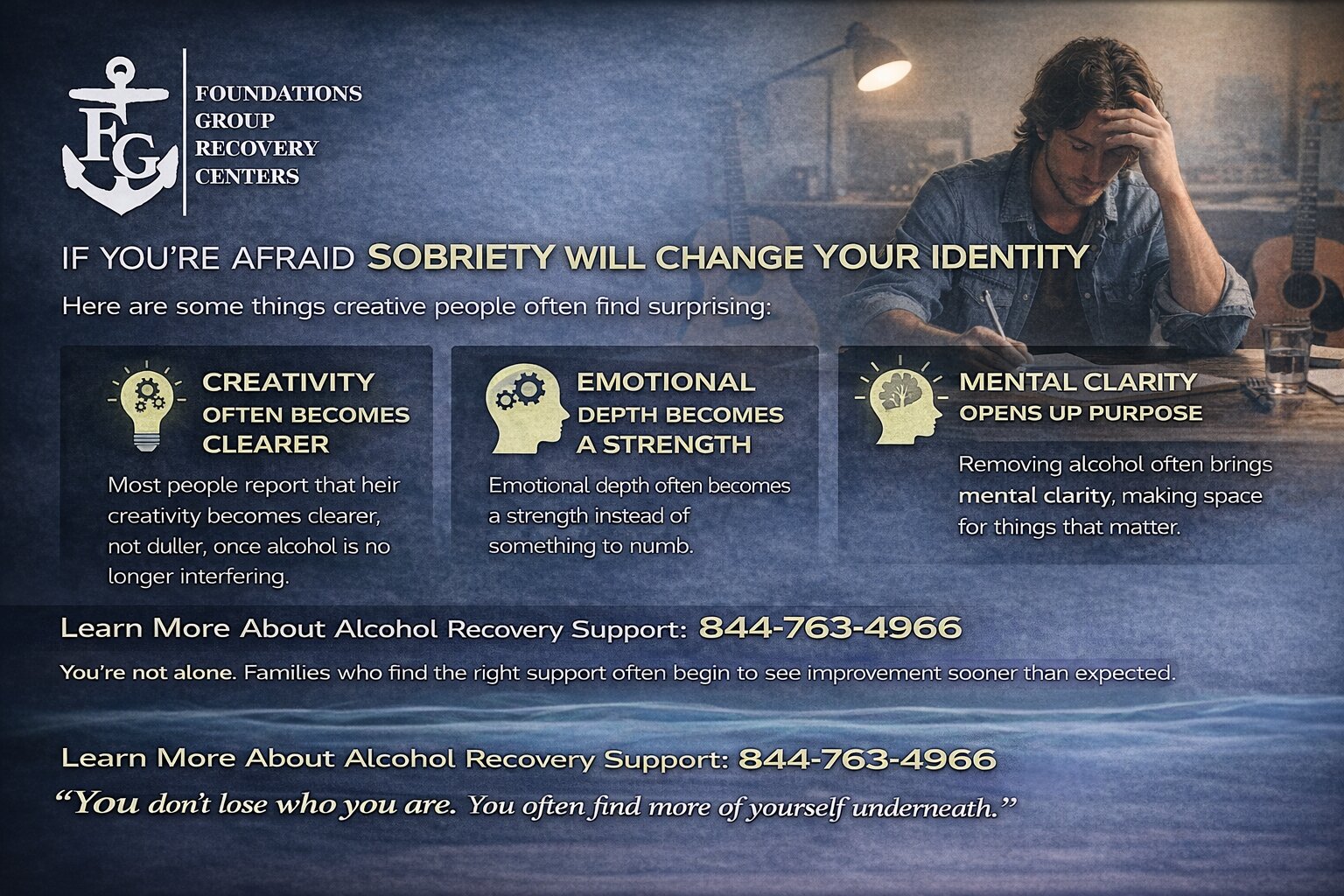
One of the most common surprises people report during recovery is that creativity doesn’t disappear.
In fact, it often becomes more consistent.
Alcohol can create moments of emotional openness or lowered inhibition, which can feel helpful for creative work. But it also tends to interrupt focus, disrupt sleep, and drain mental clarity.
Over time, those effects can make creative work harder to sustain.
When alcohol is removed from the picture, people often experience something unexpected: their ideas become easier to organize, their energy becomes more stable, and they can actually follow through on creative projects.
One musician once described it like this:
“I thought drinking made my music better. It turns out it mostly made my mornings impossible.”
Creativity doesn’t vanish in recovery.
It tends to find healthier rhythms.
The Truth About Emotional Intensity
Many creative people are emotionally perceptive. They notice subtle shifts in mood, energy, and atmosphere that others might miss.
Alcohol sometimes becomes a tool for managing that sensitivity.
It can soften anxiety. Quiet self-doubt. Make overwhelming emotions feel temporarily manageable.
When alcohol leaves the picture, those feelings can initially feel stronger.
This is often one of the early challenges people face.
But with the right support — therapy, peer connection, and structured guidance — people begin learning new ways to work with their emotional depth rather than suppress it.
Over time, emotional awareness often becomes a strength instead of something that needs to be numbed.
The Unexpected Relief of Mental Clarity
Another surprise many people describe is how much mental space opens up.
Alcohol requires a surprising amount of mental energy.
People think about when they’ll drink, how much they’ve had, whether others notice, whether they should cut back, whether they can stop tonight or tomorrow.
That constant background calculation can quietly drain cognitive bandwidth.
When alcohol is no longer occupying that space, many people experience a sense of mental relief.
Their thoughts become clearer. Decision-making becomes easier. Their attention shifts toward things that matter more — relationships, creative work, physical health, or long-term goals.
It’s like removing a constant background noise you didn’t realize was always there.
Discovering That You’re Not Alone
Many creative individuals assume recovery spaces will feel foreign to them.
They picture rigid environments filled with people who don’t understand their experiences or values.
But the reality is often very different.
Recovery communities frequently include people from all walks of life:
Artists
Entrepreneurs
Healthcare professionals
Parents
Students
Performers
Many of them share the same fear: that sobriety will take away the spark that makes them who they are.
Instead, they often discover something surprising — that the spark was never created by alcohol.
It was simply buried underneath it.
The Shift From Surviving to Living
Alcohol can quietly shrink someone’s life.
It can affect sleep, motivation, energy, and relationships in ways that accumulate slowly over time.
People sometimes stop pursuing creative goals, exploring new opportunities, or investing in personal growth simply because they feel too tired, overwhelmed, or emotionally depleted.
When alcohol is removed and people begin receiving meaningful support — sometimes through alcohol addiction treatment — something often shifts.
Energy returns.
Curiosity returns.
Goals that once felt distant start to feel possible again.
Instead of organizing life around alcohol, people begin organizing life around things that genuinely matter to them.
Identity Doesn’t Disappear — It Evolves
One of the most important things people discover during recovery is that identity is not something fragile.
It doesn’t disappear when alcohol leaves.
It evolves.
Recovery often allows people to reconnect with parts of themselves that had been pushed aside — interests, relationships, creative pursuits, and emotional clarity.
If alcohol was once used to unlock confidence, recovery often helps people build that confidence directly.
If alcohol once helped people express themselves, recovery often gives them new ways to do that without the consequences that came with drinking.
A helpful metaphor many people resonate with is this:
Alcohol sometimes acts like a dimmer switch on life.
It can brighten certain moments temporarily, but it also gradually lowers the overall light in the room.
Recovery turns the lights back on.
You Don’t Have to Decide Everything Right Now
If you’re reading this because something about your relationship with alcohol feels complicated, that awareness matters.
You don’t need to label yourself today.
You don’t need to make a permanent decision about the future.
Many people begin by simply learning what support might look like and speaking with professionals who understand the emotional and identity-based fears that often come with change.
Exploring options doesn’t commit you to anything.
It just gives you information.
And sometimes that information is the first step toward clarity.
Frequently Asked Questions
Will I lose my creativity if I stop drinking?
Most people find the opposite happens. While alcohol can lower inhibitions temporarily, it often disrupts focus, memory, and energy over time. Many creative individuals discover that their ideas become clearer and their work more consistent once alcohol is no longer interfering with sleep and mental clarity.
Why do creative people sometimes struggle with alcohol?
Creative individuals often experience emotions and environments more intensely. Alcohol can become a quick way to manage stress, social anxiety, or emotional sensitivity. However, relying on alcohol for emotional regulation can create new problems over time, which is why many people eventually explore healthier coping strategies.
What if alcohol helps me feel more confident socially?
Alcohol can temporarily lower social anxiety by reducing inhibitions. In recovery, many people learn communication skills, emotional awareness, and confidence-building techniques that allow them to connect with others without relying on alcohol to feel comfortable.
Do I have to identify as an “alcoholic” to seek help?
No. Many people explore support simply because alcohol is creating problems in their life or relationships. Labels are less important than understanding how alcohol is affecting your wellbeing and whether change might improve your life.
Is recovery only for people who have hit “rock bottom”?
Not at all. Many people seek support long before reaching a crisis point. Early conversations about alcohol use can prevent larger problems and help people make thoughtful, informed decisions about their future.
Can treatment support creative lifestyles?
Yes. Many programs understand that identity, purpose, and creativity are central parts of people’s lives. Support often focuses on helping individuals reconnect with the things that matter to them while building healthier coping strategies.
You Don’t Have to Figure This Out Alone
Questions about alcohol, identity, and creativity are deeply personal. They rarely have simple answers.
But you don’t have to navigate them by yourself.
If you’re curious about what support might look like, call 844-763-4966 or visit our alcohol addiction treatment services to learn more about our alcohol addiction treatment services in Massachusetts.
For many people, the biggest surprise about recovery isn’t losing who they are.
It’s discovering how much more of themselves was waiting underneath.