
I didn’t relapse in a dramatic way.
There was no siren. No intervention. No public collapse.
It was quieter than that.
It started with disconnection. Then isolation. Then that old mental bargaining voice I hadn’t heard in years. By the time I realized I was in trouble, I wasn’t in flames — but I was smoldering.
And the hardest part wasn’t admitting I needed help again.
It was admitting it after so much time.
When I walked back into Foundations Group Recovery Center’s opiate addiction treatment in Massachusetts, I felt like I was dragging a decade of pride behind me.
I thought I had failed.
I hadn’t. I had drifted.
And drifting can be just as dangerous.
The Version of Me That “Had It Together”
If you’ve been sober for a year or more, you know this version.
The stable one.
The responsible one.
The one people point to and say, “See? It works.”
I built a life I was proud of. I repaired relationships. I found routines. I learned coping skills. I spoke at meetings. I mentored newer people.
And slowly, quietly, something inside me went flat.
Not miserable. Not chaotic.
Just… hollow.
I wasn’t using. But I also wasn’t connected. I was going through the motions of recovery instead of living inside it.
That kind of numbness doesn’t get applause. It doesn’t get concern either. It just lingers.
Emotional Drift Is Harder to Admit Than Relapse
When I finally slipped, it wasn’t because I forgot everything I learned.
It was because I stopped paying attention to myself.
Long-term alumni don’t usually relapse out of ignorance. We relapse out of emotional erosion.
Grief we never processed.
Stress we minimized.
Resentment we buried.
Depression we called “just tired.”
There’s this dangerous myth that once you’ve been sober long enough, you’re supposed to be solid.
But sobriety isn’t immunity.
Life still hits. Trauma still surfaces. Mental health still matters.
And if you’ve used opioids in the past, the brain remembers the shortcut. It doesn’t forget just because you collected time.
The Shame Hits Harder the Second Time
The first time I entered treatment, I was desperate. I had nothing left to protect.
The second time? I had a reputation.
I had years. I had credibility. I had people who looked up to me.
Walking back in felt like admitting I had lied.
I remember sitting in my car in the parking lot thinking:
“You should’ve known better.”
“You teach this stuff.”
“What are people going to think?”
Here’s the truth: shame is louder for long-term alumni.
Because you think you’re supposed to be past this.
But recovery isn’t a graduation ceremony. It’s maintenance. It’s repair. It’s sometimes renovation.
And going back for structured support wasn’t erasing my years — it was protecting them.
You Don’t Have to Lose Everything to Deserve Help
This might be the most important thing I can say to you.
I didn’t lose my job.
I didn’t get arrested.
I didn’t burn down my life.
That almost stopped me from reaching out.
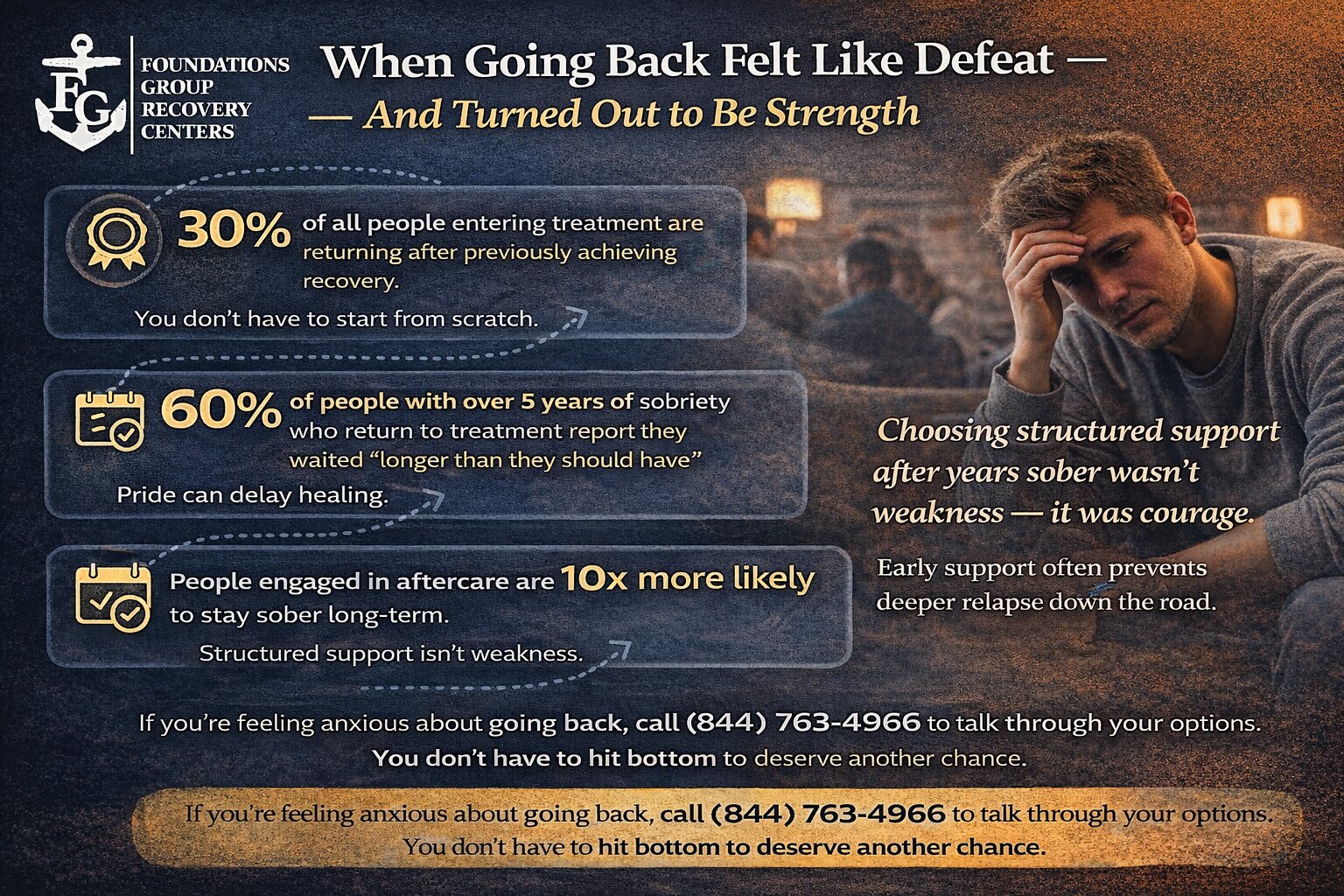
There’s this unspoken belief that you have to “earn” your return by crashing hard enough.
You don’t.
If you’re:
- Thinking about using more than you want to admit
- Feeling spiritually disconnected
- Hiding small slips
- White-knuckling your way through cravings
- Telling yourself, “It’s not that bad”
That’s enough.
You don’t need to hit a cinematic rock bottom to justify support.
Sometimes the bravest move is intervening early.
The Second Time Felt Different — In a Good Way
When I returned to opiate addiction treatment, it wasn’t about detox or crisis management.
It was about recalibration.
I showed up with humility instead of ego. With questions instead of defenses. I wasn’t there to prove I could do it — I was there to understand why I was drifting.
And because I had prior recovery experience, I went deeper.
We talked about unresolved trauma.
About long-term burnout.
About how success can mask suffering.
I learned that long-term sobriety without ongoing emotional work can turn rigid.
And rigid things crack.
Structured care gave me space to soften again.
Long-Term Alumni Struggle Quietly
Here’s something I wish more people said out loud:
Long-term sobriety can get lonely.
People stop checking in.
You stop asking for help.
You become the “strong one.”
But strength without support eventually turns into isolation.
I wasn’t failing at recovery. I was starving inside it.
Going back didn’t mean I didn’t appreciate my life. It meant I wanted to feel connected to it again.
There’s a difference.
Returning Isn’t Starting Over
One of the biggest fears I had was that I’d be treated like a beginner again.
That didn’t happen.
My history mattered. My experience mattered. My years mattered.
Recovery isn’t a scoreboard that resets to zero the second you struggle.
It’s a living system. And sometimes that system needs reinforcement.
Returning for support in Massachusetts wasn’t regression — it was refinement.
I wasn’t back at square one.
I was building square fifteen more intentionally.
If You’re Reading This and Feeling That Quiet Drift
Maybe you haven’t relapsed.
Maybe you just feel off.
Flat.
Disconnected.
Irritable.
Restless.
Maybe you’re doing “fine” — but you’re not thriving.
If you’re in Massachusetts and feeling that slow emotional erosion, it’s okay to explore support again. Not because you failed. Because you value your life.
Call 844-763-4966 or visit our opiate addiction treatment services in Massachusetts to learn more about our opiate addiction treatment services in Falmouth, Massachusetts.
You don’t have to disappear before you’re allowed to come back.
Frequently Asked Questions
Is going back to treatment after years sober a sign of failure?
No. It’s a sign of awareness.
Failure is ignoring the warning signs because of pride. Returning for support means you’re choosing long-term stability over short-term ego protection.
Many people in long-term recovery re-engage with structured care at different stages of life. It doesn’t erase your progress.
What if I haven’t fully relapsed but feel close?
That’s actually an ideal time to seek support.
You don’t need a catastrophic event to qualify for help. If you’re noticing increased cravings, emotional numbness, secrecy, or mental bargaining, that’s enough information to act.
Early intervention often prevents deeper setbacks.
Will I be treated like I’m starting over?
No. Your history matters. Your time matters. Your insight matters.
Returning alumni are often met with respect for the recovery foundation they’ve already built. Treatment can be adjusted to where you are now — not where you were years ago.
Why does long-term sobriety sometimes feel flat?
Because recovery evolves. Early sobriety is often crisis-driven and adrenaline-fueled. Long-term recovery requires emotional depth, continued growth, and ongoing mental health care.
If that inner work stalls, life can start to feel mechanical. That doesn’t mean sobriety failed. It means it’s time for the next layer of growth.
How do I know if I need structured support again?
Ask yourself:
- Am I hiding how I really feel?
- Have cravings increased?
- Am I isolating more?
- Do I feel emotionally numb or disconnected?
- Am I minimizing warning signs?
If the honest answers make you uneasy, that’s worth exploring.
You deserve stability that feels real — not forced.
Going back didn’t mean I failed.
It meant I refused to let pride cost me my peace.
If you’re a long-term alumni who feels stuck, tired, or quietly unraveling — you’re not alone. And you’re not weak for needing help again.
Sometimes the strongest thing you can do in recovery… is return.