
Early recovery can be one of the loneliest places a person ever stands.
You’ve made the brave decision to stop using. Maybe for the first time in a long time, you’re seeing the world clearly—but everything feels loud, raw, and uncertain. Nights stretch out longer. Your phone is quieter. And you’re suddenly face-to-face with feelings you used to outrun.
This blog is for you if you’re wondering what comes next, and especially if you’re considering a partial hospitalization program but don’t know what that really means for your day-to-day life.
At Foundations Group Recovery Centers in Mashpee, MA, we understand how overwhelming this decision can feel. So let’s slow it down. You don’t need all the answers right now—just a little more clarity and a lot more kindness.
What Is a Partial Hospitalization Program (PHP)?
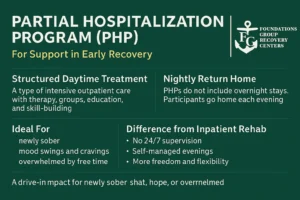
A partial hospitalization program is a type of structured, intensive outpatient treatment. You participate in a full day of therapy, group work, education, and support—usually five to six days a week—but you return home at night.
Think of PHP as the middle space between full-time residential treatment and more flexible outpatient care. It’s designed for people who need consistent, daily support to stay grounded in their recovery—but don’t require 24/7 supervision or overnight care.
It’s a rhythm that says: We’re here during the hard hours—but we trust you to begin rebuilding your life too.
Do I Sleep at the Facility?
No. PHP does not include overnight stays. Each day, you come to the facility in the morning and go home in the evening.
That might sound comforting—or intimidating. Many people in early sobriety wonder if they’re ready for that kind of independence. But it’s important to know: you’re not being left to figure it out alone.
You’re gaining something that’s just as important as clinical care: the chance to rebuild your own rhythms. The chance to learn what evenings feel like sober. To discover that you can sit with a feeling and not fall apart. And to go to bed knowing you get another shot at this tomorrow—with people in your corner.
What If I Don’t Have a Safe or Supportive Place to Go at Night?
You’re not the only one with that fear.
Sometimes “going home” isn’t a peaceful thing. For some, it’s a return to environments where substances are still present. For others, it’s loneliness in an empty apartment, or the strain of relationships still healing.
If your current living situation doesn’t support your recovery, we will talk through your options. That might include help finding sober living housing, coordinating with family, or identifying community supports.
Many of our clients come from Barnstable County, MA, Falmouth, and other local areas where transitional housing is available. Our team can help you find what makes sense for your needs—not just your ZIP code.
What Happens During the Day in PHP?
Your days in PHP are filled with meaningful, therapeutic structure.
Most days include a mix of:
- Group therapy, where you explore topics like triggers, communication, boundaries, and relapse prevention
- Individual counseling with a licensed therapist to process deeper personal challenges
- Psychoeducation, where you learn how addiction affects the brain, emotions, and body
- Skill-building sessions, where you practice coping techniques, mindfulness, and emotional regulation
- Family or support planning, if appropriate
All of it is delivered in a supportive, nonjudgmental environment. You’re not being lectured. You’re being met where you are—and helped to take the next right step.
For people who are newly sober and deeply lonely, this kind of structure offers more than just distraction. It offers belonging. It gives you a place to land when everything else still feels shaky.
What If the Evenings Feel Too Empty or Hard?
Let’s name it: Evenings can feel brutal in early recovery.
There’s a stretch of time after the sun goes down where the distractions fade, the energy drops, and the feelings rise. It’s when many of us used to reach for something—anything—to take the edge off. And now… it’s just you.
You might feel a heavy silence. You might miss the chaos. You might even feel guilty for craving the thing that broke you.
That’s not failure. That’s being human.
And PHP doesn’t leave you to carry that alone. While the formal program hours end in the evening, we help you build a plan for those hours too—whether that’s connecting to a local meeting, setting up an evening check-in call, journaling, walking, or simply having a small list of “go-to” actions when loneliness hits.
Recovery doesn’t ask you to never feel lonely. It offers you tools, people, and hope that you won’t have to stay lonely forever.
What If I Want to Work or Care for Family While in PHP?
It’s possible—but it depends.
PHP is a significant time commitment, usually five to six hours per day. For some, that makes part-time work or flexible caregiving possible. For others, this phase of recovery is best served by focusing fully on healing, even if it means taking a pause from other responsibilities.
We get that life doesn’t stop just because you’re in treatment. That’s why we collaborate with you to create a schedule that honors both your recovery and your reality. You won’t be judged for needing to balance work, parenting, or finances. We’ll just help you do it in a way that doesn’t put your sobriety at risk.
Is Partial Hospitalization Right for Me?
If you’re newly sober, feeling emotionally raw, and know you need more than once-a-week therapy—but don’t need overnight supervision—PHP might be the right fit.
Here’s how to know if it could help:
- You need daily structure and support to stay grounded
- You feel overwhelmed by unstructured time
- You’re struggling with mood swings, cravings, or shame spirals
- You’ve tried outpatient before but need more hands-on help
- You don’t need medical detox, but you’re not stable on your own yet
- You feel ready to start participating in your life again—but you need scaffolding
If you’re looking for a partial hospitalization program in Falmouth, MA or the broader Mashpee area, Foundations offers a PHP that’s designed to meet you gently and walk with you steadily.
PHP vs. Inpatient Rehab: What’s the Difference?
It helps to think of PHP and inpatient care as two points on the same support spectrum.
| Aspect | Inpatient Rehab | Partial Hospitalization Program (PHP) |
|---|---|---|
| Housing | Stay at the facility 24/7 | Go home (or to sober housing) at night |
| Support Level | 24/7 medical and emotional support | Daytime clinical care, self-managed evenings |
| Flexibility | Highly structured, less daily freedom | More freedom, more real-world application |
| Ideal For | Severe addiction, need for detox or crisis | Early recovery, post-detox, high relapse risk |
For some, inpatient is the first step. For others, PHP is the place where real-life practice begins—with a safety net underneath.
What If I’m Still Not Sure?
It’s okay to still feel unsure. Uncertainty doesn’t mean you’re not ready. It means you care about this decision—and that’s a good sign.
Our job isn’t to pressure you into choosing PHP. It’s to help you understand what it is, what it offers, and whether it meets your needs.
And if it doesn’t? We’ll help you find what does.
You Don’t Have to Walk Alone
If your days feel heavy and your nights feel heavier, you deserve a space that understands both. Call (844)763-4966 to learn more about our partial hospitalization program services in Mashpee, MA. We’re here. And there’s a place for you here too.