
I didn’t relapse.
I didn’t drink.
I didn’t “go back out.”
But I did go numb.
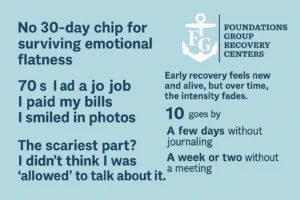
There’s no milestone for that. No 30-day chip for surviving emotional flatness. No gold star for pretending everything is fine while you quietly feel… disconnected.
I was years into sobriety. I’d done the work—detox, therapy, meetings. I had a job I didn’t hate. I paid my bills on time. I smiled in photos.
From the outside, I looked like someone who’d “made it.”
But inside, I felt like someone slowly fading.
It wasn’t about cravings. I wasn’t in danger of picking up a drink. I was in danger of forgetting why I got sober in the first place.
And that’s when I realized: I needed my alcohol addiction treatment community again—even after all this time.
The Flatness No One Warns You About
Early recovery is full of fireworks—sleepless nights, raw tears, unexpected joy. Everything feels new, and in a way, you feel alive for the first time in years.
But then time passes.
And slowly, the intensity fades. The emergency ends. You stop crying in grocery stores. You go a few days without journaling. Maybe a week without a meeting. Then two.
Not because you’re “slipping.” But because life gets full—and oddly, kind of quiet.
That’s what happened to me. I wasn’t spiraling. I was just… flat.
I didn’t feel much of anything. Not sadness, not joy. Just a low, persistent emotional static I couldn’t tune out or explain.
And the scariest part? I didn’t think I was “allowed” to talk about it.
I Wasn’t Drinking—So I Thought I Was Fine
This is where long-term recovery gets tricky.
When you’re newly sober, every struggle feels valid. The chaos is still close, and people expect you to wobble. There’s room to say, “This is hard.”
But years later? You’re supposed to have answers. You’re the one people come to for support. You’re the “strong one.” The “mentor.” The person with time under your belt.
And that pressure can be isolating.
For me, it started small: I skipped one alumni check-in because I was “too tired.” Then I stopped reaching out to sober friends. I told myself I was busy. That I didn’t need to talk as much anymore.
But the truth was: I didn’t know how to admit I was stuck. So I stayed quiet. For months.
The Moment That Broke the Silence
It wasn’t dramatic.
I was folding laundry, staring out the window, and I thought: Is this it?
Not in a despairing way. Just a hollow, honest one.
That voice—the one that helped me get sober in the first place—whispered again: You don’t have to feel this empty. You can ask for more.
That’s when I reached back out to Foundations Group Recovery Center in Mashpee, MA, where I first started my alcohol addiction treatment journey.
I didn’t have a script. I didn’t have a crisis. I just said,
“I’m doing okay, but I don’t feel connected anymore.”
And they said: “We hear that more than you think.”
Why I Came Back—and What I Found
There’s this myth in recovery that returning to treatment means failure. That if you revisit a group or call a therapist again, you’ve messed up.
That’s a lie.
What I found at Foundations wasn’t judgment. It was warmth. Familiar faces. New tools. Open arms.
They didn’t ask for a list of reasons. They didn’t say, “But you’re doing fine.” They just said,
“We’re still here. Let’s talk about what you need.”
I didn’t need detox or a major reset. What I needed was:
- A space to say things out loud again
- A group that didn’t expect me to have all the answers
- A reminder that sobriety doesn’t mean emotional perfection
That’s what Foundations gave me.
Coming Back Doesn’t Erase How Far You’ve Come
Let me say this clearly: You don’t lose your sobriety time for saying “I need help.”
You don’t go backward for circling back.
Recovery isn’t a straight road—it’s a landscape. Some seasons are bright. Others are dry and barren. And sometimes the most courageous thing you can do is admit you’re thirsty again.
For connection. For purpose. For something more than survival.
And if you’re near Falmouth, MA or anywhere in Barnstable County, Foundations isn’t just a place you once went. It’s still your community. Even now.
What I Did the Second Time Around
This time, I wasn’t in crisis. I was in curiosity.
So I asked for a few things:
- One-on-one check-ins with a therapist who got long-term sobriety
- A smaller, low-pressure alumni group
- Resources on emotional reconnection—not just relapse prevention
No one tried to oversell me on a program. No one pushed.
They just offered tools. Reflections. Spaces where I could breathe again.
And slowly, the flatness started to shift. Not overnight. But gently. Like color returning to a black-and-white photo.
You Don’t Have to “Earn” Your Way Back
I want to be clear: you don’t have to be struggling “enough” to reach out.
You don’t need to relapse. Or cry. Or spiral.
You just need to feel that quiet tug that says, “Something’s missing.”
That’s reason enough to return.
Because this community? It’s not just here to catch you when you fall. It’s here to walk beside you when you feel stuck in place.
And that includes you. Even now.
FAQs for Long-Term Alumni Who Feel Flat, Disconnected, or Quietly Lost
What if I haven’t relapsed—do I still need help?
Yes. Emotional disconnection, numbness, or spiritual flatness are valid reasons to reach out. Support isn’t just for early sobriety or crisis moments.
Will I be judged for returning after years?
Not at Foundations. Many alumni return for deeper work, new stages of growth, or simply to reconnect. There’s no shame in coming back.
I don’t want to go through full treatment again. Are there lighter options?
Absolutely. Alumni often reengage through refresh therapy, low-commitment group options, or even just periodic check-ins. It’s not all-or-nothing.
I’m doing fine on the outside—but I feel hollow. Is that normal?
Very. Many people in long-term sobriety experience periods of emotional flatness. You’re not failing—you’re just ready for a new layer of healing.
I don’t live near Mashpee—can I still access support?
Yes. Foundations offers support to alumni across the region. If you’re looking for alcohol addiction treatment in Falmouth MA or Barnstable County MA, they’ve got you covered.
Feel like something’s missing—without knowing what it is?
Call (844)763-4966 or visit our alcohol addiction treatment page to reconnect. You’re still welcome here. Not because you messed up—because you matter.