When your child starts using again—especially after treatment or a period of stability—it can feel like the floor has dropped out from under you.
You remember the warning signs. The silence. The missed calls. The defensiveness. And now, you’re watching it all unfold again, only this time you’re even more exhausted—and more afraid of getting it wrong.
You don’t want to overreact. But you also can’t ignore what’s happening.
Many parents in your shoes ask the same quiet question: “Is there something in between doing nothing and sending them away?”
There is. It’s called a partial hospitalization program (PHP)—and it might be exactly the middle ground your family needs.
At Foundations Group Recovery Centers in Mashpee, MA, we help families bridge this gap every day. This blog will explain what PHP really is, who it helps, and how to tell if it’s the right step for your child—and for you.
What Is a Partial Hospitalization Program (PHP)?
A partial hospitalization program is a structured, high-touch treatment model that offers daily care while allowing participants to return home in the evenings.
It’s often described as the most supportive level of care outside of full-time inpatient treatment. PHP is designed for people who need more than outpatient therapy—but who don’t require overnight supervision or detox.
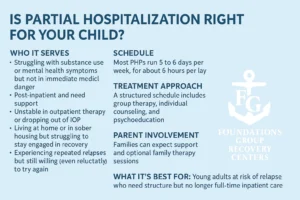
Most PHPs run five to six days per week, for about six hours per day. It’s a full therapeutic schedule, but without the total separation that inpatient rehab requires.
Who Is PHP Designed For?
PHP works well for young adults who are:
- Struggling with substance use or mental health symptoms but not in immediate medical danger
- Post-inpatient and need continued support to prevent relapse
- Unstable in outpatient therapy or dropping out of IOP
- Living at home or in sober housing but struggling to stay engaged in recovery
- Experiencing repeated relapses but still willing (even reluctantly) to try again
If your 20-year-old recently relapsed and seems to be sliding again—but you’re not sure if full-time residential is appropriate or affordable—PHP might be that critical “in-between” you didn’t know existed.
And if you’re looking for a partial hospitalization program in Barnstable County, MA, Foundations Group Recovery Centers offers PHP services designed to meet your child with compassion and clinical excellence.
What Happens During a Typical Day in PHP?
Each day of PHP includes a structured schedule of therapeutic services and clinical support. At Foundations, that often includes:
- Group therapy, focusing on relapse prevention, communication, emotional regulation, and peer support
- Individual counseling, for deeper emotional processing, trauma work, or motivation-building
- Skill-building workshops, often drawing from evidence-based practices like DBT or CBT
- Psychoeducation, where your child will learn about addiction, brain health, boundaries, and recovery tools
- Case management, including goal-setting, family updates (with consent), and coordination with other providers
This isn’t babysitting—and it’s not punishment. PHP is a space where your child can begin to reconnect with themselves, their community, and their capacity to choose differently.
How Involved Will I Be as a Parent?
You will be included—but not burdened.
At Foundations, we support parents in a way that respects your role while relieving some of the weight you’ve likely been carrying alone. That often includes:
- Optional family therapy sessions, held remotely or onsite
- Parent education and support on boundaries, communication, and what to expect during early recovery
- Regular clinical updates, when appropriate and agreed upon
- Collaborative care planning, especially during discharge or transition
We know many of you are tired of being the case manager, the therapist, and the emotional shock absorber. PHP lets you take a step back without stepping away completely.
How Is PHP Different from Inpatient or IOP?
Let’s look at it in simple terms:
| Treatment Level | Time Commitment | Where They Sleep | Best For |
|---|---|---|---|
| Inpatient (Residential) | 24/7 care | At the facility | Crisis care, detox, or high safety risk |
| PHP | 6 hours/day, 5–6 days/week | At home or sober living | Relapse risk, post-inpatient, need for structure |
| IOP (Intensive Outpatient) | 3–4 hours/day, 3–4 days/week | At home | Step-down from PHP, stable but still at-risk |
| Outpatient Therapy | 1–2 hours/week | At home | Maintenance, early-stage intervention |
PHP is often the answer for families who feel like they’re out of options—but want to avoid overreaching or under-responding.
What If My Child Refuses PHP?
It’s okay to say this out loud: “I’m afraid they won’t go.”
You’re not alone. Many young adults are reluctant about treatment—especially if they’ve been before. Maybe they feel like it didn’t help. Maybe they’re ashamed. Maybe they’re afraid of failing again.
That’s why our admissions and clinical team approaches these conversations with gentleness and clarity. We don’t coerce. We don’t scare. We simply meet them where they are, with honesty and dignity.
And often, once the pressure is off, and they learn that PHP isn’t about being locked away—but about being supported daily—they’re more open than you’d think.
What If I’m Burned Out From Trying?
You are not a bad parent for feeling tired. Or discouraged. Or done.
Watching your child struggle again and again takes a toll on your nervous system, your relationships, your finances, and your heart.
PHP doesn’t just support your child—it supports your ability to breathe again. To sleep a little easier. To feel like you’re not the only one holding the pieces.
And when you’re looking for a partial hospitalization program in Falmouth, MA, our location offers local access with flexible scheduling that works with your life—not just your fear.
Frequently Asked Questions About PHP for Young Adults
Do they have to want it for it to work?
Willingness helps—but it often comes after the structure begins. Many young adults start PHP unsure or even resistant. Change happens through consistency and connection—not perfection on day one.
What if they have a co-occurring diagnosis like depression or anxiety?
Perfect. PHP is ideal for treating co-occurring disorders. Our program is designed to support both substance use and mental health symptoms simultaneously.
Can they work or go to school during PHP?
Possibly—but many take a pause. PHP is a full-time commitment for the short-term, usually 2–4 weeks. After that, we reassess and plan for balance between life and ongoing care.
What if they relapse during PHP?
Relapse is not a failure—it’s a signal. Our team will adjust the treatment plan, explore what led to the relapse, and determine whether a higher level of care is needed.
Will this be different than what we tried before?
If PHP is new for your family, yes. It offers daily immersion and therapeutic repetition—two things traditional outpatient can’t always provide. Even if your child has “tried before,” a structured PHP may provide the grounding they didn’t get elsewhere.
Let’s Take This One Step at a Time
If you’re wondering whether a partial hospitalization program could help your child—and give you room to breathe—we’re here. Call (844)763-4966 to learn more about PHP services in Mashpee, MA.
You don’t have to decide everything today. But you don’t have to carry this alone, either.