
I thought once I finished opiate addiction treatment, I’d feel free.
I thought recovery would be this clean, triumphant arc—treatment, early sobriety, emotional breakthroughs, and then… peace. Stability. Gratitude. Maybe even joy.
But no one told me what it might feel like a year or two later. When the drama stops. When you’ve done everything “right.” And yet, inside, something still doesn’t feel right.
If you’re years into recovery and still feel disconnected, flat, or low-grade lost—you’re not failing. You’re not broken. You’re just in that strange middle space nobody warned us about.
Here’s what to know about opiate addiction treatment if you’ve hit that quiet wall and don’t know what comes next.
The Early Days Were Hard—but at Least They Were Loud
Those first six months out of treatment were full-on.
Triggers, cravings, emotional whiplash. I cried in the car. I made amends. I lost people. I found people. I started to feel things I hadn’t touched in years. It was raw, chaotic, and electric.
And then it wasn’t.
Life stabilized. The calls slowed down. I got into a rhythm. And that rhythm—at first—felt like relief. But over time, it felt like something else: numb.
Like the dial had been turned down too far. Like the silence was no longer peaceful, but hollow.
The Flatline Phase No One Talks About
You’re not using. You’re doing everything “sober people” are supposed to do. But inside? It feels like you’re going through the motions.
You don’t want to go backward. But you don’t feel like you’re moving forward either. You check in with your people, and they say, “That’s normal. Stay the course.”
But part of you is screaming: Is this really it?
This is what I call the “flatline phase.” And it’s dangerous—not because it means you’ll relapse tomorrow. But because it breeds disconnection. Quiet erosion. Emotional drift. And sometimes, that’s what takes people out years later.
I Mistook Maintenance for Growth
After treatment, I got good at maintaining. I kept routines. I made my bed. I hit my numbers. I followed structure like gospel.
But I wasn’t really growing—I was functioning.
There’s a difference between not crashing and truly living. And I had to learn that the hard way.
Because staying clean was no longer the hard part. The hard part was staying awake to a life that no longer had the urgency of early recovery. No fire. Just… quiet. Days that looked full but felt empty.
And that’s when I knew: I needed more than survival.
You Can Come Back Without Starting Over
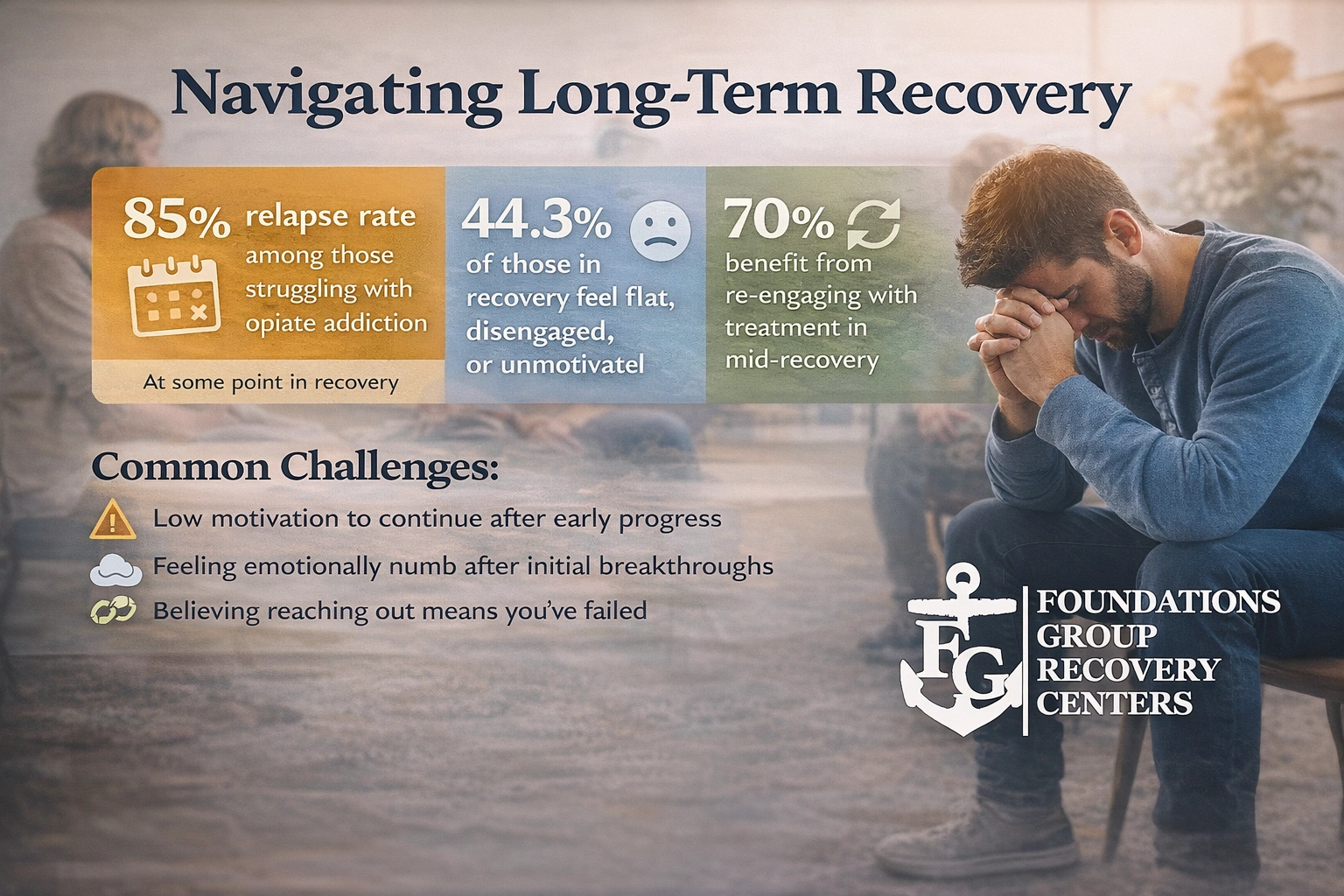
For a long time, I thought going back to treatment or reconnecting with a program would mean I had failed.
But when I finally did go back—just to talk, just to reconnect—it felt like oxygen.
I wasn’t there to start over. I was there to go deeper.
The therapists didn’t treat me like a newbie. The group didn’t look at me like I didn’t belong. In fact, they got it. They’d been there. Some still were.
That was the first time in a long while I didn’t feel like I had to pretend everything was okay.
It reminded me that the door to support doesn’t close when you “graduate.” It just waits for you to knock again—on your own terms.
I drove down from Falmouth, Massachusetts one rainy Thursday just to sit in a room where I could breathe again. Where no one expected me to smile unless I meant it.
That drive was the first thing I’d done for me in a while.
Recovery Isn’t Linear—It’s Layered
I used to think recovery was a staircase: up and up and up. But really, it’s more like orbiting the same truths from new levels.
You come back to grief. But you understand it better.
You revisit shame. But you hold it more gently.
You touch joy. But you no longer chase it like a drug.
When I let go of the idea that I had to always be getting “better,” I made space for something deeper: being real.
I stopped measuring progress in milestones. I started measuring it in moments:
- When I told the truth instead of saying “I’m fine”
- When I reached out before I was drowning
- When I let myself want more—even if I didn’t know what yet
It’s Okay to Feel Bored in Sobriety—It Doesn’t Mean You’re Broken
No one tells you this, but I will: feeling bored in sobriety is normal. Especially when you’ve spent years living in chaos or intensity.
Your brain is still rewiring. Your nervous system is still adjusting. And your soul? Your soul is probably tired.
It’s okay to crave meaning. To want color back. To feel like the meetings and routines that once saved you now leave you flat.
You’re not outgrowing recovery—you’re evolving inside it.
That’s what brought me back to Foundations. I wasn’t in crisis. I just didn’t want to sleepwalk through my “okay” life anymore.
You’re Allowed to Want More
You don’t have to wait until you’re using again to seek support.
You don’t have to justify your pain with a relapse.
You’re allowed to want more than sobriety. You’re allowed to want depth, connection, creativity, intimacy, meaning.
And you’re allowed to go after it—without shame.
That’s what Foundations helped me rediscover. Not just how to stay sober—but how to want to stay.
FAQs: Post-Treatment, Long-Term Recovery, and Emotional Drift
Is it normal to feel flat or disconnected even after years clean?
Yes. Many people experience emotional numbness or lack of direction after the intensity of early recovery fades. It doesn’t mean you’re doing anything wrong—it often means you’re ready for deeper work.
What should I do if I’m not relapsing, but I’m not okay either?
Reach out. Mid-recovery support is real and valid. You don’t need to be in crisis to need a reset. Whether it’s therapy, groups, alumni check-ins, or new goals, Foundations can help you re-engage.
I feel guilty for needing help again—shouldn’t I be past this?
There’s no “past this.” Recovery evolves. Feeling the need for new tools or support doesn’t mean you’ve failed—it means you’re self-aware. That’s strength, not weakness.
Do I have to start over if I go back to treatment?
Not at all. Many alumni return to work on new layers of themselves—not to repeat what they’ve already done, but to grow into who they’re becoming.
How do I explain to people that I’m struggling even though I’m still sober?
You don’t owe anyone an explanation. But if you choose to share, try this: “I’ve been clean for a while, but lately I feel like something’s missing—and I’m getting support to figure it out.” That’s honest, powerful, and human.
Craving more from your recovery than maintenance?
Call (844)763-4966 to learn more about our opiate addiction treatment services in Mashpee, Massachusetts.