
You’ve done everything.
You’ve begged. Set boundaries. Paid for therapy. Watched them overdose. Watched them promise. Watched them lie. Prayed they’d be the one who turned it around.
And still… they’re using.
If you’re a parent of a young adult struggling with opiate addiction, this is the place you didn’t think you’d land. Still parenting at full throttle, but with none of the control. Still hoping, but bracing. Still loving them, even when their choices are destroying them—and you.
As a clinician, I want to speak to you from that reality—not above it. Because at Foundations Group Recovery Centers, we’ve worked with families just like yours. Parents who thought they were out of options. Parents who thought they had nothing left to give.
What opiate addiction treatment offers in this moment isn’t magic. But it is something powerful that love and consequences alone can’t create: space, safety, clarity, and the chance—maybe the first real one—for your child to return to themselves.
Treatment Does What Parenting Can’t: Create Clinical Containment
Opiate use disorder is not just emotional struggle. It’s a medical condition, a brain-altering, life-threatening cycle that requires structured intervention—not just emotional appeals or discipline.
You can’t love someone out of it. You can’t consequence them out of it. And at a certain point, trying to parent someone through an active addiction becomes not just ineffective—but dangerous for your wellbeing.
Professional opiate addiction treatment creates containment:
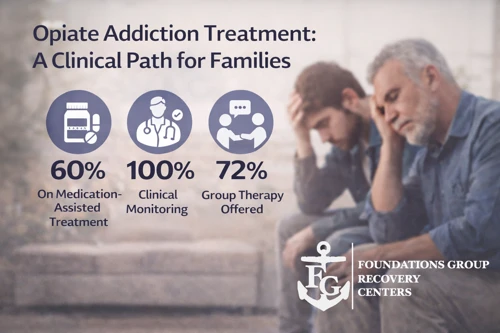
- Clinical monitoring and accountability
- Medication-assisted treatment when indicated (like Suboxone)
- Consistent staff trained in addiction dynamics
- Objective boundaries that don’t shift with emotion
Containment gives your child a chance to regulate from the outside-in—because when the brain is hijacked by opiates, internal regulation isn’t enough.
Treatment Breaks the Emotional Tug-of-War
You’re not just tired. You’re likely in a trauma response—fighting for their life while watching them ignore every lifeline.
In family systems impacted by opiate use, the dynamic often turns into emotional chess:
- They manipulate.
- You threaten.
- They promise.
- You hope.
- They use.
- You fall apart.
Treatment interrupts that cycle. It removes you from the role of enforcer, rescuer, and emotional punching bag—and puts care into the hands of a team that’s trained to hold hard lines without destroying relationships.
That doesn’t just help your child. It starts to free you from the emotional warfare you’ve been forced to survive.
Treatment Says the Same Hard Truths—But They Might Finally Hear Them
You’ve said all the right things.
“You’re killing yourself.”
“We can’t help you if you won’t help yourself.”
“I love you too much to watch this continue.”
But for someone deep in addiction, the source of the message can determine whether it lands.
When those same truths are mirrored by a clinician—especially in group therapy, where peers challenge each other with brutal honesty—it’s harder to write off. Not impossible. But harder.
They might ignore you. But they’ll often listen to someone who’s been there. Or someone who doesn’t flinch when they deflect. Or someone who can say, “I hear you, and you still need to be here.”
Treatment gives them those voices. And it gives you space to stop pleading.
Treatment Builds What Crisis Can’t: Recovery Capital
“Why didn’t the overdose change them?”
“Why wasn’t our love enough?”
“Why didn’t rock bottom do it?”
Because trauma, love, and crisis don’t build capacity—they burn it.
Opiate addiction treatment focuses on rebuilding recovery capital—the internal and external resources that make sustainable recovery possible. This includes:
- Self-worth beyond being “the screwup”
- Coping skills that don’t include numbing
- Community where they’re challenged and supported
- Healthy structure: meals, sleep, therapy, medication
- A future to look toward, not just a past to regret
Recovery requires more than motivation. It requires momentum. Treatment helps create that.
We’ve Seen the “Hopeless Ones” Heal
This isn’t theory. It’s real. And we see it every year.
We’ve had clients whose parents were told “they’ll never change.” Clients who left AMA twice. Clients who nodded off in their intake appointment.
We’ve also seen those same people get clean. Rebuild trust. Repair relationships. Cry in group. Graduate from IOP. Help someone else walk in the door.
Because people do recover. Even when they’re defensive, manipulative, dishonest, and angry. Even when they don’t want it—yet.
All it takes is a door that stays open long enough for readiness to meet opportunity.
Treatment is that door.
Healing Starts with the Family, Too
You’ve probably heard “you didn’t cause it, you can’t control it, you can’t cure it.” But what we often forget is: you still carry it—in your body, your breath, your inbox, your bank account, your dreams.
That weight isn’t yours to bear alone.
At Foundations, we include parents and loved ones as part of the treatment process. That includes:
- Family therapy with skilled facilitators
- Education about opiate addiction and recovery stages
- Coaching on boundaries and relapse prevention
- Emotional processing for the fear, grief, and guilt you carry
Your child is in treatment—but so are you, in a different way. And you deserve to be held, too.
What If It Doesn’t Work?
Let’s be honest: it might not work the first time. Or fully. Or in the timeline you’re hoping for.
But here’s what we’ve seen:
- Someone who drops out of treatment still remembers the support they were shown—and many come back.
- A failed attempt today often softens the path to a future success.
- Every exposure to recovery culture plants a seed, even if you don’t see it take root yet.
And for some—treatment does work the first time. Because it was finally the right setting, the right moment, or the right level of honesty.
No one can promise your child will recover. But we can promise that recovery is possible. And that your continued willingness to hope—combined with real support—matters.
FAQ: What Parents Ask About Opiate Addiction Treatment
What if they’ve already been to rehab and relapsed?
Relapse doesn’t mean treatment failed. It means the person needs more support, a different level of care, or a new approach. Multiple treatment episodes are common—and recovery can still be successful.
What’s different about outpatient treatment like IOP?
Intensive outpatient programs (IOP) offer structured care while letting the person stay in their home environment. It’s often a great step between residential rehab and real-world life, or as a first step if 24/7 care isn’t possible.
Is medication-assisted treatment (MAT) part of your approach?
Yes. For opiate addiction, MAT can be life-saving. When clinically appropriate, we offer or coordinate access to medications like Suboxone or Vivitrol, paired with counseling and accountability.
What if they’re refusing help?
We work with families to prepare for moments of resistance. Sometimes treatment starts with a crisis. Sometimes it begins after an honest conversation, a boundary, or a soft landing. We can help you navigate that—without pushing them away.
What if I don’t live nearby?
We can still support you. Family therapy can happen virtually, and we’re always in communication about your child’s progress—with their consent and within legal boundaries. You’re not excluded from the process.
What’s the first step I should take?
Call. Even if your child isn’t ready. Even if they’re using right now. Even if you’re unsure. Our team can talk through your options and help you plan a next step that makes sense for your family.
You’re Still Showing Up—That Means Everything
If you’ve made it this far in the blog, here’s what I want to say as a clinician and as a human:
You love your child. You’re scared. You’re allowed to be tired.
And you’re not alone.
We know that love, logic, and loss aren’t always enough to stop opiate addiction. But we also know what professional treatment can do—when families are willing to take the next step, even through fear.
Opiate addiction treatment in Falmouth, Massachusetts isn’t the end of the journey. But it’s the first place your child can begin healing with real support.
And it’s the place where you can begin healing, too.
Call (844)763-4966 to learn more about our opiate addiction treatment services in Massachusetts. Hope doesn’t have to be naïve—it can be informed, resourced, and supported. We’ll walk with you.