

You don’t need to hit a breaking point to start wondering.
Sometimes it’s quieter than that.
A thought that lingers longer than it used to.
A feeling you can’t quite ignore anymore.
“Is this still working for me?”
If you’ve been asking that—even casually—you’re already in a meaningful place. Not stuck. Not behind. Just… aware.
And awareness is where change begins.
Start Where You Are—Not Where You Think You “Should” Be
A lot of people delay exploring support because they think they don’t qualify.
They compare themselves:
- “I still go to work.”
- “I don’t drink every day.”
- “I’ve never had serious consequences.”
So they tell themselves, “This isn’t for me.”
But support isn’t reserved for extremes.
It’s for anyone who notices something feels off—and wants to understand it better.
You don’t need a label to be allowed to look closer.
Let Curiosity Be Enough for Now
You don’t need to decide what your relationship with alcohol means.
You don’t need to define it.
Instead, try approaching this like an experiment:
- What do I notice about how I feel after drinking?
- What do I notice on days I don’t?
- What am I actually getting from this—and what is it costing me?
Curiosity removes pressure.
And without pressure, you’re more likely to be honest.
Pay Attention to the Quiet Signals
Not everything shows up as a crisis.
Sometimes it’s subtle:
- You think about drinking more than you used to
- You plan your day around when you can have it
- You feel slightly off more often than you feel fully okay
These aren’t accusations.
They’re signals.
And ignoring them doesn’t make them disappear—it just delays the moment you understand them.
You Can Explore Support Without Committing to Anything
This is one of the biggest misunderstandings.
People think that looking into help means signing up for something permanent.
It doesn’t.
You can:
- Ask questions anonymously
- Learn about different levels of care
- Talk to someone without making any decisions
Exploration is just that—exploration.
You’re allowed to gather information without pressure to act on it immediately.
Try a Break—But Pay Attention While You Do
If the idea of stopping completely feels overwhelming, don’t start there.
Start smaller.
Take a break—not as a rule, but as an observation.
And while you do, notice:
- How your body feels in the morning
- How your mood shifts throughout the day
- Whether your mind feels clearer or louder
This isn’t about proving anything.
It’s about learning something.
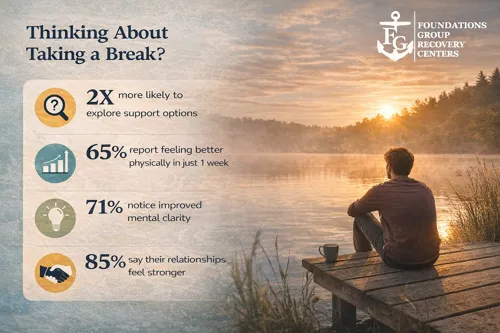
Notice What You Gain—Not Just What You Miss
Most people focus on what they’re losing.
The habit. The routine. The social comfort.
But there’s another side that often gets overlooked.
You might start to notice:
- More consistent energy
- Less emotional fluctuation
- A different kind of confidence—quieter, but steadier
At first, these changes can feel unfamiliar.
But unfamiliar doesn’t mean worse.
It often means new.
Talk to Someone Who Doesn’t Need You to Fit a Category
You don’t need someone to diagnose you.
You need someone who can sit with you in the uncertainty.
Someone who can:
- Listen without labeling
- Reflect what you’re experiencing
- Help you understand your options without pushing you
That kind of conversation can be more clarifying than any checklist.
If you’ve already found yourself looking into support for alcohol recovery in Massachusetts, that curiosity is worth following—not dismissing.
You Don’t Have to Wait Until Things Get Worse
There’s a belief that you need to “earn” the right to change.
That things have to get bad enough first.
But change doesn’t require proof of suffering.
It just requires awareness.
You’re allowed to choose something different simply because you want to feel better.
That’s reason enough.
What This Can Look Like in Real Life
Someone recently shared how this started for them while spending time near Falmouth, Massachusetts.
There wasn’t a dramatic moment.
Just a quiet realization:
They weren’t enjoying drinking the way they used to.
Nothing terrible had happened.
No major consequences.
Just a growing sense that something didn’t feel aligned anymore.
That was enough.
Not to commit to anything permanent—but to start asking better questions.
And those questions led somewhere meaningful.
You’re Allowed to Be “In Between”
You don’t have to be fully decided.
You don’t have to identify one way or another.
You can be:
- Curious, but unsure
- Open, but cautious
- Interested, but not ready
That space isn’t a problem.
It’s a starting point.
FAQs: Exploring Change Without Labels
Do I have to call myself an alcoholic to get support?
No. Labels are not required. You can explore your relationship with alcohol and seek guidance without defining yourself that way.
What if I’m not ready to quit completely?
That’s completely okay. Many people begin by exploring, learning, or making small adjustments before deciding what they want long-term.
Is it normal to feel unsure about this?
Yes. Uncertainty is one of the most common starting points. You don’t need full clarity to begin exploring.
What if I try something and change my mind?
That’s part of the process. Exploration is about understanding what works for you—not locking yourself into a decision.
Will someone pressure me into committing?
The right support won’t. It will give you space to decide at your own pace.
How do I know if I should look into help?
If you’re asking the question, it’s worth exploring. You don’t need a specific threshold to be met.
If This Is Where You Are Right Now
Not fully comfortable.
Not fully concerned.
Just aware enough to question things.
That matters more than you think.
Because most people don’t change when everything falls apart.
They change when something inside them starts paying attention.
And that might be exactly where you are.
If you want to explore what your options could look like—without pressure or commitment—you can take that step at your own pace.
Call (844)763-4966 or visit our page to learn more about our Alcohol Addiction Treatment in Mashpee, Massachusetts.