
There was no meltdown. No rock bottom. No intervention with crying family members and empty liquor bottles strewn across the floor.
There was just me, my laptop, a calendar full of meetings, and a drinking pattern that I could no longer outpace.
By every external metric, I was “fine.” Still showing up. Still leading. Still “high-functioning.”
But functioning isn’t thriving. And surviving isn’t living.
When I first typed intensive outpatient program into a search bar, I felt like an imposter. Like I didn’t deserve help because I hadn’t “lost everything.” But what I had lost—quietly—was myself.
This is what I found when I said yes to getting support.
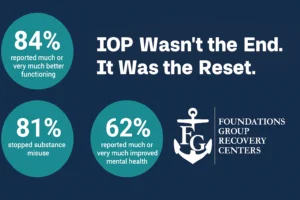
IOP Wasn’t the End. It Was the Reset.
I thought IOP would be a sign of defeat.
Instead, it became my return to reality. A place where I wasn’t managing optics or performance. A place where I didn’t need to be witty, successful, or “on.” I just needed to be honest.
At Foundations Group Recovery Centers in Mashpee, MA, I didn’t walk into a lecture hall. I walked into a space that said, “You don’t need to crash to course-correct.”
I didn’t need rehab. But I definitely wasn’t okay. And IOP was that in-between ground that let me take action without setting my life on fire.
My Life Was “Fine”—But My Brain Was on Fire
Here’s what no one tells you about high-functioning addiction or burnout:
You can hold a job, raise kids, run meetings, and still wake up every day feeling like you’re drowning.
I wasn’t blacking out. I wasn’t lying to my family. I wasn’t getting calls from HR. But I was numbing every emotion with two (okay, sometimes four) glasses of wine. I was white-knuckling through mornings and crashing hard every night.
And the worst part? I didn’t even recognize how loud the anxiety had gotten until I had a few sober weeks under my belt in IOP.
That was the gut punch. Not withdrawal—awareness.
Routine Became a Lifeline
IOP gave me something I didn’t know I was craving: predictability with purpose.
Three days a week, I showed up. And not just physically. I showed up emotionally—for myself. At first, it was uncomfortable. Like stretching a muscle you didn’t know had atrophied.
But over time, it started to anchor me.
There was structure—but not rigidity. Support—but not hand-holding. Accountability—but not shame.
If you’re looking for an intensive outpatient program in Barnstable County, MA, this isn’t just about logistics. It’s about finding rhythm in a life that’s secretly been running on fumes.
Group Therapy: Where the Masks Came Off
I was terrified of group work. I imagined strangers trauma-dumping while I silently judged their life choices.
Instead, I found mirrors.
People who also functioned. Who also knew how to keep things polished on the outside and unraveling on the inside. Professionals, parents, creatives, caretakers.
It wasn’t pity. It was resonance.
We weren’t performing recovery. We were living it—awkwardly, messily, and with a level of honesty I hadn’t felt in years.
IOP group wasn’t about dramatic breakthroughs. It was about micro-truths—little moments where someone else’s story clicked into mine and said, You’re not the only one doing this dance.
The Hardest Part? Stopping the Rationalizations
I had excuses for everything.
- “It’s just how I unwind.”
- “Everyone in my industry drinks.”
- “It’s not like I’ve ever gotten in trouble.”
- “I can stop if I really wanted to—I just haven’t tried yet.”
IOP was the first place that challenged my intellectual gymnastics. Not with force. With facts. With questions. With pauses long enough to let the truth bubble up.
I remember one facilitator asking:
“What are you actually afraid would happen if you stopped drinking?”
The silence that followed was louder than any shout. Because for me, the real answer was: I’m afraid I won’t like who I am without it.
That’s when I knew I needed help—not because I was broken, but because I’d been using alcohol as personality armor.
IOP Didn’t Fix Me. It Reminded Me I’m Not Broken.
Let me be clear: this isn’t a fairy tale.
I still have hard days. I still feel triggered by stress, by social pressure, by loneliness. But IOP gave me tools I actually use. Not just slogans or affirmations—but real tools for real moments.
- How to ride out a craving
- How to set a boundary and not implode
- How to recognize the difference between tired and triggered
- How to ask for help without feeling weak
That’s what you’ll get if you’re looking for an intensive outpatient program in Falmouth, MA: not magic, not miracles—just real support for real life.
FAQs I Asked Before Signing Up for IOP
Will I have to stop working?
No. That’s the point. I kept working full-time. We arranged my IOP hours around my job, and Foundations offered the flexibility I needed to stay employed and engaged.
Is this for “serious” addiction only?
Nope. IOP meets you where you are. I didn’t consider myself addicted—but I was definitely relying on substances more than I wanted to admit.
What if I relapse during the program?
Then you talk about it. You learn from it. You keep going. No one kicked me out. No one shamed me. They just helped me rebuild.
How long does it last?
Most people stay for 6–12 weeks. I stayed for 8. Long enough to feel a shift, not so long that it disrupted my life.
Do people in IOP actually get better?
I can’t speak for everyone. But I left feeling stronger, clearer, and way more grounded than I had in years.
You Don’t Have to Crash to Course-Correct
I’ll say it one more time for the people in the back (or hiding in plain sight):
You don’t have to lose everything to admit something’s not right.
If your version of “not okay” is quietly numbing, quietly isolating, quietly panicking when the alcohol wears off—don’t wait for the loud version.
IOP gave me a soft landing and a strong push. It gave me back my mornings, my focus, my integrity. It gave me a version of myself I actually want to live with.
And if that sounds like something you’re craving too? Then maybe this is your sign.
No Rock Bottom Required. Just Honesty.
Call (844)763-4966 to learn more about our intensive outpatient program services in Mashpee, MA. You don’t need a crisis. You just need clarity—and we’re here for that.