
You didn’t sign up for this version of parenting.
Not the sleepless nights replaying conversations.
Not the second-guessing every decision.
Not the quiet fear that somehow, despite everything you’ve done, it’s not enough.
And maybe the hardest thought of all:
“What if I’m part of the reason this isn’t getting better?”
If that thought has crossed your mind, even once—you’re not alone. And more importantly, it doesn’t mean you’ve failed.
It means you care deeply enough to ask the hard questions.
The Instinct to Protect Doesn’t Turn Off—Even When It Should Shift
When your child is hurting, your brain doesn’t slow down and analyze.
It moves fast.
You step in.
You soften the fall.
You try to absorb the impact before it reaches them.
That instinct is wired into you.
But as your child grows—especially into adulthood—the way that instinct shows up sometimes needs to change.
And that’s where things get complicated.
Because the same love that once protected them… can unintentionally keep them stuck.
How Helping Quietly Turns Into Carrying Everything
It rarely starts in an obvious way.
It looks small at first:
- Covering for missed responsibilities
- Sending money because “they’re struggling right now”
- Making excuses to keep things from escalating
Each decision makes sense in the moment.
Each one feels like the right thing to do.
But over time, those moments start to stack.
And suddenly, you’re not just supporting your child—you’re managing their life alongside them.
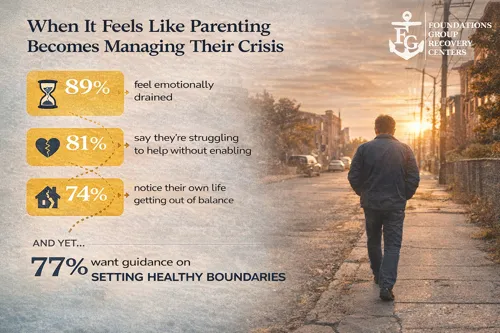
That’s when exhaustion sets in.
Not just physical exhaustion. Emotional exhaustion.
Because no matter how much you do… it doesn’t seem to create lasting change.
The Line Between Helping and Hurting Is Subtle—but Real
There’s no clear line drawn in the sand.
No moment where someone tells you, “This is where it shifts.”
Instead, it’s something you start to feel.
Helping tends to:
- Encourage responsibility
- Support growth
- Allow your child to experience outcomes
Hurting—though it never feels like that—can:
- Remove consequences that would otherwise prompt change
- Take ownership of problems that aren’t yours to solve
- Keep your child from fully seeing the impact of their actions
And here’s what makes this so difficult:
Both come from love.
That’s why it’s so easy to miss.
You’re Not Supposed to Fix This Alone
Many parents fall into a quiet belief:
“If I just do more, love more, try harder… this will get better.”
But this isn’t something you can solve through effort alone.
Because this isn’t just about behavior.
It’s about patterns.
Relationships.
Cycles that have developed over time.
And those cycles don’t change because one person works harder.
They change when the system shifts.
Boundaries Feel Like You’re Letting Go—But You’re Not
This is often the hardest step.
Because setting boundaries can feel like:
- You’re abandoning your child
- You’re withdrawing support
- You’re being too harsh
But in reality, boundaries are not about distance.
They’re about clarity.
Clarity sounds like:
- “I love you, but I can’t support this behavior.”
- “I’m here for you, but I won’t fix this for you.”
- “I care about you enough to be honest with you.”
And while that might feel uncomfortable—especially at first—it creates something your child may not have right now:
Consistency.
Why Consistency Matters More Than Control
When things feel out of control, the natural response is to try to regain it.
To manage every outcome.
To prevent every mistake.
To stay one step ahead of the next problem.
But control doesn’t create change.
Consistency does.
When your responses become predictable—not reactive, not emotional, but steady—something shifts.
Your child starts to understand:
- What to expect
- Where the boundaries are
- What they are responsible for
That clarity can feel unfamiliar at first.
But it’s often what creates the space for change to begin.
A Moment That Many Parents Recognize
One parent once shared something that stayed with me.
They described standing outside their home, feeling completely overwhelmed, after yet another situation they had tried to “fix.”
They lived near Barnstable County, Massachusetts, and in that moment, everything felt heavy.
Not just the situation—but the weight of trying to hold everything together.
And they said something simple:
“I realized I wasn’t helping anymore. I was just preventing things from falling apart—and they were still falling apart.”
That realization wasn’t the end of the story.
It was the beginning of a different approach.
What Happens When Parents Shift
When parents begin to:
- Set clear boundaries
- Step back from rescuing
- Stay emotionally present without taking control
It can feel like everything gets worse before it gets better.
Your child may:
- Push back
- Get angry
- Test those boundaries
That doesn’t mean you’re doing something wrong.
It means the pattern is changing.
And change often feels uncomfortable before it feels effective.
Supporting Without Controlling Is a Skill—Not an Instinct
No one teaches you how to do this.
There’s no manual for navigating this kind of situation.
So if it feels unnatural, that makes sense.
Supporting without controlling looks like:
- Listening more than fixing
- Asking instead of assuming
- Allowing space for your child to make choices—even difficult ones
It doesn’t mean stepping away emotionally.
It means stepping out of the role of problem-solver.
You Deserve Support Too—Not Just Your Child
This is often overlooked.
Parents carry so much:
- Fear about the future
- Guilt about the past
- Pressure to do the right thing
And many carry it alone.
But you don’t have to.
Having someone to talk to—someone who understands these dynamics—can help you sort through:
- What’s helping
- What’s hurting
- What needs to shift
If you’ve been exploring options like support for alcohol recovery in Massachusetts, that support can include guidance for you as well—not just your child.
What Helping Actually Looks Like Over Time
Helping isn’t always what it feels like in the moment.
It’s not always soft.
It’s not always comforting.
Sometimes, helping looks like:
- Letting a consequence happen
- Saying no when it would be easier to say yes
- Holding a boundary even when it’s uncomfortable
Helping is not about doing more.
It’s about doing what creates the possibility for change.
Even if that change takes time.
FAQs: The Parent’s Role in This Process
How do I know if I’m enabling?
If your actions are consistently preventing your child from experiencing consequences or taking responsibility, you may be unintentionally enabling.
Will setting boundaries damage our relationship?
It might feel that way at first. But over time, boundaries often create more honesty and stability within the relationship.
What if my child gets angry or pulls away?
That’s a common response when patterns change. It doesn’t mean you’re doing something wrong—it means the dynamic is shifting.
Should I wait for them to ask for help?
No. You can begin changing your approach and seeking support for yourself at any time.
How do I stop trying to fix everything?
Start small. Notice where you’re stepping in out of fear, and begin creating space instead of immediate solutions.
If You’re Sitting With This Right Now
You are not a bad parent.
You are a parent in a difficult situation—trying to do the right thing without clear answers.
And the fact that you’re here, reading this, questioning your role…
That matters.
Because it means you’re open to change.
And sometimes, that’s where everything begins.
If you’re ready to talk through what support could look like—for your child or for you—you don’t have to navigate this alone.
Call (844)763-4966 or visit our page to learn more about our Alcohol Addiction Treatment in Mashpee, Massachusetts.