
You’ve got that spark.
That wild, thoughtful, restless energy. The way your brain ties memories to melodies. The way you feel everything just a little more—sometimes so much it knocks the wind out of you. You’re the one who makes people laugh in dark moments, writes poems in their head while grocery shopping, and can turn chaos into beauty without even trying.
So when someone suggests alcohol and drug detox, it can feel like they’re not just asking you to quit using. It can feel like they’re asking you to amputate a part of your identity. The part that’s funny, fiery, intense, creative. The part that doesn’t fit easily into the world, but makes art out of it anyway.
I want to say this clearly, as someone who’s walked beside people like you in detox settings for years:
You’re not too much.
You’re not broken.
And you’re not going to lose your self when you get sober.
If anything, you might finally meet the version of you that doesn’t have to fight so hard to be understood.
It’s Not Your Personality That Goes — It’s the Static
For a lot of creative folks, substances feel less like a crutch and more like a translator. They soften the world when it’s too loud, or rev the engine when it feels like you’re moving in slow motion. They seem to make you more you.
So it’s terrifying to imagine what happens when that chemical bridge is gone. Will the words still come? Will the spark still light?
Here’s what I’ve seen again and again in alcohol and drug detox:
That spark doesn’t vanish—it steadies. It stops flickering in panic. It starts burning with purpose, not just urgency. Because the static? The exhaustion, anxiety, hypervigilance, emotional whiplash? That’s what the substance kept chasing, not curing.
Detox helps clear the interference. What’s left isn’t emptiness. It’s you. Quieter, maybe. But also braver.
You’re Allowed to Miss the Version of You That Used
Here’s a truth that gets swept under the rug:
You might miss the high.
You might miss how fast the jokes came.
You might miss the flood of emotion, even the messy kind, because it felt like something when everything else felt numb.
And that’s okay. That doesn’t make you weak. It makes you honest.
Sobriety doesn’t ask you to erase that version of you. It just invites you to ask: What was I really using it for?
Was it helping me write—or helping me escape the fear I couldn’t write sober?
Was it helping me connect—or numbing the fear that I didn’t deserve connection?
Alcohol and drug detox isn’t about judging that past self. It’s about understanding them. Thanking them, even, for getting you this far. And then gently letting them rest.
Detox Is Where You Stop Surviving and Start Listening
Most people think detox is just a physical process. Get through the sweats, the shakes, the cravings, then move on.
But for our most creative clients, detox is often the first time they’ve ever slowed down long enough to hear themselves clearly.
Not the high-speed monologue of anxiety.
Not the crash after benders.
Not the wired state of being always “on.”
Just… you. Tired. Alive. Undone, maybe. But honest.
In a safe, medically supported detox environment—like what we offer in Mashpee—you’re not left alone with that silence. We’re right there with you. Helping you map what’s coming up. Helping you name what hurts. Helping you notice when the fog starts to lift and your voice—your real voice—starts to reemerge.
Sobriety Doesn’t Flatten You — It Gives You More Range
This fear comes up a lot:
“What if I lose my edge?”
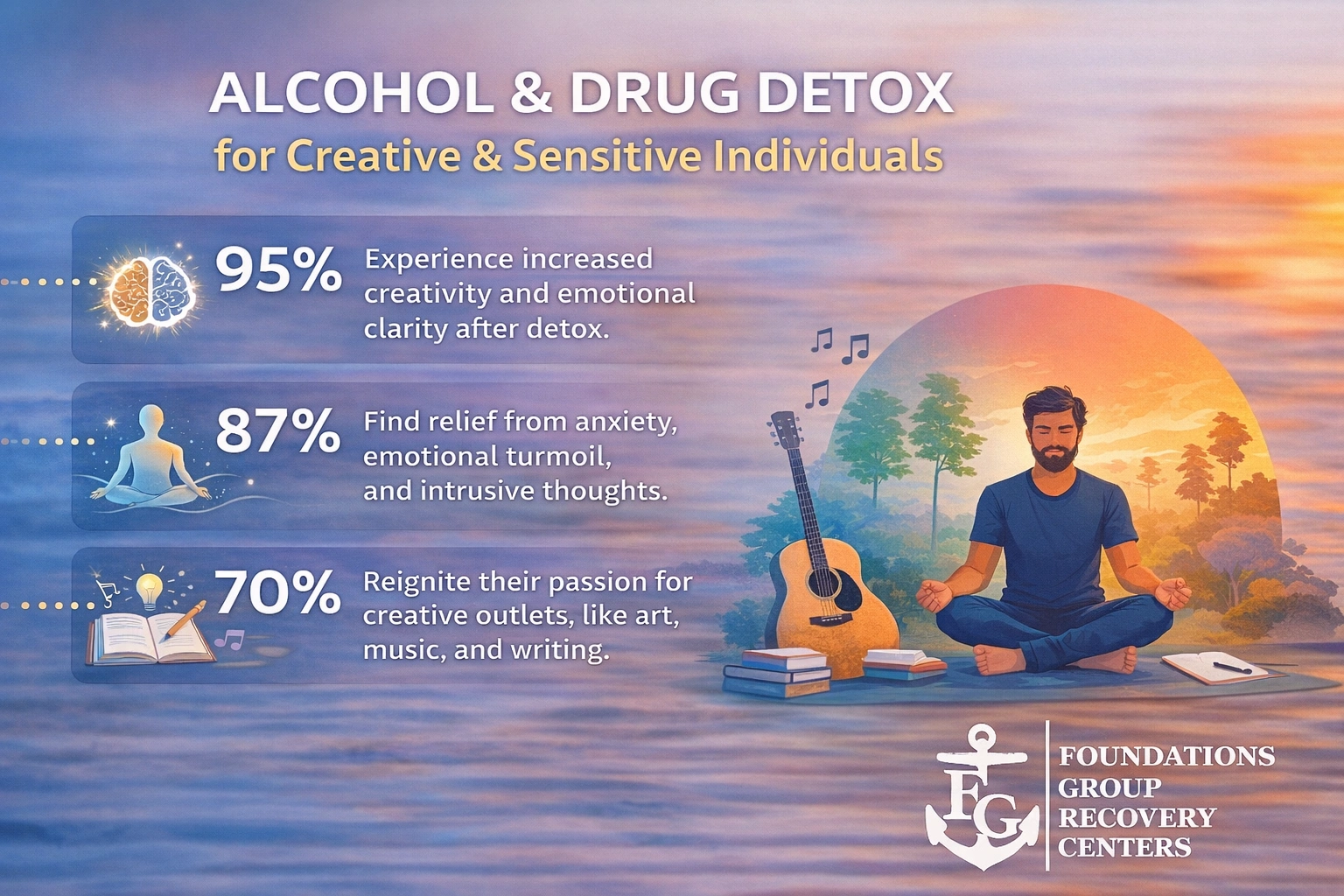
Here’s the truth: Using can compress your emotional range. You might feel higher highs, but you also get trapped in smaller loops—dopamine chases, crash cycles, tight rewinds of the same pain.
Detox isn’t erasure. It’s expansion.
When substances leave your system, your emotional bandwidth grows. You feel more of everything—not just sadness or anxiety, but joy, clarity, rest. You find pockets of yourself you didn’t know existed because you were too busy staying above water.
Creativity after detox doesn’t have to be bland. It might be slower at first. But then it gets deeper. Fuller. Less about proving and more about expressing.
What Detox Looks Like for People Like You
If you’ve got a fast mind, a big heart, or a body that stores everything you’ve ever felt—detox can be… intense.
That’s why the way we do it matters.
At Foundations Group Recovery Center, our alcohol and drug detox services are:
- Medically supervised to ease withdrawal symptoms safely
- Emotionally attuned, especially for clients with trauma, anxiety, or sensitivity
- Low-pressure, meaning we honor where you are without demanding where you “should” be
- Creatively friendly, meaning we don’t pathologize your fire. We help protect it.
If you’re nearby and looking for care, check out our detox program in Falmouth, MA.
Your Story Isn’t Over. It’s Unfolding.
You’re not in detox because you failed. You’re here because you’re done settling for half-versions of yourself.
It’s not about becoming someone new. It’s about finally giving the real you a chance to breathe—without borrowing false energy, without chasing the crash, without asking permission to feel deeply.
You’re still creative. Still expressive. Still you.
And that? That’s enough.
FAQ: Alcohol and Drug Detox for Creative Clients
Will detox make me feel flat or numb?
Not permanently. While emotional flattening can happen early on due to chemical adjustment, most people report a gradual return to clarity and emotional range after detox. It’s often the beginning of deeper creativity—not the end.
I’m scared I won’t be “fun” or “myself” without using. Is that normal?
Yes. Many people fear that substances are tied to their identity or social spark. But detox often reveals that the core of your personality—your humor, your insight, your style—was always there. You’ll still be you, just with more access to rest and clarity.
How long does alcohol and drug detox take?
Most detox programs last 5–10 days, depending on substance type, frequency of use, and individual health. Foundations Group Recovery Center provides medical and emotional support throughout, with referrals for ongoing care after stabilization.
Can I bring creative tools or journals into detox?
In many cases, yes. We encourage self-expression and support clients in exploring safe, creative outlets during detox. Talk with our staff about what’s allowed and helpful during your stay.
Do I have to commit to long-term treatment after detox?
Not immediately. Detox is a starting point, not a contract. Our team can help you explore next steps at your pace, whether that’s outpatient care, therapy, or peer support. You get to decide how your recovery unfolds.
Looking for Alcohol and Drug Detox in Barnstable County?
Whether you’re an artist, musician, teacher, entrepreneur—or just someone who feels a lot and thinks hard—you don’t have to lose yourself to get well. Foundations Group Recovery Center offers detox services that honor your identity, your mind, and your capacity to heal.
See how we support clients across Barnstable County with detox options designed for real people with big inner lives.
Ready to take the next step without losing yourself in the process?
Call (844)763-4966 or visit our alcohol and drug detox program in Mashpee, MA to learn how we support creative, thoughtful people through detox and beyond.