
I didn’t think I’d be “that person.”
You know—the one who relapsed. Not after everything. Not after 90+ days. I was working my program. I had a sponsor. I could tell you the exact number of days I’d been sober, down to the hour.
And then… I drank.
It started as “just one.” One turned into two. The guilt came faster than the buzz. I didn’t spiral, but it felt like the floor gave out under me anyway. I woke up the next day and thought: I ruined everything.
But that voice? The one saying I’d blown my shot and had to start from zero? It was lying.
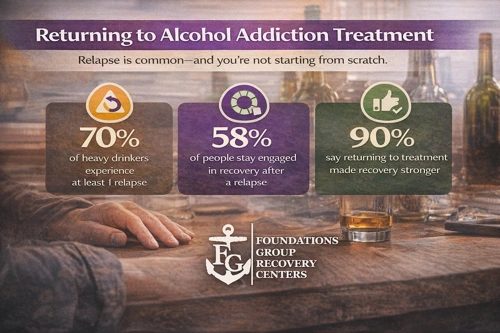
If you’re reading this in the haze of that same shame—maybe you slipped last week, or maybe you’re trying to convince yourself it didn’t count—pause here with me. Because here’s what alcohol addiction treatment actually says about relapse: It’s not a failure. It’s feedback. And you’re not alone.
Explore our alcohol addiction treatment services in Massachusetts.
You’re Not Starting Over — You’re Starting From Experience
Here’s what no one tells you in the early days: relapse doesn’t erase your recovery.
You still have the work you did. The insight you gained. The moments you resisted. None of that gets wiped away because you drank. It just means something still needs attention. Something cracked through the surface—and instead of pretending it didn’t, you get to face it now with more tools than you had the first time.
“I thought slipping meant I was back at square one. My counselor told me, ‘You’re not starting over. You’re starting from experience.’ That reframe saved me.”
– Alumni, 2023
Every relapse carries a message. It’s not always profound. Sometimes, it’s as simple as “you were tired,” or “you were lonely,” or “you were human.” But if you listen, it can help you recalibrate—not just your recovery plan, but your life.
Why Relapse Happens (Even When You’re Doing “Everything Right”)
Here’s the tough truth: relapse can happen even when you’re “doing the work.”
It doesn’t always mean you stopped going to meetings or ghosted your support team. Sometimes, it sneaks in when life is quiet—after the chaos calms and you think you’ve got it under control. Sometimes, it shows up after a huge win or milestone, when you let your guard down because it feels safe to celebrate “like a normal person.”
Other times, it’s old wounds reopening. A breakup. A family fight. A holiday. A random Tuesday when you just didn’t want to feel.
Relapse isn’t about weakness.
It’s about patterns—emotional, neural, environmental. It’s about being triggered by things you didn’t even know were still wired into you. And it’s about being human in a world that keeps handing you reasons to want escape.
What Alcohol Addiction Treatment Actually Teaches About Relapse
When I walked back into treatment after my slip, I braced for judgment. I expected side-eyes, lectures, that dreaded “What happened?”
What I got instead? A chair, a nod, and someone saying, “Glad you made it back.”
That’s what real recovery programs do. They don’t punish you for slipping. They make space for you to come back.
Good alcohol addiction treatment in places like Mashpee, MA doesn’t just offer detox or therapy—it offers perspective. It teaches you that relapse is common, not shameful. It helps you look at the moments leading up to it without flinching. It gives you the skills to interrupt the next cycle earlier.
It doesn’t treat you like a beginner again. It meets you where you are: a little bruised, maybe, but wiser.
The Shame Spiral Is the Real Threat — Not the Slip
Relapse is dangerous. That’s true.
But it’s not always the drink that does the damage—it’s the shame spiral that follows.
It’s the inner voice that says, “See? You’re not cut out for this.”
It’s the silence that creeps in when you stop reaching out.
It’s the fear that whispers, “They won’t take you back.”
That spiral is what turns a slip into a slide.
It’s what makes one drink turn into ten. One night into a month. That voice—the one telling you not to bother?
It’s lying to you. Again.
Treatment isn’t a door that closes behind you. It’s one that stays cracked open. You can walk back through at any time. In fact, that’s often where the real recovery starts.
Looking for a non-judgmental, trauma-informed treatment option? Check out our services in Falmouth, MA.
What “Coming Back” Actually Looks Like
You don’t have to re-enter full inpatient care unless that’s what your situation calls for. Coming back might mean:
- Re-engaging with alumni groups
- Scheduling a few IOP sessions
- Talking to your old therapist again
- Just… making the call and asking, “What now?”
Every relapse has a rhythm. Treatment helps you slow it down. Interrupt it. Learn from it. You don’t need to hide. You need support. And you deserve it.
I Thought I Was Done. I Was Just Beginning.
My relapse felt like the end. But it ended up being the beginning of the most honest phase of my recovery. It was the moment I stopped trying to “do sobriety perfectly” and started doing it real.
If that’s where you are? You’re not broken. You’re just in the part where things get deeper. More uncomfortable. More healing.
And if you’ve been here before, and you’re scared it’ll keep happening—remember: repetition is not failure. It’s practice. It’s learning. And every time you come back, you come back stronger.
FAQ: Alcohol Addiction Treatment After Relapse
Do I have to start over after a relapse?
No. A relapse doesn’t erase your progress. You may need to revisit some parts of your program or strengthen your support system, but you’re not starting from zero. You’re starting from experience.
Will I be judged if I return to treatment?
Not at Foundations. Our team is built on compassion, not shame. We understand relapse is a part of many people’s recovery. You’ll be welcomed, not punished.
What type of treatment is best after relapse?
It depends. Some people benefit from stepping back into outpatient or IOP care. Others may need detox or inpatient support if the relapse was significant. We tailor care to your current needs—not a one-size-fits-all model.
Can I just talk to someone without committing to a full program?
Yes. We offer consultation calls where you can talk through what happened and explore next steps without pressure. You can just call and ask, “What do I do now?” That’s enough.
What if I’m not ready to come back—but I know I need to?
You don’t have to be “ready.” You just have to be willing to talk. Let that be your first step. The rest can follow.
Looking for Alcohol Addiction Treatment in Barnstable County?
Whether you’ve relapsed recently or you’re just feeling shaky and disconnected, it’s never too early—or too late—to reach back out. Foundations Group Recovery Center serves Barnstable County and nearby communities with flexible, real-world support for people navigating all stages of alcohol recovery. See how we support recovery in Barnstable County.
You didn’t fail. You’re still fighting—and we’re still here.
Call (844)763-4966 or visit Alcohol Addiction Treatment page in Mashpee, MA to reconnect with support that gets it. You’re not alone—and you’re not past hope.