
Some mornings it feels like the world wakes up without you. Even if you’re functioning on the outside, your mind is stuck in a loop of exhaustion, fear, or quiet numbness. You’ve probably searched “partial hospitalization program” out of late-night curiosity, wondering if there’s a way to get help without leaving your life completely behind.
At Foundations Group Recovery Center in Mashpee, MA, we’ve walked with people who felt that same uneasy curiosity. People who wondered, “Is there something out there that can help without flipping my life upside down?” The answer is yes. A partial hospitalization program (PHP) offers structured, intensive therapy—while still allowing you to go home each evening.
Below are five therapies you’ll likely encounter in a PHP, and how they can help you feel like yourself again—or maybe, for the first time.
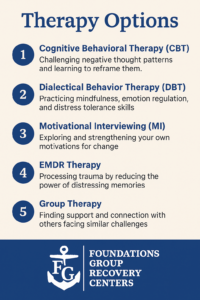
1. Cognitive Behavioral Therapy (CBT): Challenging the Inner Narrator
We all have that internal voice. For some, it’s reasonable. For others, especially when struggling with suicidal ideation, it’s vicious—endlessly reminding you of every flaw, every mistake.
Cognitive Behavioral Therapy (CBT) teaches you to recognize and question that negative inner narrator. Through structured exercises, you’ll identify thought patterns that drag you down and practice reframing them into something more realistic and compassionate.
CBT isn’t about denying your reality—it’s about seeing it more clearly. In a partial hospitalization program, CBT is often one of the first steps toward realizing your thoughts are not absolute truths, but habits that can be reshaped.
One client once described it perfectly: “CBT didn’t fix me—it gave me a flashlight for the dark corners.”
2. Dialectical Behavior Therapy (DBT): Building a Calm Core
When emotions feel like they’re spiraling, Dialectical Behavior Therapy (DBT) can help you hit pause.
Originally developed for people dealing with extreme emotional swings and self-harm, DBT offers practical skills for surviving distress without self-destructing. You’ll learn mindfulness techniques to stay present, emotion regulation skills to manage big feelings, distress tolerance strategies to get through tough moments, and interpersonal skills to set healthier boundaries.
Many in PHP find DBT to be life-changing because it blends acceptance and change—you’re taught how to sit with your emotions, without letting them dictate harmful behavior. Think of it as building an emotional life raft: you still feel the waves, but you stay afloat.
3. Motivational Interviewing (MI): Reconnecting with the Part of You That Still Hopes
One of the strangest things about depression or suicidal thoughts is how they make you feel like there’s no point—but somewhere deep down, you still wonder if there’s more to life.
Motivational Interviewing (MI) is a therapy that helps you explore that hidden part. Through gentle, non-judgmental conversation, a therapist guides you to hear your own motivations and goals, even if they feel buried right now.
It’s not about forcing you to “be positive.” It’s about listening to yourself with curiosity, finding tiny threads of hope you can pull on until they’re strong enough to hold your weight.
In PHP, MI offers a safe space to think out loud and notice, “Maybe… just maybe… there’s something worth staying for.”
4. EMDR Therapy: Loosening Trauma’s Grip
Trauma doesn’t always look like car accidents or violence—it can be subtle, cumulative, and suffocating. And when those memories go unprocessed, they can amplify the despair you feel today.
Eye Movement Desensitization and Reprocessing (EMDR) therapy uses bilateral stimulation (like eye movements or tapping) to help your brain process trauma in a way that reduces its emotional charge.
You won’t be forced to relive every terrible memory in vivid detail. EMDR focuses on helping your brain release what’s stuck so those memories lose their power to hijack your mood or choices.
Many clients in PHP discover that EMDR allows them to feel lighter, as if invisible weights they’ve carried for years are finally lifted.
5. Group Therapy: Finding Connection in Shared Struggle
Isolation fuels suicidal thoughts. Group therapy, a core part of PHP, offers something profoundly healing: connection.
In group therapy, you’re not expected to spill your life story immediately. You listen, share when you’re ready, and realize you’re not the only one fighting this quiet war. You hear echoes of your own story in others and offer encouragement you didn’t know you had.
Group therapy doesn’t “fix” you, but it often helps you feel human again. For many, it’s the first place they experience being seen without judgment—and that alone can be life-altering.
6. 12-Step-Inspired Therapy: Structured Hope for the Road Ahead
Some partial hospitalization programs offer therapy based on the principles of 12-step programs, like Alcoholics Anonymous. Even if you have mixed feelings about spirituality or group culture, 12-step-inspired therapy can offer useful guideposts.
The steps offer a framework for honesty, accountability, connection, and progress—especially for those dealing with addiction alongside mental health struggles. You’ll never be forced into belief systems, but you’ll be invited to explore tools that have helped millions navigate recovery.
At Foundations Group Recovery Center, many clients find comfort in knowing that these steps don’t demand perfection—just progress.
Why Choose a Partial Hospitalization Program?
A partial hospitalization program is ideal when outpatient therapy isn’t enough but residential care feels too intense. At Foundations Group Recovery Center, PHP offers a middle path: six-hour therapy days with the comfort of returning home each night.
It’s not a punishment—it’s a soft landing. It’s a place to rest your mind, build coping skills, and regain balance without sacrificing your life completely.
Frequently Asked Questions (FAQs)
What is a partial hospitalization program?
A partial hospitalization program (PHP) is a structured treatment program offering intensive therapy during the day while allowing you to return home in the evening. It provides daily support through group therapy, individual therapy, and psychiatric care without requiring overnight stays.
How many days a week is PHP?
Most PHP programs run 5 days a week, usually Monday through Friday, for about 5-6 hours per day. This gives you focused support while leaving evenings and weekends open for home life and rest.
Is PHP only for people with severe mental health issues?
Not at all. PHP is for anyone who needs more than traditional outpatient therapy but doesn’t require full hospitalization. It’s common for people dealing with suicidal ideation, depression, anxiety, trauma, or substance use to benefit from PHP.
Will I have to talk in group therapy?
Group therapy encourages participation, but no one is forced to speak before they’re ready. Many people start by listening and naturally begin contributing as they feel safer. You’re encouraged to move at your own pace.
Can I work or go to school while in PHP?
Some people choose to take a break from work or school while in PHP, but others manage flexible schedules. PHP typically happens during the day, so part-time work or evening classes may be possible. Our team can help guide you based on your specific needs.
A Gentle First Step Forward
When your mind feels like a maze with no exit, it’s easy to believe you’ll always feel this way. But therapies like CBT, DBT, EMDR, MI, group therapy, and 12-step principles can offer you something many people forget is possible: a path forward.
At Foundations Group Recovery Center, our partial hospitalization program services in Mashpee, MA is built on respect, dignity, and the belief that you are worth fighting for.
You don’t have to decide everything today. Curiosity is enough. A single phone call or click is enough.
Call (844)763-4966 to learn more about our PHP services in Mashpee, MA.