
You’re Still Here. That Matters.
Relapse is not what defines you. What you do next does.
If you’ve made it 90 days—or longer—without using, then found yourself slipping back into old patterns, the weight of that can feel unbearable. You might feel like you’ve disappointed everyone. You might even be asking yourself: Did I really change at all?
Yes, you did. And you still can.
At Foundations Group Recovery Center in Mashpee, we’ve walked alongside countless people who’ve relapsed after a season of sobriety. Not one of them was beyond help. Not one of them was without hope. If you’re here, reading this, you haven’t given up. And that’s enough for us to welcome you back with open arms.
Relapse isn’t failure. It’s feedback. It’s the mind and body’s way of signaling that something deeper needs attention—and we’re here to help you respond to that signal without shame.
Relapse Isn’t a Moral Failure. It’s a Human Experience.
It’s easy to think of recovery as a clean line: sober or not. But anyone who’s lived it knows—it’s messier than that.
Relapse doesn’t mean you weren’t serious about your recovery. It doesn’t mean you were lying, or weak, or didn’t try hard enough. It means you’re human. It means that, like millions of others in long-term recovery, you hit a moment where pain outpaced coping. And that moment doesn’t erase all the work you’ve done.
Relapse can happen during grief. During transition. After a job loss. After a breakup. Even after a celebration. It often sneaks in not when things are at their worst—but when they’re just fine on the surface, and lonely underneath.
Let’s take the moral weight off it. Let’s treat it like what it is: a health signal, not a character defect.
You Don’t Have to Start Over
One of the biggest fears after a relapse is that you’ll be sent back to square one. That you’ll have to pretend like you’re new to recovery again. That everything you earned is gone.
Not here.
At Foundations Group, we recognize that your recovery journey didn’t disappear. It hit turbulence. And your history matters. We don’t erase it—we build from it.
Coming back doesn’t mean repeating early steps for the sake of appearance. It means receiving care that honors where you’ve been and helps you navigate where you are now—with honesty, support, and flexibility.
What Returning to Opiate Addiction Treatment Can Look Like
Many alumni imagine “treatment” as a dramatic reset—24/7 care, detox, locked doors. In reality, it can be much more grounded, accessible, and personalized.
When you come back to treatment after relapse, your care might look like:
- Individual therapy to explore what triggered your return to use and how to work through it without judgment
- Outpatient support that fits into your work and life schedule
- Relapse processing groups with peers who’ve been where you are
- Emotional rebuilding that digs deeper than before—grief, identity, trauma, relationships
- Local care close to home, whether you’re in Mashpee or looking for Opiate addiction Treatment in Falmouth MA
For those in the broader Cape area, we also welcome clients looking for Opiate addiction Treatment in Barnstable County MA. We’re not here to punish—we’re here to help you realign.
A Quiet Return Still Counts
Some relapses happen quietly. One day. One pill. One choice that no one noticed but you.
And that can make returning feel even harder. What if they think I’m being dramatic? What if I’m making this into a bigger deal than it is?
Let us say this clearly: If it feels big to you, it is big. You’re allowed to ask for help, even if the relapse was brief. Even if no one saw. Even if it didn’t “ruin your life.”
You don’t need disaster to deserve support. You just need honesty. And the courage to take one step forward.
You’re Not the Only One
Relapsing after 90+ days is more common than you might think.
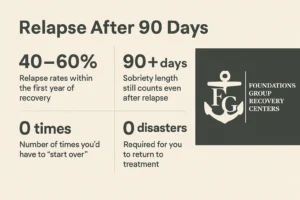
In fact, research shows that relapse rates within the first year of recovery range between 40–60%. It’s not because people don’t care about sobriety. It’s because recovery is complex. Life doesn’t stop throwing curveballs just because you stopped using.
We’ve seen alumni return to us after six months. A year. Three years. And every single one was met with compassion.
You’re not a failure. You’re a person who deserves another chance—and we’re here to help you take it.
What You Did Doesn’t Cancel Who You Are
If no one’s told you yet: you’re not broken.
You made a choice you wish you hadn’t. That doesn’t erase all the other choices you made—the brave ones, the sober ones, the healing ones.
You are still worthy of love. Of support. Of recovery that works for who you are today.
We don’t want you to stay stuck in shame. We want you to return to yourself—with guidance, clarity, and care that meets you right where you are.
“I thought relapse meant I had to go back to the very beginning. But I didn’t need detox—I needed connection. I needed someone to help me remember I was still in this.”
– Alumni, 2023
FAQs About Relapsing After 90 Days Sober
Is relapse common even after several months of sobriety?
Yes. Many people relapse between the 3- to 12-month mark. That’s often when routines get looser, emotions deepen, and external support fades—making it easier for old patterns to resurface.
Do I have to detox again after a short relapse?
Not necessarily. Our clinical team will assess your recent use and make personalized recommendations. Some clients return to care through outpatient services only.
Will I be treated like a beginner if I come back?
No. We recognize and honor the recovery work you’ve already done. Your treatment plan will reflect your experience, not your relapse.
Can I rejoin treatment even if I used just once?
Yes. One use is still a relapse—and still worthy of support. Whether it was a weekend slip or something ongoing, we’re here to help you respond with care and action.
How soon should I seek support after a relapse?
The sooner, the better. Shame and silence can compound the emotional damage of relapse. Reaching out early can prevent further harm and help you reconnect quickly.
You Don’t Have to Do This Alone
If you’ve relapsed and you’re ready to return—not just to treatment, but to yourself—we’re here. Call (844)763-4966 or visit our Opiate addiction Treatment services in Mashpee, MA to learn how we can support your next step. No shame. No reset button. Just help, right where you are.