
When Love Isn’t Enough—but Hope Still Is
If your adult child is drinking again—or never really stopped—it can feel like you’re stuck in a quiet storm. The worry, the waiting, the walking-on-eggshells. You’ve done what you could. You’ve offered support. Maybe you’ve driven them to appointments, paid for therapy, or tried to set boundaries you’re not even sure you have the energy to enforce.
And now, you’re wondering if it’s time to talk about something more structured. A Partial Hospitalization Program (PHP) could offer the kind of focused help your child needs—but how do you even begin that conversation without making it worse?
At Foundations Group Recovery Center in Mashpee, MA, we meet families at this exact crossroads every day. If you’re here, you’re not alone. And there are ways to move forward with compassion, not conflict.
What Is a Partial Hospitalization Program (PHP)?
A Partial Hospitalization Program, or PHP, is a day treatment model designed for people who need significant support for addiction recovery, but who don’t require overnight supervision. For alcohol addiction, this often includes:
- Daily clinical care without a residential stay
- Medical and psychiatric support for withdrawal or co-occurring issues
- Group and individual therapy sessions
- Relapse prevention and emotional regulation skills
PHP is typically more intensive than outpatient therapy but allows participants to return home each evening, making it especially useful for those who need daily structure without disrupting their entire lives.
In short, PHP is for when “talk therapy once a week” isn’t cutting it—but full-time rehab feels like too much.
Why This Conversation Feels So Hard (And Isn’t Hopeless)
You’re not imagining it—this is a deeply difficult conversation. Especially if your child is over 18, especially if they’re independent in other ways, and especially if this isn’t the first time things have gotten bad.
As a parent, you’re holding love and heartbreak in the same hand. You might be thinking:
- “What if I say the wrong thing?”
- “What if I lose them by pushing too hard?”
- “What if they say no—and I can’t make them go?”
These are real fears. But there’s also real power in what you can do: speak clearly, with compassion, about what you’ve noticed and what kind of help exists.
You don’t need to fix everything. You just need to open a door.
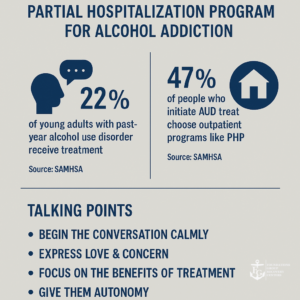
How to Start the Conversation Without Pushing Them Away
1. Find the right moment—not the perfect one.
Perfection isn’t the goal. Wait for a time when things feel relatively calm. A quiet morning, a car ride, or a walk together can all create space for openness.
2. Lead with observation, not accusation.
Try using statements that begin with “I’ve noticed…” rather than “You always…” or “You need to…”
Example:
“I’ve noticed you’ve been drinking more lately, and I see how much pain you’re in. I found a treatment option I didn’t know much about before. It’s called a Partial Hospitalization Program. Would you be open to hearing about it?”
3. Emphasize their agency.
The more control they feel, the more likely they are to listen. Make it clear this isn’t about control—it’s about care.
4. Share what you’ve learned, not what they “should” do.
You’re offering information, not issuing an ultimatum. Let curiosity guide your tone.
What If They Say No?
They might.
And if they do, it doesn’t mean you failed. It means you planted a seed. In some cases, just hearing about a program like PHP helps a person realize there is a middle ground between doing nothing and going to rehab.
You can also let them know where services are available nearby. If you’re local to Cape Cod, they might feel more open to treatment close to home. Looking for Partial Hospitalization Program in Barnstable County, MA? Or explore our program in Falmouth, MA.
How a PHP Can Support Both of You
A PHP doesn’t just help your child—it helps you, too.
When your child has daily therapeutic support, you can stop trying to be their crisis manager. You can begin to shift out of survival mode. Some parents even take that time to begin therapy themselves, or to reconnect with their own lives that may have quietly paused.
This isn’t just about fixing a problem. It’s about restoring a relationship—starting with the one your child has with themselves.
What’s the Next Step?
If your child expresses interest—or even mild curiosity—the next step is to gather more information together. Let them read. Let them ask questions. Encourage them to call or schedule a consultation without pressure.
If they shut the conversation down, you can still follow up with a gentle reminder:
“If you change your mind or just want to know more, we can call together—or I can just text you the link.”
Let them know they can come back to the idea. That the door stays open.
Frequently Asked Questions
What makes a Partial Hospitalization Program different from rehab?
Rehab typically requires 24/7 stay, often in a residential facility. PHP provides the same structured care during the day, but participants return home each evening. It’s ideal for those who need intensive help but also want to stay connected to family or other responsibilities.
Can my adult child choose to leave PHP at any time?
Yes. PHP is a voluntary program, and clients can leave or step down to lower levels of care. However, we work closely with clients to ensure transitions are supportive and intentional.
What if they have a job or are in school?
Some PHP programs offer flexible schedules, but in most cases, PHP requires full-day attendance (typically 5–6 hours a day). Short-term leave from work or school may be necessary—but it’s often worth the long-term gain in stability and recovery.
How do I know if PHP is enough—or if they need more?
Our clinical team can assess your child’s needs through an intake evaluation. Sometimes PHP is the right starting point. Other times, it’s used as a step-down after detox or residential care. Every plan is individualized.
Is PHP covered by insurance?
In many cases, yes. Most insurance providers recognize PHP as a standard level of care and may cover some or all of the costs. Our team can help you verify benefits and understand your options.
📞 Ready to Talk?
Call (844)763-4966 or visit our Partial Hospitalization Program services in Mashpee, MA to speak with someone who can guide you through the next step—with clarity, care, and zero pressure.