You left. Maybe in a moment of frustration. Maybe because life got in the way. Or maybe it was more subtle—one missed group became two, and before you knew it, you’d stopped showing up to your Intensive Outpatient Program altogether.
You didn’t mean to ghost. But you did.
And now, here you are—wondering what would happen if you came back.
The answer? You’d be welcomed. Not judged. Not punished. Not made to explain yourself to a room full of strangers.
Because at Foundations Group Recovery Center, we know leaving treatment doesn’t mean you stopped caring. And coming back doesn’t mean you failed.
It means you’re still in the fight.
You’re Allowed to Come Back Without Shame
Let’s say this out loud:
Leaving doesn’t disqualify you. It makes you human.
Maybe you had to prioritize your job. Maybe a family crisis pulled you away. Maybe treatment itself felt overwhelming, and you didn’t have the words to say, “I’m struggling.”
Whatever happened—it happened. And now you’re considering reaching out again.
There’s no shame in that. No need to perform readiness or pretend the break didn’t matter.
If you’re even thinking about returning to IOP, your recovery is still alive.
That’s what we care about.
Ghosting Happens More Than You Think
You might feel like the only one who left without saying goodbye. But that’s far from the truth.
Treatment dropout is more common than most people realize. Especially in Intensive Outpatient Programs, where the balance between structure and freedom can sometimes get tricky.
We see people leave for all kinds of reasons:
- Emotional burnout
- Relapse or near-relapse
- Scheduling conflicts
- Financial stress
- A single bad group session
- Shame after opening up too much
- Or just… life.
None of these make you a failure. They make you a person who’s still figuring things out. And that’s exactly who IOP is built for.
You Don’t Have to Start Over From Scratch
Another common fear? That coming back means resetting everything—intake, goals, groups, the whole schedule.
But in most cases, you pick up where you left off. With tweaks that reflect what you’ve learned about yourself in the meantime.
Here’s what usually happens:
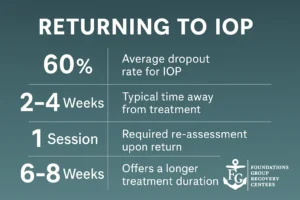
- You do a short re-assessment.
- We talk about what worked, what didn’t, and what’s different now.
- You collaborate with your care team to create an updated treatment plan.
- You rejoin IOP with a fresh sense of ownership—not a walk of shame.
If you’re looking for an Intensive Outpatient Program in Falmouth, MA, this is the kind of re-entry process you can expect at Foundations: collaborative, non-judgmental, and built around you—not your past attendance record.
Returning Doesn’t Mean You “Failed” the First Time
This one’s big.
So many people delay coming back because they feel like returning is proof that IOP “didn’t work” the first time.
But that’s not how healing works.
You don’t go to treatment, check a box, and come out transformed. You build recovery in layers. In chapters. In attempts.
Leaving might’ve been part of the process. Coming back might be part of the healing.
And this time? You’ll bring the experience of what didn’t work before.
You’ll come in with eyes more open.
That matters. That counts.
You’re Still Welcome—Even If You Left Without a Word
It’s awkward, right? You ghosted. You didn’t say goodbye. You may have stopped answering calls or texts from the team.
You might worry that you “burned a bridge.” That calling now would feel weird. Or that someone will answer the phone with disappointment in their voice.
But here’s what you need to know:
We’re just glad you’re calling.
That’s it. That’s the headline.
You don’t need a speech. You don’t need to explain everything. Just say something like:
- “Hey, I was in your IOP a while back. I think I need to come back.”
- “I left kind of abruptly last time… can I restart?”
- “I wasn’t ready before. I think I might be now.”
At Foundations in Mashpee, we respond with curiosity, not criticism. Always.
If you’re nearby in Barnstable County, MA, you’re not far from a fresh start.
You’re Not the Same Person You Were When You Left
That break you took? It changed something.
Maybe it taught you what happens when support disappears. Maybe it helped you realize what parts of treatment you actually missed. Maybe it showed you how much harder it is to manage triggers alone.
Whatever the lesson—it’s yours now.
You’re not crawling back. You’re stepping forward with new insight. That’s powerful.
When you return to IOP, bring that with you. You’ll be surprised how much more you notice, how much more you can handle, and how much less you feel like an imposter this time around.
You Deserve a Plan That Works This Time
You might need different group times. A different therapist. A different approach. That’s okay.
We’ll help you adjust your treatment plan so it fits your actual life—not just the version you had when you started last time.
This isn’t about plugging you back in like a machine. It’s about meeting the person you are today and making sure treatment honors that.
You’ve already done the hardest part: considering help again.
Now let’s make it stick.
FAQs: Coming Back to IOP After Dropping Out
Do I need a new referral?
Not usually. If it’s been a while, we might update your file and do a quick reassessment. But you typically don’t need to start from zero.
What if I left because of a bad experience?
You’re allowed to be honest. If something didn’t work before, tell us. We can help you navigate alternatives—whether that’s a different group, provider, or structure.
Will I get in trouble for leaving?
Nope. This isn’t school. You won’t be scolded or reprimanded. The focus is on where you are now—not where you disappeared to.
Can I rejoin if I relapsed after leaving?
Absolutely. Relapse is part of the reality for many people. We’ll meet you where you are—with care, not shame.
What if I don’t want to tell my family I’m coming back?
Your treatment is confidential. You control who knows and who doesn’t. We support autonomy as part of recovery.
How long will I have to stay this time?
That depends on your needs. Some people stay in IOP for 4–8 weeks, others longer. We’ll build a flexible plan with you.
Come Back Without Apology
Call (844) 763-4966 or visit our Intensive Outpatient Program in Mashpee, MA to explore what returning could look like.
You don’t need the right words. You don’t need a clean record. You just need the courage to say, “I want to come back.”
And when you do, we’ll meet you with open hands—not crossed arms.
Because at Foundations, your story doesn’t end when you leave. And it doesn’t restart when you return. It continues.
Let’s write the next chapter—together.