
You left. You walked away—maybe silently, maybe with chaos.
You’ve been carrying the weight of what people might think.
Now, there’s a part of you that wants to return—but the fear of disappointing again looms too large.
This guide is for you. It’s not a lecture. It’s a map for stepping back into your intensive outpatient program—on terms that respect your wounds and your dignity.
Why the Guilt Feels Real—and Why It Doesn’t Have to Stop You
Guilt is one of the loudest feelings after you ghost treatment. It whispers:
- “You weren’t strong enough.”
- “You let everyone down.”
- “You’ll never be trusted again.”
Here’s what’s true:
- Leaving is not proof you didn’t care. Many people walk away because they got overwhelmed—not because they gave up.
- You don’t owe silence forever. The fact you’re reading this means there’s still a part of you that wants to try again. That matters.
- You don’t have to prove yourself. Return isn’t about escalating performance. It’s about honest presence.
You can respect your guilt—listen to it—but you don’t have to live in it.
1. Start with Self-Compassion, Not Self-Criticism
Before anything else, you’ve got to turn your care inward—even if it feels awkward.
- Tell yourself: “I’m here now.” That’s one true sentence.
- Remind your inner critic: You made a choice. You can make another.
- Let your pain exist. You don’t have to dress it up or shrink it. It’s part of your path back.
Self-compassion isn’t fancy. It’s a quiet grounding. The more you give yourself that, the less guilt grips you.
2. Send One Real Message — No Overexplanation Needed
You don’t need to pen an epic apology. You don’t need to confess everything in one go. You only need to start.
Try something like:
“Hey — I left treatment before because I was overwhelmed. I’m thinking of coming back. Can we talk about what that could look like?”
You don’t owe vulnerability in full. You just owe honesty.
If you’re looking for intensive outpatient program in Barnstable County, MA or around Falmouth, include that in your message: see if local IOPs will welcome your return—many do.
3. Pick a Gentle Entry Point
You don’t have to resume full intensity right away. Easing back in is a strategy, not a weakness.
Possibilities:
- Show up to a group or session without speaking
- Attend certain days or modules, not full schedule
- Ask for a “lighter attendance week” during your first week back
These small steps let you rebuild confidence without being crushed by the weight of “all or nothing.”
4. Recast Your Return as a Renewal, Not a Reset
When you come back, don’t speak to your relapse like failure. Speak to it like data.
- What broke?
- What got too heavy before?
- What supports did you stop leaning on?
Let your return be informed—not fearful. You’re not erasing your past; you’re building from it.
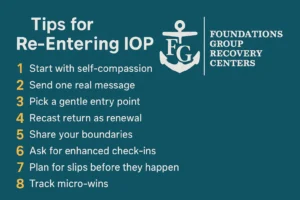
5. Share Your Boundaries (And Watch Others Respect Them)
You might fear returning because you think you’ll be forced into a structure that breaks you again.
So say this out loud:
- “I need some flexibility on attendance at first.”
- “I’m not ready for full disclosure yet.”
- “I want to build back my strength before intense assignments.”
A healthy IOP will hear that and build with you—not against you.
6. Ask for Enhanced Check-ins or Support
People returning from dropout often need more scaffolding. Request:
- One-on-one check-ins with a counselor
- Extra support for days you feel weak
- Smaller or beginner groups for reentry
- Accountability buddies
You’re not being needy. You’re being strategic. Good programs see that.
7. Plan for Slips Before They Happen
When you return, consider writing your slip protocol ahead of time:
- Who to call when cravings spike
- How long you’ll wait before reaching out
- What rapid adjustments you’ll make (e.g. increase check-ins)
- How you’ll re-enter group after a minor relapse
When you have a plan, relapse feels less like shame and more like a sign to adjust.
8. Track Micro-Wins, No Matter How Small
It’s easy to feel invisible. But your small choices matter.
- You came back. That’s a win.
- You spoke when it felt scary. That’s a win.
- You honored your boundary. That’s a win.
Celebrate, journal, share those small bursts of courage. Over time, they build momentum.
9. Re-anchor in Why You Came in the First Place
You started treatment for a reason. Pain was unbearable, life felt out of control, or hope whispered you could be different.
Return not because of shame, but because of that original seed. That reason still lives in you. When shame threatens to extinguish hope, hold onto that root.
FAQs: Returning to IOP After Dropping Out
Will they even let me back in?
Yes—many programs welcome returning clients. Ask intake about “re-entry” policies. Some IOPs in Barnstable and Falmouth specifically support this.
Will people judge me for leaving before?
Possibly—but also probably not. Many clients have walked similar paths. The better programs foster safety, not shame.
Do I have to start over from day one?
No. You bring your history, your insight, even your mistakes. Good programs build from where you left off, not pretend you never were.
What if I relapse again?
Then you bring it back into IOP—not disappear silently. Treatment should be flexible enough to allow slips, adjustments, and recommitment.
How soon can I return?
As soon as you’re ready. Some places let you re-enter next day. Others need a brief re-evaluation. Ask your local IOP.
Will therapists and group leaders trust me again?
Trust is rebuilt through consistency, transparency, and time. Your willingness to return is a part of that rebuilding.
Courage Isn’t Never Leaving Again—It’s Choosing to Return
The bravest thing here isn’t that you left. It’s that you’re considering coming back.
That’s not failure. That’s hope.
You don’t have to re-enter with a perfect record. You just have to re-enter with whatever is still alive inside you.
Call (844) 763‑4966 to learn more about our intensive outpatient program services in Mashpee, MA.
Let your return be real—not forced. You’re not too far gone. You’re not too broken. You’re human—and you deserve to come back on your terms.