
When High-Functioning Stops Feeling Like Control
I used to think being “high-functioning” meant I was safe. I still had my job. I still paid the bills. I never missed a family event. People even said I was “the dependable one.” But what they couldn’t see was that I was running on fumes. Alcohol wasn’t a weekend problem anymore—it was my nightly reset button. And yet I kept telling myself, “I’m not that bad. I don’t need treatment.”
The truth? I was terrified. I thought getting help meant blowing up the life I had carefully held together. What I didn’t know was that treatment didn’t have to be an all-or-nothing choice. At Foundations Group Recovery Centers in Mashpee, I found an Intensive Outpatient Program (IOP) that fit inside my life instead of erasing it. And those three hours a day ended up saving my life.
The Lie High-Functioning People Tell Themselves
High-functioning addiction is tricky. You’re not passed out in alleys or missing work—you’re showing up, on time, with a smile that hides the hangover. You use your productivity as proof you’re “fine.”
The lie goes like this: If I can keep everything together, I don’t need help.
But addiction doesn’t negotiate with your résumé. It doesn’t care that you’re a parent, an executive, a volunteer, or the one everyone depends on. Addiction is greedy—it keeps taking until you’ve got nothing left to offer. IOP is about stopping that spiral before it takes more than it already has.
What Three Hours Really Means
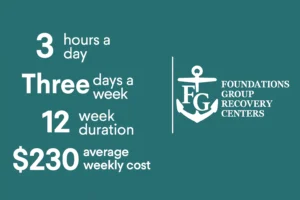
Three hours a day. That’s the average time commitment for an IOP. At first, I thought, “That’s impossible. My schedule’s packed.” But then I realized—I was already spending three hours a day drinking, recovering, or hiding my habits. IOP simply redirected that time into something that actually gave me my life back.
Here’s how it worked:
- Three days a week: Group therapy, where I met people like me—people who looked “fine” on the outside but were exhausted inside.
- Individual sessions: Private time with a clinician who helped me unpack the stress, perfectionism, and anxiety driving my drinking.
- Skills training: Practical strategies to survive cravings, work stress, and social pressure without picking up a drink.
The hours added up to progress. And slowly, the “impossible” became routine.
Why Intensive Outpatient Programs Work
An Intensive Outpatient Program is structured treatment that keeps you in your real life. You’re not cut off from your job or family—you live at home, and you show up to sessions in between. That design is what makes IOP uniquely effective for people who think they “don’t need” treatment.
Here’s why:
- It’s flexible: You can keep your responsibilities while doing the work.
- It’s immersive: With multiple sessions a week, you stay accountable and supported.
- It’s practical: You practice sobriety in real time, not in isolation.
- It’s honest: You stop hiding and start admitting what’s really going on.
When you’re high-functioning, you don’t need treatment that takes you out of life—you need treatment that shows you how to live it differently.
The Shift From Control to Connection
I thought my drinking was about control. I drank to take the edge off, to manage the stress, to “stay on.” But in IOP, I learned control was the illusion. Connection was what I actually needed.
In groups, I heard stories that sounded eerily like mine. Executives, teachers, parents—they were all carrying the same secret load. The relief of saying out loud, “I can’t keep this up,” and hearing someone else nod was unlike anything I’d experienced.
That’s the power of IOP. It’s not just therapy—it’s a mirror. And once you see yourself clearly, you can’t go back to denial.
Local Roots Make the Difference
Sobriety isn’t just a personal journey—it’s a community one. That’s why location matters. At Foundations, I wasn’t treated like just another number in a faraway facility. I was part of a local network, with resources and support right here in Massachusetts.
If you’re looking for an Intensive Outpatient Program in Barnstable County, MA, Foundations Group Recovery Centers is in your backyard. And if you live near the coast, you can also find an Intensive Outpatient Program in Falmouth, MA.
Local care keeps you grounded. It ensures the changes you’re making in treatment can immediately be applied in your daily environment.
What Life After IOP Looks Like
IOP isn’t the end. It’s the turning point. For me, life after IOP didn’t mean everything was magically fixed. It meant I had:
- A toolbox of coping skills instead of just alcohol.
- A group of people I could call when things felt shaky.
- The ability to walk into work without the fog of shame.
- A chance to be present with my family instead of half-there.
Life after IOP looks like momentum—finally moving forward instead of circling the same drain.
Myths That Keep People Away
Let’s bust a few:
Myth 1: “I’ll lose my job if I go to treatment.”
Truth: Many clients schedule sessions around their work. Confidentiality protects your privacy.
Myth 2: “I’m not bad enough yet.”
Truth: Waiting for things to collapse is like waiting for the fire to spread before calling the fire department. IOP is about early, effective intervention.
Myth 3: “Three hours is too much.”
Truth: You’re already losing more than three hours a day to drinking, recovering, or hiding. IOP gives those hours back to you.
FAQ: Intensive Outpatient Programs in Massachusetts
Q: How long does an IOP last?
A: Most run 6–12 weeks, but some clients continue longer depending on progress.
Q: Can I still work full-time during IOP?
A: Yes. Programs are designed to fit around work and family commitments.
Q: Do IOPs handle mental health as well as addiction?
A: Absolutely. Many clients are treated for both substance use and conditions like anxiety, depression, or trauma.
Q: What happens if I slip up during IOP?
A: Relapse isn’t failure—it’s feedback. The team works with you to adjust your plan and strengthen your recovery.
Q: Will I meet people like me?
A: Yes. Many high-functioning clients are surprised at how many others share the same hidden struggles.
The Bottom Line: Three Hours Can Change Everything
When I finally gave three hours a day to IOP, I got something back I hadn’t felt in years—myself. IOP didn’t take away my life. It gave me my life back.
If you’re reading this and telling yourself you don’t need help, I’ll be honest: that’s exactly what I said too. But those three hours a day were the best investment I ever made.
Call (844)763-4966 to learn more about our Intensive Outpatient Program services in Mashpee, MA.