
You thought 90 days in, you had momentum.
Maybe you believed in the program, the peers, the promise.
Then something shifted. One misstep. One desperate hour. One relapse.
Now you’re sitting across from me—tired, discouraged, doubting. You wonder if all the effort meant anything. If you can ever rebuild from here.
I want you to hear this: relapse isn’t erasure. It’s not a full defeat. It’s a crack in the path—not the end of the trail. And a partial hospitalization program (PHP) offers a bridge back—one that holds both the shame and the hope.
At Foundations Group Recovery Center in Mashpee, MA, we’ve walked this road with many alumni. Some thought relapse meant they lost the right to return. Others came back quietly, broken, unsure. But what we see each time is this: when someone comes back into PHP with honesty, a new chapter begins.
Let me show you how.
The Weight of Relapse After 90 Days
Relapse at 90 days often carries extra shame.
Because it contradicts the narrative you carried: “I’m past this.”
Because people expect progress, not regression.
You might hear internal voices:
- “I was never serious.”
- “No one will trust me now.”
- “This proves I’m weak.”
Those voices lie. What’s true is you’re human. You were managing, growing, healing—and something cracked. That’s not failure. It’s part of the vulnerability that recovery always asks you to negotiate.
Coming back after relapse means stepping toward humility, not shame. It means opening your hand, not bruising your own knuckles trying to hold perfection.
Why PHP Is a Strong Place to Return
If you relapse, your recovery needs shift. The supports you needed in early sobriety may no longer be enough. Here’s why PHP often becomes the right level:
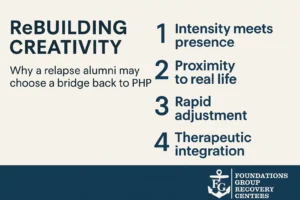
- Intensity meets presence: You get more hours, more consistency, more structure—so you’re not left in the gaps where relapse sneaks in.
- Proximity to real life: You return to your home, work, relationships—but with the anchor of PHP’s daily clinical time.
- Rapid adjustment: You can test triggers in real time and bring them back into treatment the next session. No waiting for weekly therapy to catch up.
- Therapeutic integration: Topic work around relapse, shame, damage, new coping strategies, identity repair—all in one container.
- Safety net before things spiral: Instead of waiting for things to deteriorate before reaching out, PHP gives you a middle ground of early intervention.
Staying in outpatient alone may not provide enough “muscle” to contain the strong currents that relapse reintroduces. PHP gives you a stronger hull—and a supportive crew.
What Rebuilding in PHP Feels Like
You might enter with fear, guardedness, hesitation. That’s okay. Real change almost always begins with a bit of resistance.
Here’s a trajectory many alumni describe:
- First days: You’re quiet. You’re analyzing yourself. You’re measuring your shame.
- Midst of week 1–2: One moment cracks: someone else says something that mirrors your experience. You realize you’re not alone.
- Weeks 2–3: You try again. You reach. You expose a fear. You feel glimmers of trust.
- By week 4+: You see shifts—not huge, but real. You miss fewer sessions. You talk about relapse without hiding. You reclaim agency.
You don’t have to come in polished. You come fragmented. That’s fine. The process is to heal through the fragmentation.
What a Relapsed Alumni Should Watch For in a PHP
Returning after relapse demands discernment. Not all programs will hold you well. Here’s what to look for:
- Compassion over discipline
A program that meets your relapse with curiosity, not guilt. - Relapse-specific therapy
Groups or modules that address the mechanics of relapse: what changed, what failed, what to rebuild. - Flexibility with accountability
You may test boundaries. You need a structure that adapts, but doesn’t flatten you. - Safe space for shame & anger
You may feel furious, humiliated, scared. You need environments that can hold those emotions without judgment. - Gradual reconnection to life
The return to work, relationships, stress doesn’t have to be full speed. A good PHP paces reentry. - Continued alumni support
After PHP, you’ll still need community. The decision to relapse return should include your pathway forward.
If you’re looking for a partial hospitalization program in Falmouth County, MA or in Barnstable County, choose one that understands relapse—not as a collapse, but a touchpoint of transformation.
Addressing the Fears That Echo After Relapse
Let’s name some of your internal objections. You’re not alone in them.
- “They’ll treat me like a newbie again.”
You bring history. A good PHP honors that. They ask, “What do you already know? What worked before? What broke?” - “I’ll be judged for falling off.”
Not by people who do this work well. They see relapse not as disqualification, but as data. - “I don’t deserve help anymore.”
You do. The willingness to come back is proof. Recovery isn’t earned—it’s extended. - “If I relapse again, they’ll drop me.”
In a well-run PHP, relapse becomes part of the conversation, not the verdict.
Real Alumni Voices (With Their Permission)
“I thought I had erased my progress. But in returning to PHP, I didn’t have to act like I’d never failed. They asked me what I’d gained anyway.”
“I came back quiet, ashamed. In week two, someone in group said something I had thought in secret. I spoke. The container held me. That’s how I started again.”
“Relapse didn’t erase the tools I learned before. It exposed where they were weak. PHP helped me rebuild those edges stronger.”
These words aren’t fluff. They’re lived. They’re testimony to the fact that return doesn’t negate your journey—it deepens it.
FAQs About Returning to PHP After Relapse
Do I lose my status as alumni if I relapse?
No. Many programs welcome alumni returnees. You don’t reset your identity—you reengage it.
Is PHP “too much” after relapse?
It may feel intense, but that intensity is often what helps you rebuild solid ground. The difference between overwhelm and over-support is a good design.
How long do people typically re‑enter?
It varies—some need a few weeks, others need months. The plan should adjust to your needs, not a preset timeline.
Can I still maintain obligations—work, family—during PHP?
Yes, often. PHP is meant to integrate with life, not pull you away entirely. You engage your world with more support, not less.
If I relapse again while in PHP, what happens?
You talk about it. You don’t get cut. Good PHPs view relapse as a data point—for what changed, what broke, what needs adjustment.
What if I’m scared to come back?
Then come softly. Start by talking to someone you trust. Ask questions. Visit the program. You don’t need to commit right away. But you deserve a space that sees you—even in your fissures.
Rebuilding Doesn’t Mean Repeating
Relapse may feel like you’re back at square one. But you are not. You carry insight, memory, experience, relationships, understanding of triggers, and a sense of your own strengths in crisis.
PHP after relapse is not a reset to zero. It’s reinvestment. It’s reclaiming the trajectory you nearly lost.
If you walk back in—open, honest, hurting—you might find more durability this time. More integration. More resilience. More proof that rebuilding is still your path.
Call (844) 763‑4966 to learn more about our partial hospitalization program services in Mashpee, MA.
You don’t have to start from scratch—you build from what’s already yours: your story, your scars, your yearning.