
I’ve sat across from painters, poets, musicians, coders—people who feel certain if they lose their edge, they lose their soul.
They confess to me in quiet: “What if sobriety erases me?” “What if I become generic?” “What if the meds make me safe but not alive?”
These fears are not frivolous. They are deeply human. They come from a lifetime of believing your most intense self can only be born from unrest.
Medication assisted treatment (MAT) is often misunderstood by creatives—seen as a compromise, or a silence to your internal music. But at Foundations Group Recovery Center in Mashpee, MA, we see it differently. We see it as scaffolding, not suppression. A foundation, not a formula.
Here’s what MAT really offers the creative mind. And why you don’t have to trade your voice to find steadiness.
The Creative Mind Carries Both Light and Noise
You may already know this: your creativity thrives in contrast. The deep joy, the sharp pain, the paradox of stillness and motion—that tension fuels your work.
But that same tension can feed addiction. The internal turbulence, the restless energy, the craving for transcendence—it’s a powerful siren.
So when MAT is introduced, many creatives worry: “Will I lose my fire? My angst? The darkness that often births my best work?”
That question matters. Because for people like you, keeping who you are isn’t optional. It’s essential.
Stability Doesn’t Silence You
Here’s a truth I’ve witnessed over years of clinical work: stability doesn’t equal blandness.
When the storm quiets enough, you can hear your own subtleties again. The half‑formed ideas, the whisper of narrative, the corners of your imagination you’d drowned out with noise.
MAT helps by:
- Quieting the compulsion, allowing space for reflection
- Smoothing the emotional highs and lows so ideas aren’t lost in chaos
- Giving you enough continuity to sustain long creative stretches
- Reducing burnout so you can return to your practice instead of disappearing into collapse
You don’t disappear. You deepen.
What MAT Does—Especially For Creatives
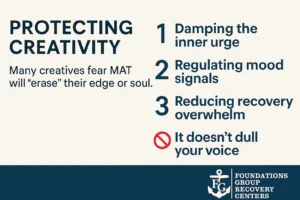
1. Damping the Inner Urge
Compulsion hijacks your attention. When MAT softens that grip, your mind can turn toward nuance again.
2. Regulating Mood Signals
Your brain’s dopamine, motivation, reward circuits—they’re often skewed in addiction. MAT helps recalibrate them, so you’re not chasing extremes.
3. Reducing Recovery Overwhelm
Early sobriety often feels like managing damage. With MAT, your system fights less and stabilizes sooner. So you get mental breathing room.
4. Enabling Identity Work
This is key. You finally have energy to ask: Who am I, apart from using? What parts of me survived behind that mask? What becomes possible now?
What MAT Doesn’t Do—So You Don’t Fear What It Doesn’t Do
- It doesn’t erase your voice or palette
- It doesn’t shortcut meaning, growth, or purpose
- It doesn’t guarantee emotional safety forever
- It doesn’t replace deep work—therapy, arts, purpose, relationships
If someone acts like it’s a cure-all, that’s misleading. MAT is a tool—powerful, essential for many—but not the entire toolkit.
How We Use MAT at Foundations Group (With Respect for Who You Are)
Your autonomy matters. Your creative identity matters. Your fears matter.
Here’s how we approach MAT with care:
- Comprehensive assessment — your mental, physical, creative history
- Choosing the right medication — we discuss options (e.g. buprenorphine, naltrexone) with you, not at you
- Integration with therapy & art work — identity, values, meaning all part of the plan
- Flexible dosing and tapering — not forced permanence; adjustments over time
- Safe transition planning — if you decide to taper, we help you design the transition
If you’re looking for medication assisted treatment in Barnstable County, MA or Falmouth, MA, we aim to serve you close to home—without asking you to give up your creative soul.
A Quiet Turn: When Creatives Begin to Rediscover
I’ll never forget a client—a poet—who told me she’d forgotten how her voice sounded without trembling. She worried the meds would flatten her words.
Six weeks in, she read to our group lines she’d been holding in silence. Words that felt fragile. Yet there they were. She said:
“I didn’t lose the tremor. I just felt it from a steadier place.”
That line echoes: your fire doesn’t vanish. It learns to live within a safer container.
How to Explore MAT as a Creative—Without Losing Yourself
- Ask directly: What parts of myself am I afraid I will lose?
- Seek a clinician who understands creativity, identity, nuance
- Start slow. Try a low dose, monitor what shifts
- Keep creation in your life—whether sketching, journaling, humming
- Document your experience: what changes? What lingers?
You don’t have to surrender your identity. You get to test the possibility that your voice can survive—and even expand.
FAQs About MAT for the Identity‑Driven Creative
Will it dull my sensibility?
Not permanently. There may be an adjustment period. But many creatives report deeper perception after stabilization rather than numbness.
Do I have to stay on meds forever?
Not always. Some people taper; others find long-term stability works best. You and your team decide.
Will it slow me down?
Some medications may require adaptation. But the reduced chaos often lets creative work return with greater consistency.
Does MAT work with artistic or expressive modalities?
Absolutely. Therapy, art, music, journaling, movement—all are part of the design. The meds support the process, not replace it.
What if people judge me for using medication?
Some may misunderstand. Many in the healing arts and modern recovery world see MAT as medicine and respect it. What matters is your truth.
Can I taper later, when I feel more stable?
Yes. If and when it’s safe, tapering is an option—gradual, supported, not enforced.
You came to this because part of you wants to heal. And another part fears what healing demands.
Take heart: medication assisted treatment doesn’t ask you to erase your edges. It asks you to stop fighting every day just to survive.
Here’s your invitation: step into a steadier space. Not because of weakness—but because your art, your depth, your voice deserve to live when life isn’t chaotic.
Call (844) 763‑4966 to learn more about our medication assisted treatment services in Mashpee, MA.
You don’t have to lose who you are to heal. You just need a shelter for your inner storm—and space to become more of what you already are.