
If you’ve been taking benzodiazepines for a while — whether that’s Xanax for anxiety, Klonopin for panic attacks, or Valium to help you sleep — stopping can feel more complicated than it sounds. Maybe you’ve tried before and felt terrible within a day. Maybe you’re scared of what stopping will actually look like.
That fear makes sense. Benzo withdrawal is real, it’s physical, and in some cases it’s genuinely dangerous. Here’s what you need to know before you make any changes.
What Are Benzodiazepines?
Benzos are a class of prescription medications that slow down the central nervous system. Common ones include:
- Alprazolam (Xanax) — prescribed for anxiety and panic disorder
- Clonazepam (Klonopin) — prescribed for panic disorder and seizures
- Diazepam (Valium) — prescribed for anxiety and muscle spasms
- Lorazepam (Ativan) — prescribed for anxiety and as a pre-surgical sedative
They work quickly and effectively — which is exactly why the brain adapts to them. After regular use, your nervous system recalibrates around the presence of the drug. When you remove it, the system swings in the opposite direction.
That swing is withdrawal.
Physical benzo addiction can develop even when you’re taking a medication exactly as prescribed. This isn’t a character flaw — it’s physiology.
Benzo Withdrawal Symptoms
Withdrawal from benzodiazepines affects both the body and the mind. The two categories often overlap and feed each other.
Physical symptoms
- Tremors and shaking
- Sweating, especially at night
- Heart palpitations and elevated heart rate
- Headaches and muscle aches
- Nausea and vomiting
- Sensitivity to light and sound
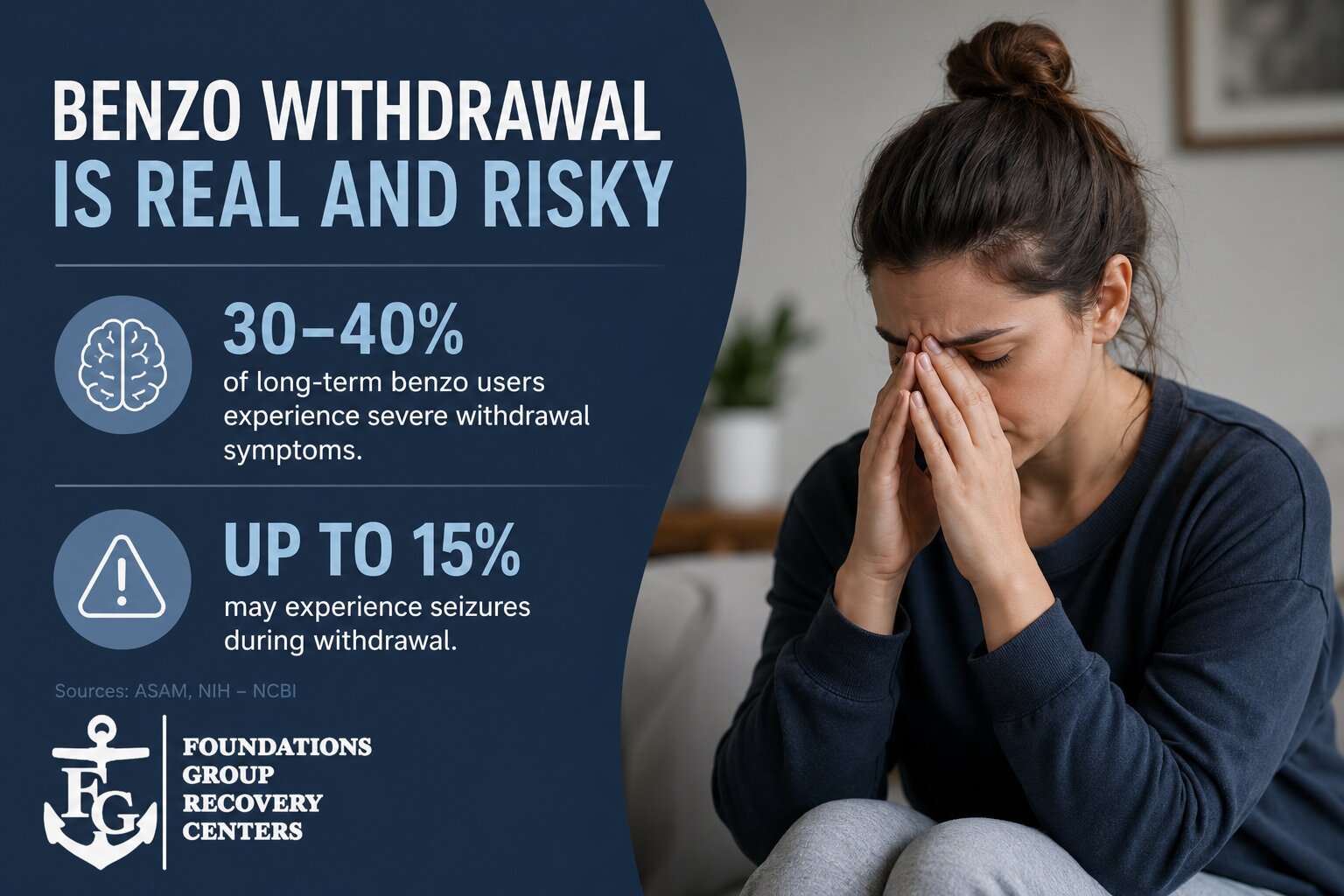
- Seizures — this is the critical one
Benzo withdrawal is one of the few withdrawal syndromes that can cause seizures, even in people who have no history of seizure disorders. This is why stopping cold turkey without medical oversight carries real risk.
Psychological symptoms
- Intense anxiety — often worse than the anxiety the medication was originally treating
- Panic attacks
- Insomnia, vivid nightmares
- Depression and emotional flatness
- Difficulty concentrating
- Paranoia or depersonalization (feeling detached from yourself)
The psychological symptoms often start before the physical ones and tend to last longer. Many people describe the anxiety spike of early benzo withdrawal as unlike anything they’ve experienced — more severe and more physical than their baseline anxiety ever was.
The Benzo Withdrawal Timeline
How quickly symptoms start and how long they last depends primarily on which benzo you were taking. Short-acting and long-acting benzos behave very differently.
Short-acting benzos (Xanax, Ativan)
- Onset: 6–12 hours after last dose
- Peak: 1–4 days
- Duration of acute phase: 5–10 days
Because these drugs leave the system faster, withdrawal hits harder and sooner.
Long-acting benzos (Valium, Klonopin)
- Onset: 24–48 hours after last dose
- Peak: 1–2 weeks
- Duration of acute phase: 2–4 weeks, sometimes longer
The slower half-life means symptoms build more gradually — but they can also stretch on well past the two-week mark.
Post-acute withdrawal syndrome (PAWS)
For many people, the acute phase isn’t the end of it. PAWS refers to a prolonged set of symptoms — usually psychological — that can persist for weeks to months after the drug is out of your system. Common PAWS symptoms include:
- Ongoing anxiety or low-level depression
- Sleep disruption
- Difficulty with memory and concentration
- Mood swings
PAWS isn’t a sign that something is wrong with your recovery. It’s the brain continuing to readjust. The symptoms typically fade over time, especially with proper support.
Why Quitting Cold Turkey Is Dangerous
This is the most important thing to understand about benzo withdrawal: stopping abruptly is medically risky.
Unlike opioid withdrawal — which is genuinely miserable but rarely life-threatening — benzo withdrawal can cause grand mal seizures. This can happen even if you’ve been taking a relatively low dose for a moderate amount of time. There is no reliable way to predict who will seize and who won’t.
The other risk of abrupt stopping is severe psychological destabilization. The rebound anxiety and panic that often accompany the first few days can be disorienting enough that people in unsupported withdrawal are at higher risk of making impulsive and dangerous decisions.
The medically accepted approach is a supervised taper — gradually reducing the dose over weeks or months, at a pace your nervous system can tolerate. This significantly reduces seizure risk and makes the overall process far more manageable.
What Medical Detox for Benzos Actually Looks Like
A supervised detox on Cape Cod doesn’t mean you’re locked in a room and left to struggle. Medical detox for benzos typically involves:
- A thorough intake assessment (current medications, how long you’ve been using, health history)
- A tapering schedule designed around your specific situation
- Medical monitoring for seizure risk and vital sign changes
- Comfort medications where appropriate — things that ease the anxiety and physical symptoms without creating a new dependency
- Regular check-ins from nursing and clinical staff
The goal isn’t just to get through it. It’s to get through it safely enough that you’re ready to do the actual work of recovery on the other side.
After detox, most people benefit from stepping into structured outpatient care — an intensive outpatient program where you can address the underlying reasons the benzo use became a problem in the first place, with the support of a clinical team around you.
You Don’t Have to White-Knuckle This
If you’ve been trying to manage on your own — reducing your dose a little each week, suffering through the nights, not telling your doctor — you’re not alone. A lot of people try that approach first. Some manage. Many don’t, and end up right back where they started.
The thing about benzo withdrawal is that the difficulty of it is not a measure of your willpower. It’s chemistry. Your nervous system is doing exactly what nervous systems do when a substance is removed. Getting support isn’t giving up — it’s working with your biology instead of against it. Safely overcome with expert care at Foundations Group Recovery Centers, proudly serving Barnstable County and Falmouth, MA.
Ready to stop safely? The team at Foundations Group can help. We work with most insurance plans and offer confidential evaluations with no pressure and no judgment. Call us 24/7 at (844) 763-4966 or verify your insurance coverage online.