
If a doctor recently told you that you have “alcohol use disorder,” you might have walked out wondering what that actually means — and whether it’s the same thing as being an “alcoholic.”
The short answer: they describe the same basic problem, but they’re not quite the same thing. The distinction matters, and not just as a technicality.
Why the Language Changed
For most of the 20th century, “alcoholism” was the dominant term — an informal word that carried a lot of weight, and a lot of stigma. It implied a certain type of person: someone who had lost everything, who couldn’t hold a job, who drank from the moment they woke up.
That image is inaccurate for most people with serious drinking problems, and it kept a lot of people from recognizing themselves in it. If you’re still going to work, still holding your marriage together, still managing — you might not think the word “alcoholic” applies to you. Even if your drinking is causing real damage.
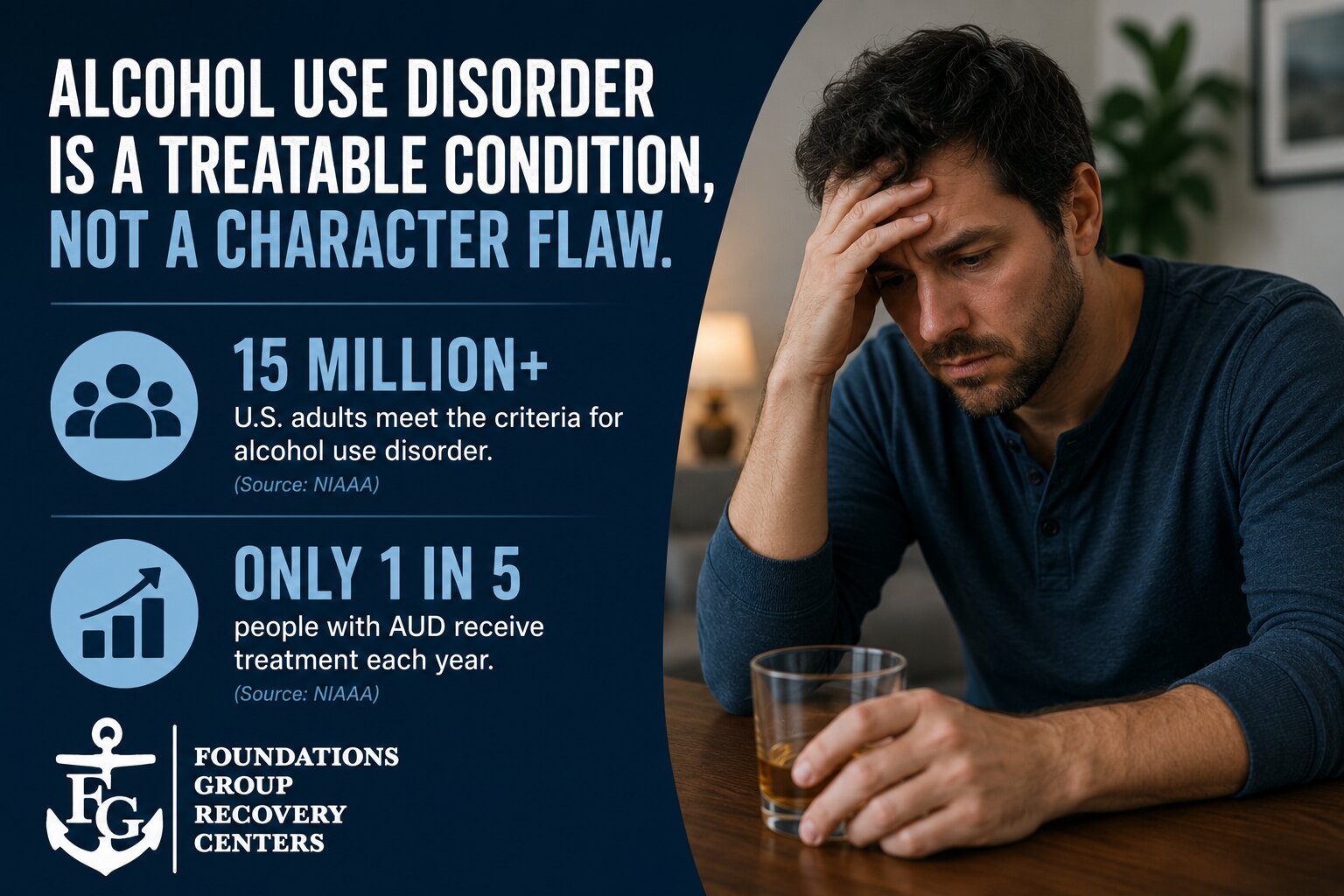
In 2013, the American Psychiatric Association updated the Diagnostic and Statistical Manual of Mental Disorders (DSM-5) and replaced the older terms — “alcohol abuse” and “alcohol dependence” — with a single diagnosis: alcohol use disorder (AUD). The change was intentional. AUD is a clinical description, not a moral label. And critically, it exists on a spectrum.
What Alcohol Use Disorder Actually Is
AUD is diagnosed based on 11 criteria, grouped around patterns of drinking that cause real problems in someone’s life. A clinician will ask about things like:
- Drinking more than you intend to, or for longer than you planned
- Trying to cut back and not being able to
- Spending a lot of time drinking or recovering from it
- Craving alcohol when you’re not drinking
- Drinking interfering with work, relationships, or responsibilities
- Continuing to drink even when it causes problems
- Giving up activities you used to care about
- Drinking in situations where it’s physically dangerous
- Building tolerance — needing more to get the same effect
- Experiencing withdrawal symptoms when you don’t drink
Mild AUD = 2–3 of these criteria. Moderate AUD = 4–5. Severe AUD = 6 or more.
“Severe AUD” is roughly what most people mean when they say “alcoholism.” But the mild and moderate categories are just as real, and just as worth addressing — often earlier, before the consequences compound.
So What Do People Mean When They Say “Alcoholic”?
The word “alcoholic” isn’t a clinical term, but it hasn’t gone away. Most people use it to describe someone whose drinking has clearly spiraled — lost jobs, broken relationships, physical decline.
The problem with that framing is the threshold. If someone has to look like that before the word applies, it creates an easy out: “I’m not that bad.” And “not that bad” can go on for a long time before it becomes undeniable.
AUD’s spectrum framing removes that exit. You don’t have to hit rock bottom to have a diagnosable, treatable condition. Two criteria is enough for a clinical diagnosis — and a reason to take a serious look at what’s happening.
Signs and Symptoms of Alcohol Use Disorder
The 11 DSM criteria are the clinical picture. In day-to-day life, AUD often shows up as:
Physical signs
- Frequent hangovers that take longer to recover from
- Shaking, sweating, or nausea when you haven’t drunk in a while
- Weight changes, skin changes, disrupted sleep
- Blackouts — gaps in memory from drinking
Behavioral signs
- Drinking earlier in the day than you used to
- Hiding how much you’re drinking from people close to you
- Making plans around when and where you can drink
- Drinking alone regularly
Psychological signs
- Using alcohol to manage anxiety, stress, or emotional pain
- Feeling irritable, anxious, or low when you’re not drinking
- Knowing it’s a problem and not being able to stop anyway
The last one is the one most people recognize. The gap between “I should stop” and actually stopping is where alcohol addiction lives.
Does Having AUD Mean You Need Rehab?
Not necessarily — and that’s actually the point of the spectrum.
Mild AUD may respond well to individual therapy, support groups, or a structured outpatient program. Moderate AUD often benefits from a more intensive structure — like an intensive outpatient program — where you’re getting daily or near-daily clinical support while still living at home.
Severe AUD, particularly when there’s a physical dependence (meaning stopping causes withdrawal), typically needs medical supervision. Alcohol withdrawal is one of the few withdrawal syndromes that can cause seizures — going cold turkey without support carries real risk.
The right starting point depends on where you are right now. A free substance use evaluation is the most straightforward way to figure that out — no commitment, just an honest conversation about what’s going on and what the options are.
What Treatment Looks Like
Treatment for alcohol use disorder isn’t one-size-fits-all. The typical path looks something like this:
Evaluation → Detox (if medically needed) → PHP or IOP → Outpatient → Aftercare
Not everyone starts at the same point. Some people go straight to IOP. Some need a medical detox first. A good treatment team will help you figure out where you fit in that continuum — and adjust as you go.
Not Sure Where You Fall? A Free Evaluation Can Help.
You don’t have to decide whether you’re an “alcoholic” to ask for help. You don’t have to have lost everything, or be drinking every morning, or fit anyone’s picture of what the problem looks like.
If drinking is causing problems — in your relationships, your health, your work, your sense of yourself — that’s enough.
Foundations Group Recovery Centers offers free, confidential substance use evaluations on Cape Cod in Mashpee, MA. No labels, no judgment. Just a conversation. Call us 24/7 at (844) 763-4966 or book a free evaluation online. Most insurance accepted — check your coverage here. Safely overcome with expert care at Foundations Group Recovery Centers, proudly serving Barnstable County and Falmouth, MA.