
You’ve had the conversation. Probably more than once. You’ve watched them promise to cut back, and then not. You’ve covered for them, worried about them, and maybe started to feel like you’re losing yourself in the process.
If that sounds familiar, you’re not doing this wrong. Getting someone into treatment when they’re resistant is genuinely hard — there’s no trick that works every time. But there are approaches that work better than others, and there are things you can do right now that increase the odds.
This is for the family members, partners, and friends who are trying to figure out what those things are.
Step 1: Have the Right Conversation
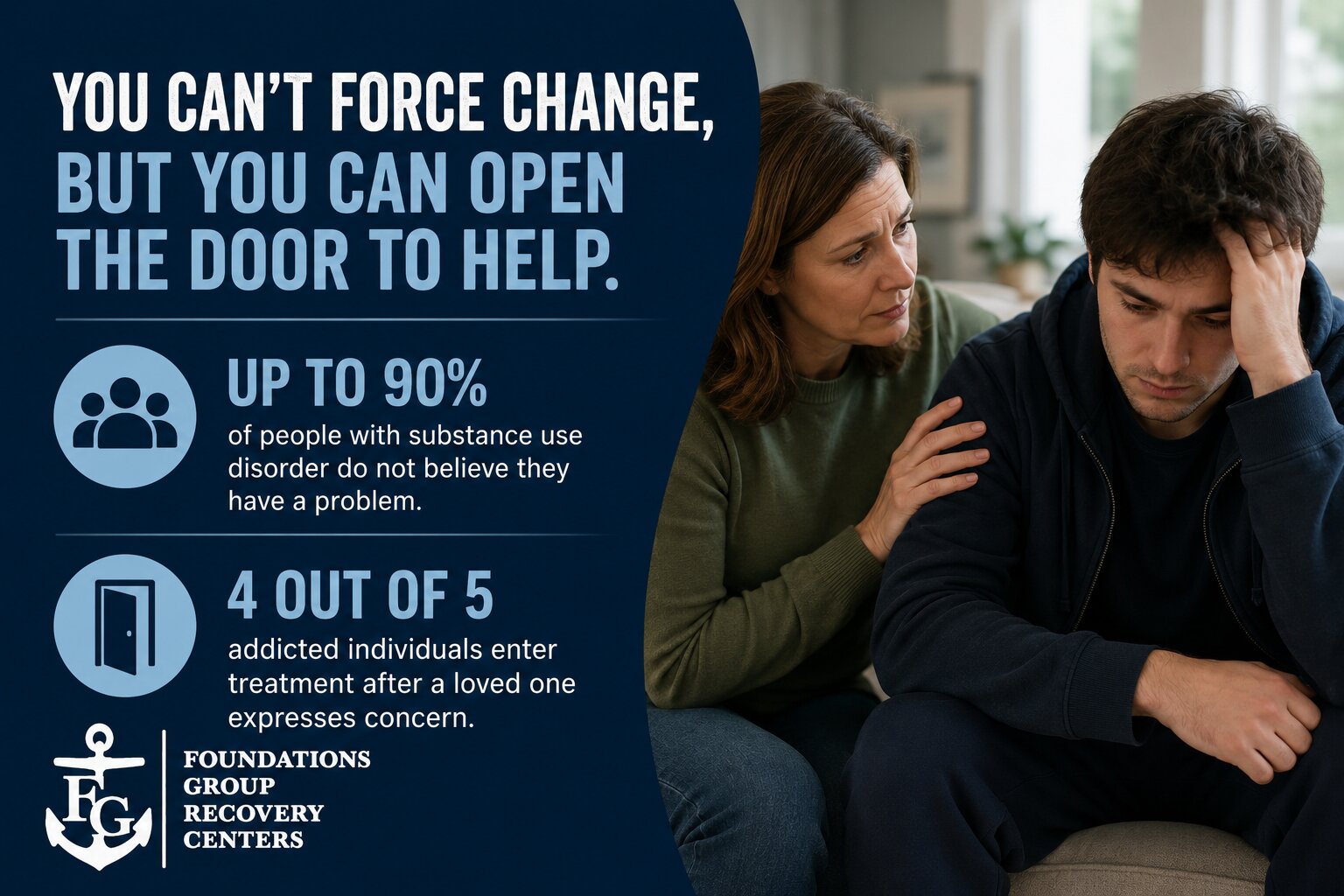
The instinct when someone is in denial is to make the case louder. More evidence. More urgency. More emotion. But confrontational conversations almost always produce one thing: defensiveness. And a defensive person digs in.
What tends to work better:
- Pick the right moment. Not when they’re using, not when you’re at your limit. A calm, sober window — even a short one — is more productive than a heated confrontation at the worst possible time.
- Use “I” language. “I’m scared” lands differently than “you’re destroying everything.” One invites a response; the other invites a fight.
- Be specific, not global. “I’ve noticed you haven’t been making it to work on time, and I’m worried” is harder to dismiss than “you’re ruining your life.”
- Don’t set ultimatums you’re not prepared to follow through on. Empty ultimatums teach the person that nothing you say has real consequences.
You don’t have to resolve everything in one conversation. The goal of the first conversation is often just to open a door, not push someone through it.
Step 2: Remove the Logistics Barrier Before You Ask Again
One of the most common reasons people agree to get help and then don’t follow through is that the next step feels overwhelming. They don’t know how it works. They don’t know what insurance covers. They don’t know what to pack or how long they’ll be gone or what happens at work.
You can solve most of this before the conversation happens again.
- Call the treatment center first. Admissions teams talk to families all the time — that’s their job. You can get answers to most logistical questions without your loved one being involved.
- Verify insurance coverage ahead of time so “I can’t afford it” isn’t a reason to say no.
- Know what the first few days actually look like so you can describe it to them.
When you can say “I’ve already looked into it, here’s what it looks like, and here’s what it costs” — you’ve removed the unknown. That’s often what’s standing between someone and saying yes.
Step 3: Consider a Structured Intervention
If direct conversations aren’t moving things forward, a structured intervention may help. Two models are worth knowing about:
CRAFT (Community Reinforcement and Family Training) is an approach that trains family members to change how they interact with their loved one — reinforcing non-using behavior and allowing natural consequences to occur when using behavior happens. Research supports it as one of the more effective approaches for getting resistant people into treatment. It’s not confrontational; it’s strategic.
Traditional intervention (the kind you might picture from TV) can work, but it carries risk. A poorly timed or poorly facilitated confrontation can backfire and push someone further away. If you want to try this approach, working with a professional interventionist significantly improves the odds.
FGRC’s family support program can help you figure out which approach makes sense for your situation and connect you with the right resources.
Step 4: Know Your Legal Options in Massachusetts
Massachusetts has a law specifically designed for situations where someone’s addiction is putting them at serious risk and they won’t accept help voluntarily: Section 35.
Section 35 allows a family member, police officer, or physician to petition a district court to involuntarily commit a person for addiction treatment. If the court agrees — based on evidence that the person poses a likelihood of harm to themselves or others — they can be ordered into treatment for up to 90 days.
A few things to understand about Section 35:
- It’s a last resort, not a first step. Courts take it seriously, and the bar for approval is high.
- The process is not instantaneous — there’s a court hearing, and the person is assessed before a commitment is ordered.
- The outcome varies. Involuntary treatment can be the thing that saves someone’s life. It can also create resentment that makes future engagement harder. It depends on the person and the circumstances.
If you’re considering this route, speaking with an attorney or your loved one’s physician first is the right move. You can also call the Massachusetts Substance Use Helpline at 1-800-327-5050 for guidance specific to your situation.
What If They Still Say No?
Sometimes you do everything right and the answer is still no. That’s painful, and it doesn’t mean you’ve failed.
What it might mean is that it’s not the moment yet. Addiction rarely resolves in a single confrontation — most people who eventually get into treatment have had several “almost” moments first. Your job is to keep the door open without losing yourself in the process.
Detachment with love means caring deeply about someone while accepting that you cannot control what they do. Al-Anon and other family support groups exist because this is one of the hardest things a person can experience, and you don’t have to do it alone.
What you can control: being honest about what you will and won’t accept, taking care of yourself, and making sure your loved one knows that help is available whenever they’re ready.
When They Say Yes: What to Do in the Next 24 Hours
When someone agrees to get help, move quickly — not urgently enough to scare them, but quickly enough that the window doesn’t close.
- Call admissions while they’re still agreeable. Our team at FGRC can walk through the next steps with you on the same call.
- Get insurance verified so there are no surprises.
- Help them pack the practical things — comfortable clothes, any prescribed medications, something from home that’s grounding.
- Drive them yourself if you can. The trip to treatment is not the time to leave logistics to chance.
You’ve Already Taken the First Step
Looking for answers — even at midnight, even when you’re not sure what to do — is the first step. You haven’t failed. You’re still showing up.
Foundations Group Recovery Centers is on Cape Cod in Mashpee, MA. Our admissions team talks to families like yours every day, and we’re used to exactly this kind of conversation. There’s no pressure and no judgment — just honest guidance on what’s available and what might help. Safely overcome with expert care at Foundations Group Recovery Centers, proudly serving Barnstable County and Falmouth, MA.
Call us 24/7 at (844) 763-4966 or schedule a free, confidential substance use evaluation online. Most insurance accepted — check your coverage here.