
Many people have heard someone say, “Adderall is basically meth.”
That statement is simple—but it isn’t accurate.
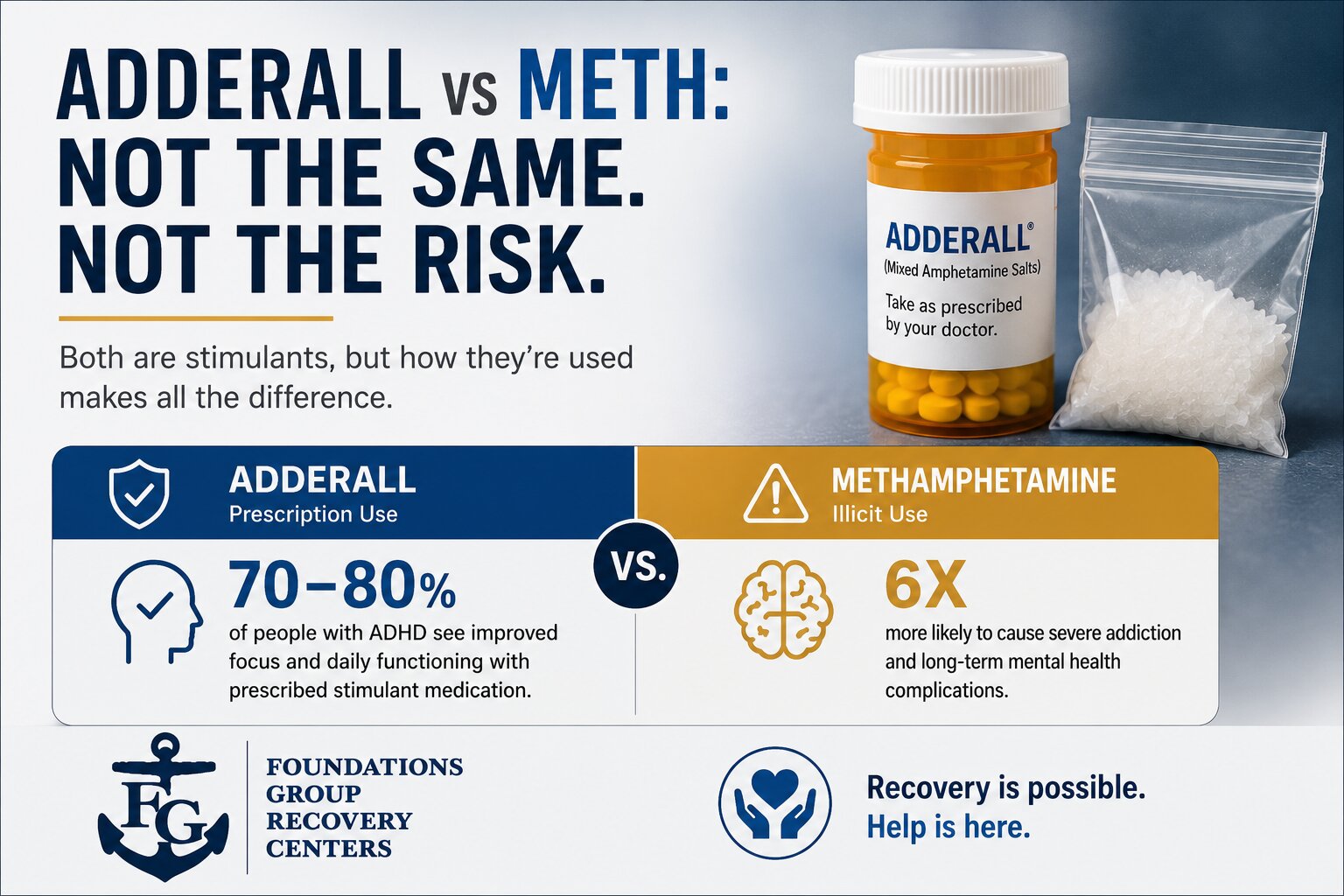
If you’ve been searching for Adderall vs meth, you’re probably trying to understand whether they’re truly the same drug, whether prescribed ADHD medication is safe, or whether increasing your Adderall use should be a cause for concern. While both medications belong to the amphetamine family, they differ in important ways that affect their medical use, potency, risks, and potential for addiction. If you’re concerned about stimulant misuse, learning more about meth addiction treatment can help you understand when professional support may be appropriate.
The goal isn’t to create fear around ADHD medication.
Millions of people take prescribed Adderall safely under medical supervision. At the same time, misusing Adderall can increase health risks and, in some cases, lead to stimulant addiction.
Understanding the similarities—and the equally important differences—can help you make informed decisions without relying on myths or sensational headlines.
Adderall vs Meth: At a Glance
Although both drugs are amphetamines, they are not interchangeable.
Feature |
Adderall |
Methamphetamine (Meth) |
|---|---|---|
| Drug class | Prescription amphetamine stimulant | Methamphetamine stimulant |
| Legal status | Prescription medication (Schedule II) | Illegal in most non-medical settings; prescription methamphetamine exists but is rarely prescribed |
| Purity | Pharmaceutical-grade with standardized dosing | Often illicitly manufactured with variable purity |
| Potency | Effective therapeutic stimulant when prescribed | Generally more potent and longer-lasting |
| Typical use | Oral tablets or capsules as prescribed | Often smoked, injected, snorted, or swallowed |
| Medical use | ADHD and narcolepsy treatment | Rarely prescribed for ADHD or obesity in limited circumstances |
| Addiction potential | Increased with misuse or prolonged nonmedical use | High, particularly with repeated illicit use |
Both medications affect the brain’s dopamine and norepinephrine systems, but how they are produced, prescribed, and commonly used creates significant differences in risk.
Both Are Amphetamines—But the Differences Matter
One reason people compare Adderall and meth is that they belong to the same family of stimulant medications.
Both increase levels of dopamine and norepinephrine, neurotransmitters involved in:
- Attention
- Alertness
- Motivation
- Energy
- Reward
This shared mechanism explains why both can increase wakefulness and improve concentration.
However, the similarities shouldn’t overshadow the differences.
Adderall
Adderall contains mixed amphetamine salts manufactured under strict pharmaceutical standards.
When prescribed for ADHD, it is:
- Carefully dosed
- Taken orally
- Monitored by a healthcare provider
- Adjusted based on the individual’s response
For many people with ADHD, Adderall helps improve attention, reduce impulsivity, and support daily functioning.
Methamphetamine
Methamphetamine is chemically related to amphetamine but has structural differences that allow it to enter the brain more rapidly and produce stronger stimulant effects.
Most meth used recreationally is:
- Illicitly manufactured
- Variable in purity
- Used in larger amounts
- Smoked, injected, or snorted
These methods deliver the drug to the brain much more quickly, producing a larger dopamine surge and significantly increasing addiction risk.
The difference isn’t simply the chemical structure.
It’s also the dose, purity, method of use, frequency, and medical supervision that shape each drug’s overall risk profile.
Effects and Risks by Use Type
The way a stimulant is used has a major influence on its effects and potential harms.
Prescribed Adderall at Therapeutic Doses
When taken exactly as prescribed, Adderall is intended to:
- Improve focus
- Reduce impulsivity
- Increase attention span
- Support executive functioning
- Help individuals manage ADHD symptoms
Healthcare providers monitor:
- Blood pressure
- Heart rate
- Side effects
- Dose adjustments
- Potential misuse
Like any medication, Adderall carries risks, but medical supervision helps reduce those risks while maximizing its benefits.
Taking prescribed Adderall as directed is not the same as misusing stimulants.
Adderall Misuse
Problems arise when Adderall is used differently than prescribed.
Examples include:
- Taking larger doses
- Taking extra doses throughout the day
- Using someone else’s prescription
- Taking it to stay awake
- Using it for weight loss
- Using it to improve academic or work performance
- Crushing and snorting pills
- Injecting dissolved medication
Misuse increases the likelihood of:
- Elevated heart rate
- High blood pressure
- Chest pain
- Anxiety
- Panic attacks
- Insomnia
- Appetite suppression
- Mood swings
- Dependency
Over time, repeated misuse can change the brain’s reward system, making it increasingly difficult to function without the medication.
Meth Use
Methamphetamine generally produces a much larger dopamine release than therapeutic doses of Adderall.
Because of its greater potency and the ways it is commonly used, meth is associated with:
- Rapid tolerance
- Strong cravings
- Severe addiction
- Sleep deprivation
- Weight loss
- Aggressive behavior
- Paranoia
- Hallucinations
- Methamphetamine-associated psychosis
Long-term meth use can have devastating effects on both physical and mental health.
While not everyone who uses meth experiences these complications, the risk is substantially higher than with prescribed stimulant use.
When Prescribed Stimulant Use Becomes Misuse
One of the most important questions isn’t whether Adderall and meth are the same.
It’s whether someone’s relationship with Adderall has begun to change.
Misuse doesn’t always begin with recreational intent.
Many people initially increase their dose because:
- The medication seems less effective.
- They have a demanding workload.
- They need to stay awake longer.
- They want to lose weight.
- They feel more productive while taking it.
Over time, these patterns can become difficult to control.
Signs that prescribed stimulant use may be shifting toward misuse include:
Taking More Than Prescribed
Increasing your dose without consulting your prescriber can increase the risk of dependence and serious side effects.
Using It for Reasons Other Than ADHD
Taking Adderall solely to:
- Pull all-night study sessions
- Improve athletic performance
- Lose weight
- Increase productivity
- Stay awake for work
is considered nonmedical use, even if the medication was originally prescribed.
Using Someone Else’s Prescription
Prescription stimulants are prescribed for specific medical conditions and individual health needs.
Taking medication prescribed to another person is both unsafe and illegal.
Using Non-Oral Methods
Crushing, snorting, or injecting Adderall bypasses its intended delivery system and increases addiction risk by producing a faster, more intense effect.
Building Tolerance
You may notice:
- Needing larger doses for the same effect
- Medication wearing off much sooner
- Feeling unable to function without it
- Spending significant time thinking about your next dose
These changes may indicate that dependence is developing.
Recognizing these signs early allows people to seek help before problems become more severe.
Can Adderall Misuse Lead to Addiction?
Yes.
Although many people use Adderall safely under medical supervision, repeated misuse can lead to amphetamine addiction.
Addiction involves more than physical dependence.
Someone may continue using despite:
- Health problems
- Relationship conflict
- Work or school difficulties
- Financial consequences
- Failed attempts to cut back
As tolerance grows, larger doses are often needed to achieve the same effects, increasing the likelihood of complications.
The earlier someone addresses these changes, the better their chances of preventing more serious problems.
Getting Help for Stimulant Misuse
Whether someone is struggling with meth use or misusing prescription Adderall, the underlying challenges often share common features:
- Compulsive use
- Cravings
- Loss of control
- Difficulty stopping despite negative consequences
Treatment is not about judging how someone arrived there.
Some people began with a legitimate prescription.
Others experimented recreationally.
Still others were trying to improve performance at school or work.
Whatever the path, recovery is possible.
Comprehensive treatment may include:
- Medical evaluation
- Individual therapy
- Cognitive behavioral therapy (CBT)
- Group counseling
- Relapse prevention planning
- Treatment for co-occurring mental health conditions
- Ongoing recovery support
Seeking help early can reduce the likelihood of long-term health complications and support lasting recovery.
Frequently Asked Questions
Is Adderall the same as meth?
No. Both are amphetamines, but they are different substances. Adderall is a prescription medication containing mixed amphetamine salts, while methamphetamine has a different chemical structure and is generally more potent. The way each is produced, prescribed, and commonly used also contributes to major differences in risk.
Is Adderall more dangerous than meth?
When taken exactly as prescribed under medical supervision, Adderall has an established safety profile for treating ADHD and certain other conditions. Methamphetamine carries a much higher risk of addiction and severe physical and mental health complications, particularly when used illicitly. However, misusing Adderall can still lead to serious health risks and addiction.
Can Adderall misuse lead to meth use?
Not necessarily. Most people who misuse Adderall do not go on to use methamphetamine. However, untreated stimulant misuse can progress over time, and some individuals may seek stronger stimulants as tolerance develops. Addressing Adderall misuse early can reduce the risk of more serious substance use problems.
Take the Next Step
If you’re worried that your Adderall use has changed—or if methamphetamine use has become difficult to control—know that help is available. Recovery doesn’t begin with judgment. It begins with honest information and compassionate support. Get help that’s close to home, Proudly serving in Falmouth, Barnstable County, MA.
Call (844) 763-4966 or learn about meth addiction treatment at Foundations Recovery.