
I didn’t walk into the idea of getting help with confidence.
I walked in with resistance disguised as logic.
“I just need to cut back.”
“I’m not like other people who need treatment.”
“I’ll lose something important if I stop.”
But underneath all of that was one belief I couldn’t shake:
Sobriety will take away who I am.
And I held onto that belief longer than I want to admit.
The Story I Told Myself About Who I Was
I had built an identity I was proud of—or at least one I knew how to maintain.
I was:
- The one who could keep the energy going
- The one who made people laugh
- The one who could turn a quiet night into something memorable
And if I’m being honest… substances felt like part of that identity.
Not the whole thing. But enough of it that I couldn’t separate the two.
So when people started suggesting help—even something like medication support in Massachusetts—it didn’t feel like support.
It felt like a threat.
The Fear Wasn’t About Stopping—It Was About Losing Access
That’s what I couldn’t explain at the time.
I wasn’t afraid of not drinking or using.
I was afraid of losing access to:
- The version of me that felt more open
- The version of me that didn’t overthink everything
- The version of me that could connect instantly
Because without that… who was I?
Just quieter? More anxious? Less interesting?
That question sat with me longer than any consequence ever did.
I Didn’t See How Much I Was Already Compromising Myself
Here’s the part I wish someone had helped me see sooner.
I thought I was protecting my identity.
But I was slowly shrinking it.
- I avoided things that didn’t fit the version of me I had built
- I relied on substances to feel “ready” to be myself
- I started needing something external just to access parts of my own personality
And that’s a hard truth to face:
When you need something to be yourself…
you’re not actually free to be yourself.
The First Step Didn’t Feel Like Freedom—It Felt Like Loss
When I finally made the decision to try something different, I expected relief.
Instead, I felt… off.
Everything was quieter.
Not peaceful—just unfamiliar.
Conversations felt slower.
My reactions felt delayed.
Even my sense of humor felt different.
And my first thought was:
“I knew it. I lost it.”
That’s where a lot of people turn back.
Because the early version of sobriety doesn’t feel like the best version of you.
It feels like a stripped-down version.
What No One Told Me About the “In Between”
There’s a space no one really prepares you for.
You’re not who you were before.
But you’re not yet who you’re becoming.
It’s awkward. Uneven. Sometimes uncomfortable.
You might:
- Feel less expressive at first
- Question your personality
- Wonder if things will ever feel natural again
And this is where the lie gets loud again:
“See? This is who you are without it.”
But that’s not true.
That’s just the adjustment period.
Then the Small Moments Started Adding Up
There wasn’t a big breakthrough moment.
It was quieter than that.
I remember laughing at something—and realizing I didn’t have to force it.
I had a conversation where I didn’t replay everything afterward.
I showed up somewhere and didn’t need anything to feel “ready.”
These moments didn’t feel extreme.
They felt steady.
And over time, that steadiness started to feel better than the intensity I used to chase.
I Didn’t Become Boring—Just More Honest
This was one of the biggest shifts for me.
I used to think being “interesting” meant being on all the time.
Quick. Funny. Engaging. Effortless.
But that version of me came with pressure.
Without substances, I didn’t lose my personality.
I lost the pressure to perform it.
I could be:
- Quiet without overthinking it
- Social without forcing it
- Funny without needing to maintain it
And that felt… different.
But also more real.
Hearing Other People Say It Helped Me Believe It
I wasn’t the only one carrying this fear.
I heard it from others in different ways:
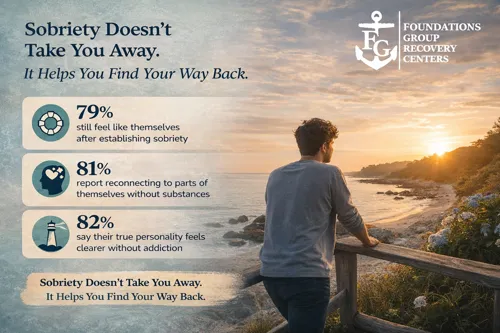
“I thought I’d lose my edge, but I actually feel sharper.”
“I thought I’d be boring, but I just stopped trying so hard.”
“I feel more like myself now than I did before.”
At first, I didn’t believe them.
But over time, I started to understand what they meant.
They weren’t saying they became better people.
They were saying they became more themselves—without the constant interference.
Something Shifted in Me Living Near the Coast
There’s something about slowing down that feels uncomfortable at first.
I remember walking one morning, not far from Falmouth, Massachusetts, noticing how quiet everything felt.
No rush. No urgency. No need to be anything other than where I was.
And for a second, I felt restless.
Like I should be doing more. Being more.
But then it hit me:
That restlessness used to drive everything.
And for the first time, it wasn’t in control.
That moment stayed with me.
Because it wasn’t dramatic—but it was real.
The Truth I Had to Learn the Hard Way
Sobriety didn’t take anything essential from me.
It took away what was covering it.
And yeah—there was an adjustment.
There were moments where I questioned everything.
But over time, I realized something important:
The parts of me I was afraid of losing…
were never dependent on substances to begin with.
They were just harder to access without them at first.
You Don’t Have to Believe It Yet
If you’re reading this and thinking:
“That might be true for you, but I’m different.”
I get it.
I thought the same thing.
You don’t have to fully believe that you won’t lose yourself.
You just have to be open to the possibility that the story you’ve been telling yourself…
might not be the full truth.
FAQs: The Fear of Losing Yourself in Sobriety
Will I feel like a completely different person?
At first, things can feel unfamiliar. But over time, most people report feeling more like themselves—not less. The difference is that it’s more stable and consistent.
What if I lose my social confidence?
Social confidence may feel different early on, but it often returns in a more natural way. You don’t have to rely on anything external to access it.
Does medication change your personality?
Many people worry about this, but the goal isn’t to change who you are—it’s to reduce the internal noise that makes it hard to function or feel steady.
What if I don’t like who I am without substances?
That’s a valid fear. But recovery gives you the space to actually shape who you are, instead of reacting or coping automatically.
How long does it take to feel normal again?
There’s no fixed timeline. It’s different for everyone. But what most people notice is gradual improvement—not perfection, just more ease over time.
Can I still be creative or expressive?
Yes. In fact, many people find their creativity becomes more sustainable and consistent without the highs and crashes.
If You’re Still Holding Onto That Fear
You’re not wrong for feeling it.
You’re not weak for questioning this.
And you’re definitely not alone.
But if there’s even a small part of you wondering what it would feel like to show up without needing anything to get there…
That part is worth listening to.
If you want to explore what that next step could look like, you can do that without pressure.
Call (844)763-4966 or visit our page to learn more about our medication assisted treatment in Massachusetts.