
There’s a quiet question that doesn’t always get said out loud.
It doesn’t sound like fear at first. It sounds like hesitation. Like overthinking. Like “maybe later.”
But underneath it is something deeply personal:
“If I stop… will I still be me?”
As a clinician, I’ve sat with people in that exact moment—right on the edge of change, but held back by something that feels too important to risk. Not the substance itself, but what it seemed to unlock.
And if you’re here, there’s a good chance you’re not afraid of getting better.
You’re afraid of disappearing.
The Identity You Built Wasn’t Accidental
Let’s name something clearly: you didn’t just stumble into who you are.
The way you think.
The way you feel things deeply—or maybe avoid feeling them at all.
The way you show up socially, creatively, emotionally.
Some of that has been shaped—at least in part—by your relationship with substances.
Not because you’re weak.
Because you adapted.
For some, it made conversations easier.
For others, it softened anxiety enough to function.
For many, it opened emotional doors that otherwise felt locked.
So of course the thought of letting it go doesn’t feel simple.
It feels like you’re being asked to give up access to parts of yourself that matter.
This Fear Isn’t Irrational—It’s Protective
When someone considers change, especially something as personal as medication support, the brain doesn’t just evaluate logic.
It protects identity.
It asks:
- Will I still feel like myself?
- Will people recognize me?
- Will I lose the parts of me I actually like?
These aren’t small questions. They’re core to how you understand who you are.
And in places like Falmouth, Massachusetts, where community identity and social circles can feel tight-knit and visible, the fear of changing how you show up can feel even heavier. It’s not just internal—it feels like everyone might notice.
So instead of pushing this fear away, it’s worth sitting with it.
Because it’s trying to protect something meaningful.
The Version of You That Felt “Better” Was Real—But It Wasn’t Sustainable
Here’s where the conversation shifts.
That version of you—the more open one, the more creative one, the more connected one—that wasn’t fake.
You didn’t imagine that.
But it also didn’t come without cost.
Maybe it came with:
- Emotional crashes afterward
- Regret you had to carry quietly
- A dependency that slowly started making decisions for you
What started as access eventually became something you had to maintain.
And that’s the part people don’t always say out loud:
At some point, it stops being about becoming more yourself…
and starts becoming about avoiding being without it.
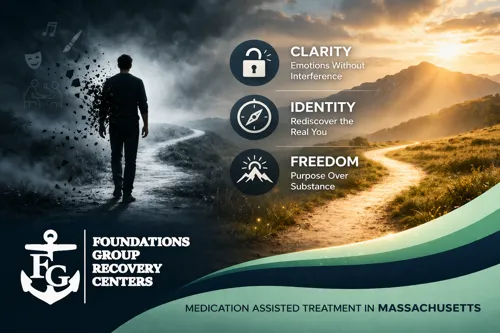
You’re Not Losing Yourself—You’re Untangling Yourself
One of the most honest ways to describe early recovery—especially with medication support—is not “becoming a new person.”
It’s untangling.
Separating what’s actually you from what was amplified, numbed, or distorted.
That process can feel uncomfortable at first. Even disorienting.
Because suddenly:
- Your emotions aren’t filtered the same way
- Your reactions might feel unfamiliar
- Your creativity or social rhythm might shift before it stabilizes
And that’s where people get scared.
They think: “This is it. I’ve lost it.”
But what’s actually happening is something quieter.
You’re meeting yourself without interference.
Medication Doesn’t Erase You—It Creates Space
This is one of the biggest misconceptions I hear.
That medication-assisted approaches will “flatten” personality or remove emotional depth.
In reality, what many people experience is the opposite.
Not numbness—but regulation.
Not silence—but clarity.
The constant background noise—the cravings, the anxiety spikes, the emotional swings—starts to settle.
And in that space, something unexpected happens:
You begin to choose how you respond instead of reacting automatically.
That’s not losing yourself.
That’s gaining access to parts of yourself that were buried under chaos.
In Barnstable County, Massachusetts, where many individuals are balancing work, family, and internal struggles quietly, that kind of steadiness can feel unfamiliar at first—but also deeply relieving.
There’s a Grief No One Prepares You For
Even when you know something isn’t working anymore, letting it go still hurts.
You might grieve:
- The version of you that felt more fearless
- The routines and rituals tied to your identity
- The social spaces where you felt like you belonged
And here’s the important part:
That grief doesn’t mean you’re making the wrong decision.
It means you’re aware of what you’re leaving behind.
And awareness is not weakness—it’s depth.
You Don’t Have to Become “Boring” to Be Stable
A lot of people carry this unspoken belief:
Stability equals dullness.
That if things are more balanced, they’ll also be less meaningful, less exciting, less alive.
But what actually happens over time is different.
The highs may feel less chaotic—but they become more genuine.
The connections may feel slower—but they become more real.
Instead of chasing intensity, you begin to experience consistency.
And consistency doesn’t erase personality—it supports it.
You’re Allowed to Move Slowly Through This Decision
There’s no requirement to rush into certainty.
You don’t need to have everything figured out before you take a step.
You’re allowed to:
- Ask questions
- Feel unsure
- Change your mind
- Take things one decision at a time
Exploring options like medication assisted treatment massachusetts doesn’t lock you into anything.
It opens a door.
What you do with that door is still your choice.
The Question Isn’t “Will I Lose Myself?”
It’s “What Parts of Me Have Been Covered Up?”
Sometimes the fear is framed the wrong way.
It’s not about losing who you are.
It’s about discovering who you are without something influencing every layer of your experience.
That can feel unfamiliar. Even uncomfortable.
But unfamiliar doesn’t mean wrong.
It often means new.
FAQs: The Identity Fear Behind Recovery
Will I feel like a completely different person?
Most people don’t become someone else—they become more aware of themselves. The early phase can feel unfamiliar, but over time, people often describe feeling more like themselves, not less.
What if I lose my creativity or emotional depth?
This is a common fear, especially for creative or emotionally expressive individuals. What typically changes isn’t your depth—it’s the instability around it. Creativity often becomes more sustainable, even if it feels different at first.
Does medication make people feel numb?
Some people worry about this, but many actually experience increased emotional clarity. Instead of extreme highs and lows, emotions become more manageable and easier to understand.
What if I don’t like who I am without substances?
That’s a real fear—and one worth exploring, not avoiding. Recovery isn’t about forcing you to accept a version of yourself you don’t like. It’s about giving you the space and support to shape that version intentionally.
How long does it take to feel “normal” again?
There’s no fixed timeline. For some, it takes weeks. For others, longer. What matters is that the process moves toward stability, not perfection.
Can I still be social, fun, or outgoing?
Yes—but it may feel different at first. Many people find that their social confidence returns in a more grounded, authentic way over time.
If You’re Standing in That In-Between Space
If part of you is curious…
and another part is holding tightly to what feels like “you”—
That tension doesn’t mean you’re stuck.
It means you’re paying attention.
You’re not being asked to erase yourself.
You’re being invited to understand yourself without interference.
And that’s a very different kind of change.
If you’re ready to explore what support could look like, you can take the next step at your own pace.
Call (844)763-4966 or visit our page to learn more about our medication assisted treatment in Massachusetts.