
You thought the worst part was behind you.
The first crisis. The first admission. The first fragile stretch of hope.
And now you’re back here — watching your 20-year-old use again.
If you’re exhausted, scared to answer your phone, or replaying every parenting decision you’ve ever made, you are not dramatic. You are grieving in real time.
As a clinician who has worked with many families in this exact place, I want to offer something steadier than panic: perspective. If you’ve been quietly researching opiate addiction treatment in Massachusetts again, this isn’t a step backward. It’s you refusing to give up.
Let’s talk honestly about why relapse happens — and how recovery can still move forward, even after repeated setbacks.
Relapse Is Common — Even When No One Prepares You for It
Many families leave early treatment believing that sobriety will now move in a straight line.
But opioid addiction rarely unfolds that way.
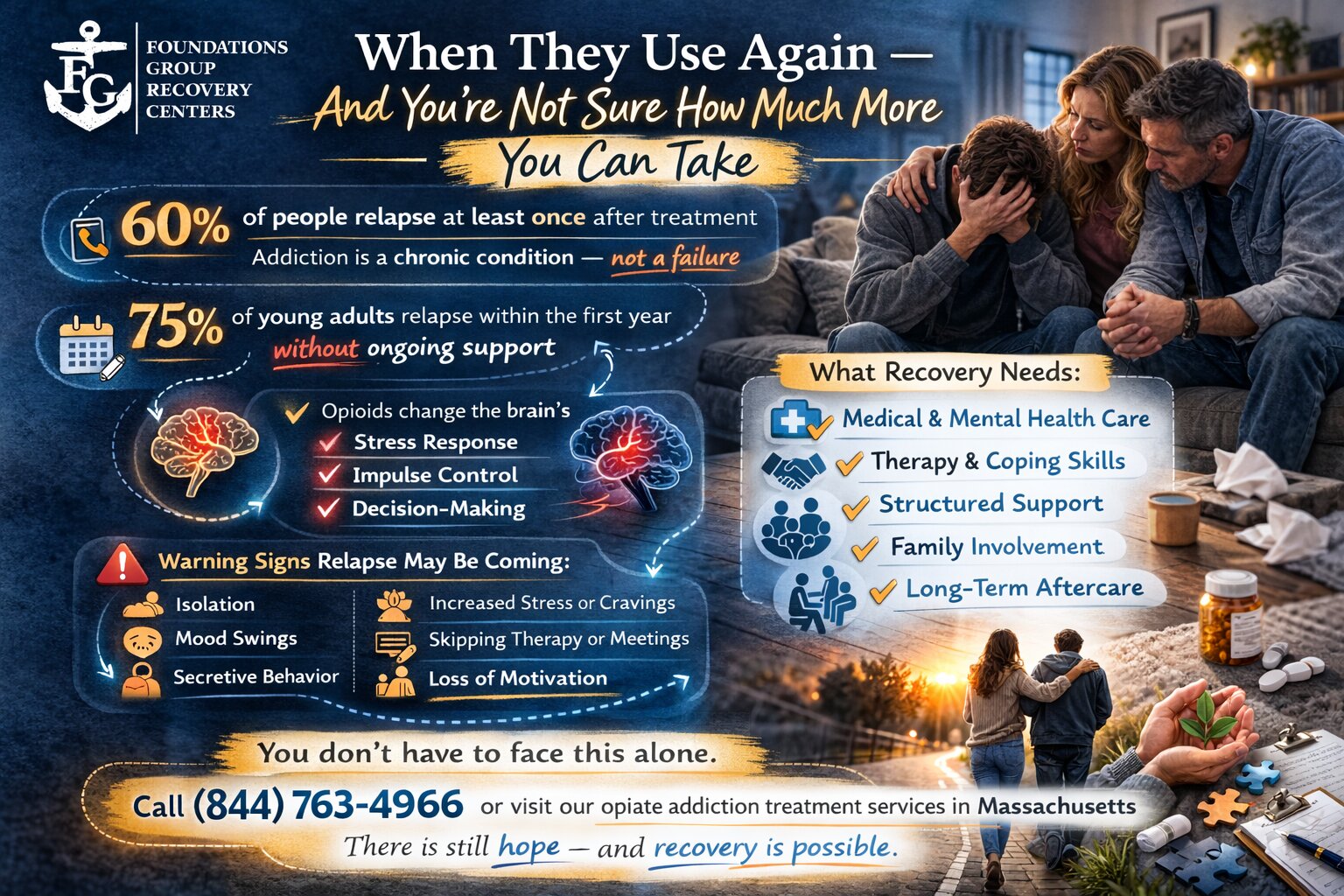
Relapse rates for substance use disorders are comparable to other chronic medical conditions like asthma or diabetes. That doesn’t make it less painful. It simply means recurrence is part of the clinical picture — not proof that someone is beyond help.
When relapse keeps happening, it usually tells us one of three things:
- The level of care wasn’t intensive enough
- Underlying mental health needs weren’t fully addressed
- The individual wasn’t ready to sustain recovery without stronger structure
Relapse is not a moral collapse. It’s a signal flare.
The Brain Is Still Healing — Even When Behavior Looks “Better”
Opioids fundamentally change how the brain processes stress and reward.
During early recovery, your child’s brain may still:
- Crave relief intensely under stress
- Overreact to emotional discomfort
- Struggle with impulse control
- Experience low motivation or depression
From the outside, they may look stable. They might go to work. Attend family dinner. Say the right words.
Inside, their nervous system may still feel like it’s on fire.
Without consistent therapeutic support, medication when appropriate, and structured accountability, relapse risk remains high — especially in young adults whose brains are still developing.
This is why adjustments in care matter. Not punishment. Not lectures. Adjustments.
Young Adults Often Underestimate How Much Support They Need
At 20, independence feels urgent.
Many young adults leave treatment determined to “handle it themselves.” They want their old life back. They don’t want to feel labeled. They don’t want recovery to define them.
But recovery requires rebuilding:
- Coping skills
- Social circles
- Identity
- Daily structure
That’s a lot to carry alone.
When someone returns to use, it doesn’t always mean they rejected recovery. Sometimes it means they tried to sprint through a marathon.
More structure — whether that’s live-in treatment, structured daytime care, or multi-day weekly treatment — can create the consistency the brain needs to stabilize.
When Mental Health Is Driving the Relapse
This is one of the most overlooked factors.
Many young adults using opioids are also struggling with:
- Depression
- Anxiety
- Trauma
- ADHD
- Unprocessed grief
If those conditions aren’t treated effectively, opioids can become a form of self-medication.
From a clinical standpoint, integrated care is critical. Modern opiate addiction treatment addresses both substance use and mental health together — because separating them increases relapse risk.
If your child relapsed, it’s worth asking:
- Were psychiatric medications evaluated thoroughly?
- Was trauma therapy part of care?
- Did they feel emotionally safe enough to be honest?
Relapse sometimes reveals what wasn’t safe or possible to say the first time.
Shame Can Quietly Sabotage Progress
When relapse happens again, shame floods the room.
Your child may feel like they’ve destroyed your trust permanently.
You may feel angry — and afraid to show softness.
Here’s what I’ve seen repeatedly: shame deepens secrecy.
Accountability matters. Boundaries matter deeply. But when conversations are driven by fear alone, many young adults hide instead of reaching out.
And hiding increases danger.
A steadier approach looks like:
- Clear expectations
- Firm boundaries
- Consistent communication
- Refusal to fund or enable use
- Continued openness to treatment
It’s possible to say, “I love you, and this cannot continue,” at the same time.
That balance is hard. Most parents need guidance learning it.
Treatment Isn’t “Starting Over” — It’s Recalibrating
When families return to treatment after relapse, it often feels humiliating.
It isn’t.
Clinically, we view it as recalibration.
The treatment plan changes based on what we now know:
- What triggers were underestimated
- What peer influences were too strong
- What coping skills weren’t internalized
- What emotional wounds weren’t addressed
The second or third attempt is often more personalized, more honest, and more grounded.
And sometimes, it’s the one that takes root.
What Makes Recovery Stick After Multiple Relapses?
There isn’t one magic ingredient. But there are patterns.
Recovery stabilizes when:
- The individual shifts from compliance (“I’ll do this to get everyone off my back”) to engagement (“I want this”)
- Peer community feels authentic and age-appropriate
- Medication support is used when clinically indicated
- Structure is sustained long enough for habits to change
- Family systems shift alongside the individual
This last piece is important.
Parents sometimes unknowingly carry too much responsibility — monitoring, rescuing, over-functioning. When families receive support as well, the dynamic changes.
You did not cause this. But your support system matters.
You’re Allowed to Be Tired
Parents rarely say this out loud:
“I don’t know how much more I can take.”
That doesn’t mean you don’t love your child. It means you’re human.
Chronic stress changes your nervous system, too. You may feel hyper-alert, reactive, or emotionally numb.
Part of helping your child recover may include you getting support — therapy, parent groups, clinical consultation — so you’re not carrying this alone.
Hope does not require you to be endlessly strong. It requires sustainability.
FAQ: When Relapse Keeps Happening
Is repeated relapse a sign that treatment won’t work?
No. It’s a sign that the previous approach may not have addressed everything needed. Addiction is a chronic condition. Adjusting levels of care is common and clinically appropriate.
Should we choose a higher level of care after another relapse?
Often, yes — especially if relapse occurred quickly after discharge or involved significant risk. More structured environments can interrupt patterns long enough for deeper stabilization.
A clinical assessment can help determine whether live-in care, structured daytime support, or multi-day weekly treatment is appropriate.
Does medication mean they “failed” at recovery?
No. For opioid use disorders, medication-assisted support can significantly reduce relapse and overdose risk. It’s a medical tool, not a shortcut.
How do we set boundaries without pushing them away?
Clear, consistent boundaries combined with calm communication are most effective. Avoid reactive ultimatums in moments of crisis. Instead, outline expectations during stable periods.
Working with a family therapist can make this process much safer and more sustainable.
What if they refuse to go back to treatment?
This is painful and common.
You can:
- Refuse financial support for use
- Stop shielding natural consequences
- Offer clear pathways back to treatment
- Seek guidance from a professional about structured interventions
You cannot force readiness. But you can shift the environment around it.
How do we manage the fear of overdose?
Take overdose risk seriously. Have naloxone accessible. Maintain communication. Encourage treatment quickly after relapse. And understand that every return to care reduces long-term risk.
Fear is understandable. Let it guide preparation, not panic.
There Is Still a Path Forward
If you are here — reading, researching, trying again — you have not given up.
At Foundations Group Recovery Center, we approach relapse not as failure but as clinical information. Our layered approach to opiate addiction treatment focuses on young adults who need structure, psychiatric support, and individualized care after repeated setbacks.
Recovery is rarely linear. But it is still possible.
Call 844-763-4966 or visit our opiate addiction treatment services in Massachusetts to learn more about our opiate addiction treatment services in Barnstable County, MA.