
There’s a moment before the call.
It’s quiet. Heavy. Maybe it happens at 2 a.m. Maybe it happens in your car before work. Maybe it’s after another promise you didn’t keep.
You already know this can’t keep going.
What you don’t know is what happens next.
At Foundations Group Recovery Center Massachusetts, we talk to people every day who are in that exact space—aware they need help, but scared of what treatment will actually be like. If you’ve been looking into opiate addiction treatment in Massachusetts, this is what the real process looks like when you reach out.
Not a sales pitch. Not a clinical manual.
Just the truth.
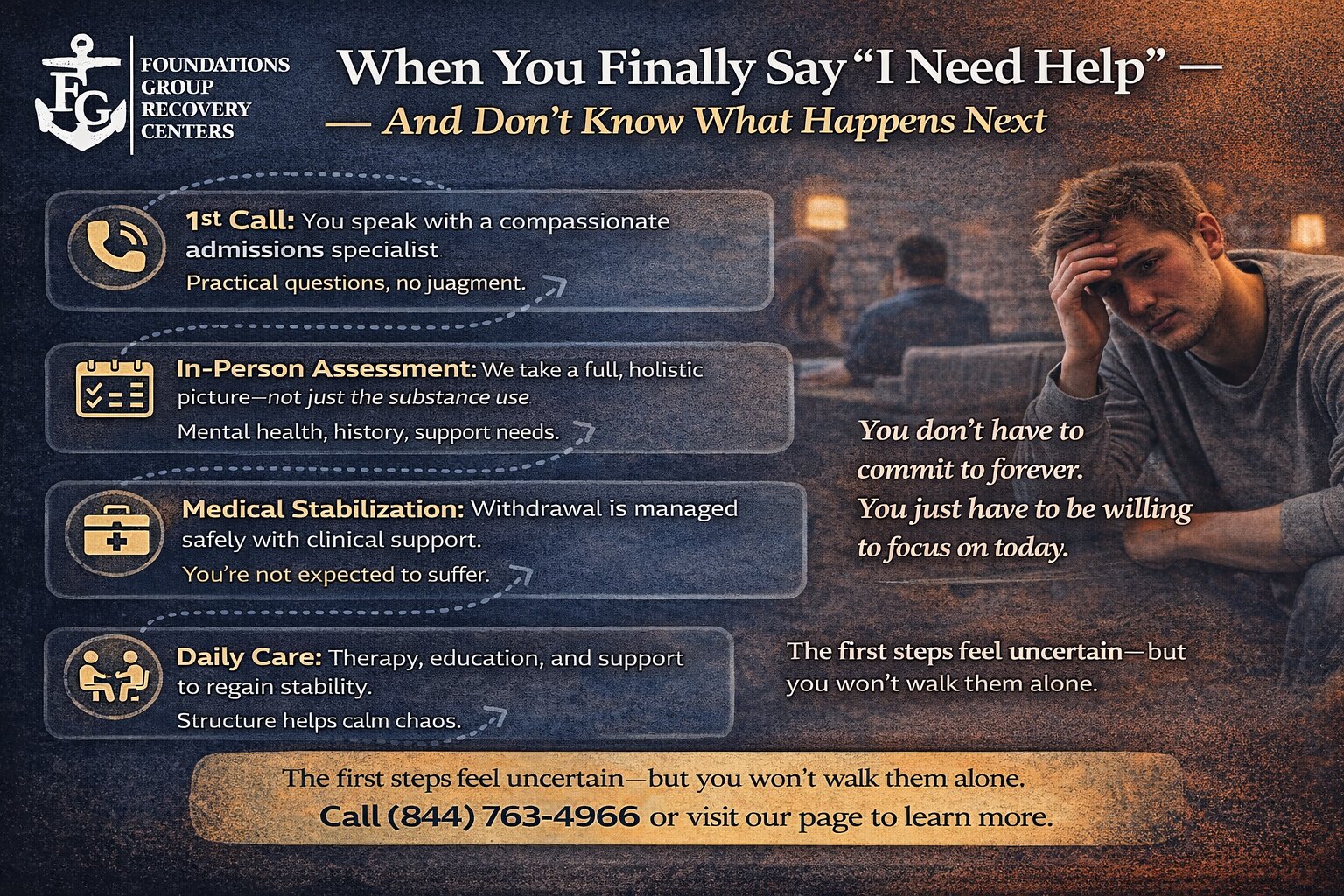
The First Call: You’re Not in Trouble
Let’s start here.
When you call, you’re not calling a hotline that’s going to pressure you into signing something. You’re not speaking to someone who’s judging you. You’re not being evaluated for worthiness.
You’re talking to a human being whose job is to help you feel safe enough to take the next step.
We’ll ask practical questions:
- What substances are you using?
- How often?
- Have you tried to stop before?
- Are you safe right now?
But this isn’t an interrogation. It’s a conversation.
You can say, “I don’t even know what I need.”
You can say, “I’m scared.”
You can say, “I’ve never done this before.”
That’s enough to begin.
You Don’t Have to Be “Bad Enough” to Deserve Help
This is one of the biggest barriers.
A lot of people who finally call still feel like imposters. They think:
- “I still have my job.”
- “I haven’t overdosed.”
- “Other people are worse.”
- “Maybe I’m being dramatic.”
Addiction doesn’t have one look.
If you’re organizing your day around using…
If your mood crashes when you can’t access it…
If you’ve tried to cut back and couldn’t…
If your relationships feel strained or secretive…
That matters.
You don’t have to destroy your life to earn support. You just have to be tired of living this way.
The Assessment: A Full Picture, Not a Label
When you arrive for an intake appointment, we slow things down.
This isn’t about stamping you with a diagnosis and moving on. It’s about understanding what’s underneath the substance use.
We’ll talk about:
- Your mental health
- Sleep patterns
- Anxiety or depression
- Trauma history
- Family dynamics
- Medical history
- Stress levels
- Past treatment experiences (if any)
Because opioid use rarely exists in isolation. It’s often tied to pain—physical, emotional, or both.
Think of it like mapping a blueprint before rebuilding a house. We can’t repair what we don’t understand.
From there, we’ll recommend a level of care that fits your needs. Some people benefit from round-the-clock support. Others thrive in structured daytime care. Others attend multi-day weekly treatment while maintaining work or family responsibilities.
There isn’t one “right” path. There’s the right fit for you.
What About Withdrawal?
Let’s name the fear directly.
“What if detox is unbearable?”
“What if I can’t handle it?”
“What if I get sick?”
You don’t have to white-knuckle this.
Medical support is available to help manage withdrawal symptoms safely and comfortably. For many people, medications can ease cravings, reduce physical discomfort, and stabilize mood during early recovery.
You are not expected to suffer your way into sobriety.
Stabilizing your body gives your brain space to think clearly again. And that clarity is powerful.
What Your Days Actually Look Like
A common misconception is that treatment means sitting in a circle all day being forced to confess your worst moments.
That’s not what this is.
Depending on your level of care, your days may include:
- Group therapy sessions where people speak honestly about real struggles
- One-on-one counseling
- Education about how opioids affect the brain and nervous system
- Skills training for managing cravings, triggers, and stress
- Support around rebuilding routines
- Planning for what happens after the program
There is structure. That’s intentional.
Structure helps calm chaos. It gives your nervous system predictability. It replaces the daily obsession with a rhythm that feels steadier.
But you are still a person—not a project.
There is room for humor. For connection. For quiet breakthroughs.
Many clients say the biggest surprise is this: they don’t feel judged. They feel understood.
When Mental Health and Substance Use Collide
For many people, opioid use is closely connected to anxiety, depression, trauma, or chronic stress.
When mental health and substance use collide, treating one without the other rarely works long term.
That’s why integrated care matters.
We look at the whole picture—not just the substance. That may include therapy focused on trauma, coping skills for panic or depression, or psychiatric support when appropriate.
Recovery isn’t about ripping something away from you. It’s about replacing it with tools that actually work.
The Emotional Whiplash Is Normal
Here’s something people don’t talk about enough:
The first week can feel strange.
You might feel relief one moment and panic the next.
You might feel hopeful and then suddenly doubt everything.
You might wonder, “What did I just sign up for?”
That emotional whiplash is normal.
Your brain is recalibrating. Your nervous system is adjusting. You’re stepping out of survival mode and into something unfamiliar.
It doesn’t mean you’re failing.
It means you’re changing.
You Don’t Have to Commit to Forever
One of the quiet fears many first-time treatment seekers carry is this:
“What if I can’t promise to be sober forever?”
You don’t have to.
You only have to be willing to focus on today.
Recovery is built in small increments. Today becomes this week. This week becomes this month.
We help you create a plan for what comes after your initial level of care—whether that’s stepping down into multi-day weekly treatment, continuing therapy, joining support groups, or building community resources.
You’re not signing your life away. You’re building it back intentionally.
What Happens After the Program?
Another common worry:
“What if I finish and then I’m on my own?”
Aftercare planning begins early. We talk about:
- Ongoing therapy
- Support meetings
- Relapse prevention strategies
- Family involvement when appropriate
- Alumni resources
Recovery isn’t a single event. It’s a supported transition.
And if you stumble? That doesn’t erase progress. It’s information. It’s data. It’s something we can work with—not something that disqualifies you.
Frequently Asked Questions
How long does treatment last?
It depends on your needs and the level of care. Some people begin with round-the-clock support and then transition into structured daytime care or multi-day weekly treatment. Length is individualized, not one-size-fits-all.
Can I keep working while getting help?
In many cases, yes. Certain levels of care are designed to allow you to maintain work or family responsibilities while receiving consistent therapeutic support.
Will my family find out?
Your privacy is protected. We encourage family involvement when it’s helpful and safe, but nothing is shared without your consent except in legally required situations.
What if I’ve tried treatment before and it didn’t work?
That doesn’t mean you can’t recover. It may mean the level of care, support structure, or approach wasn’t the right fit at the time. Recovery isn’t linear, and many people succeed after prior attempts.
Is medication part of treatment?
For many individuals, medication can be a valuable part of stabilizing cravings and reducing relapse risk. It’s not mandatory—but it’s an option discussed openly and without stigma.
What if I relapse during or after treatment?
Relapse is not a moral failure. It’s a signal that something needs adjustment. If it happens, we focus on re-engagement, not punishment.
I’m scared. Is that normal?
Yes.
Almost everyone is scared before starting.
Courage doesn’t mean the fear disappears. It means you move forward anyway.
The Hardest Step Is the First One
Walking through the door—or picking up the phone—is often the most difficult part.
After that, you’re not alone.
You’ll meet professionals who have seen recovery happen thousands of times. You’ll meet peers who thought they were beyond help. You’ll begin to feel something unfamiliar but steady:
Relief.
Not because everything is magically fixed.
But because you’re no longer fighting in isolation.
If you’re ready to explore what real support looks like, call (844)763-4966 or visit our opiate addiction treatment services in Massachusetts to learn more about our opiate addiction treatment services in Barnstable County, MA.