
Ninety-three days.
That’s how long I stayed clean before I relapsed. Three months—just long enough for people to start believing in me again. Just long enough to believe it myself. Just long enough to say it out loud: I’m good.
And I wasn’t lying when I said it.
But then came the familiar script. A long shift. A panic I couldn’t talk myself down from. A single excuse that felt reasonable in the moment. One “slip” that turned into a week of silence. One skipped appointment that turned into disappearing.
And then?
I was right back where I swore I’d never be. Numb. Ashamed. Exhausted. Terrified to tell anyone. Even more terrified to ask for help.
If you’re reading this and you’ve relapsed—or you’re standing on the edge of it—I want to tell you what it actually felt like to return to opiate addiction treatment after I swore I was “good.”
Because maybe you need to know what I didn’t: that it’s okay to come back. And that coming back isn’t failure. It’s the most honest step forward I’ve ever taken.
The Walk Back In Was Heavy
I knew the building. Knew the faces. Knew what to expect.
But that didn’t make walking back in any easier.
I was convinced they’d be disappointed. Convinced they’d think I wasted their time the first go-round. I imagined them exchanging glances. Thought maybe they’d say, “Didn’t he already graduate?”
The shame was sharp and constant. I almost turned around three times. I even rehearsed a joke in case someone asked what I was doing there.
But nobody laughed. Nobody rolled their eyes. Nobody made me prove I deserved to be back.
They just said, “Hey. You’re here. Let’s talk.”
And in that moment, I remembered why treatment mattered in the first place: because it’s one of the only places where your worst day doesn’t define you.
I Thought I Was Solid—But I Was Just Performing
The first time around, I did well. Or at least, I did all the right things.
I went to group. I said the “right” stuff. I followed the rules. I got my chip. I even helped a few new guys settle in.
But underneath, I was still performing recovery more than I was living it.
I didn’t talk about my cravings. I didn’t admit when I felt lonely or triggered. I gave people the cleaned-up version of what was going on. I wanted to be the success story. I didn’t want to be the guy who almost fell apart at 61 days because his sister stopped answering his texts.
So when stress hit? I didn’t reach out.
I reached for what had always worked before: escape. And in one moment of tired, lonely quiet—I used.
This time, I’m not interested in impressing anyone. I’m interested in staying real.
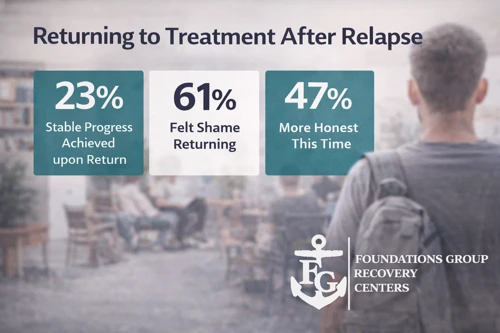
Coming Back Felt Like Admitting I Wasn’t Done—and That Hurt
There’s this myth in recovery that the longer you stay clean, the less likely you are to relapse. Like time itself builds a wall between you and the old stuff.
So when I hit 90+ days, I thought I was on the other side of it.
Coming back to treatment meant facing a hard truth: I wasn’t done. Not with the work. Not with the triggers. Not with the parts of myself I hadn’t dealt with yet.
But here’s what I learned: relapse doesn’t erase progress. It reveals where support is still needed.
Coming back wasn’t starting over. It was picking up where I left off—with more truth, more grit, and fewer illusions.
Everyone Says “You’re Not Alone”—But This Time I Believed It
Something shifts when you walk back into group as a relapsed alumni. You realize you’re not the exception. You’re not the only one who made it a few months, thought you had it all figured out, and then faceplanted.
You hear someone say, “Same here,” and they mean it.
You watch another guy nod when you say, “I didn’t think I’d be the one to come back.”
You hear a counselor say, “That makes sense,” when you expect them to say, “What the hell?”
That’s what healed me more than anything.
Not the worksheet. Not the lectures. The people. The grace. The quiet way someone scoots over in a group circle and makes room for you without asking for an explanation.
I Built a Different Kind of Recovery This Time
This time, I’m not checking boxes. I’m not trying to graduate. I’m not chasing a number of clean days just to prove something.
I’m building a recovery I can actually live inside of.
That means:
- Telling on myself early and often
- Saying “I don’t know” without shame
- Choosing connection over control
- Letting people challenge me when I want to run
- Owning my triggers before they become slips
Foundations Group Recovery Center helped me start over—not with less faith in myself, but with more realism. More slowness. More honesty.
You’re Allowed to Come Back—and You Don’t Have to Earn It
Maybe you’re reading this and you’re in the in-between.
You haven’t called yet. You’re still pretending things aren’t that bad. You’re trying to outrun the lie that “it was just once.”
I’ve been there.
And here’s what I’ll tell you:
The longer you wait, the louder the shame gets.
The harder it is to believe you deserve another chance.
The more alone you’ll feel.
So stop trying to earn your way back into recovery. Just come back.
We already know you’re hurting. You don’t have to prove anything to belong.
FAQ: Returning to Opiate Addiction Treatment After a Relapse
Am I allowed to come back to treatment after relapsing?
Yes. And more than that—you’re encouraged to. Many alumni return after a slip or relapse. It’s not shameful. It’s part of the process for a lot of us.
Will I have to start all over?
Not exactly. You’ll revisit core concepts, but you’re bringing in more life experience. This round can go deeper because you know what’s at stake.
What if I’m embarrassed to face staff or group members?
You’re not the first person to come back. And if your program is anything like Foundations, you’ll be met with empathy, not judgment.
Will people see me differently?
Maybe. But often, they’ll see you as someone brave enough to tell the truth and show back up. That earns respect, not ridicule.
What makes this round of treatment different?
You do. You’re walking in with new insight. New wounds. A new kind of willingness. And that changes everything.
If You’re Thinking About Coming Back, You Already Know What Courage Feels Like
Coming back after relapse isn’t weakness. It’s growth in motion.
It means you’re done pretending.
It means you’re choosing truth over shame.
It means you want your life back.
And that matters more than any clean day total ever will.
If opiate addiction treatment in Barnstable County, Massachusetts helped you once—even a little—it’s okay to let it help again. Not because you’re broken. But because you’re still becoming someone you actually want to be.
Call (844)763-4966 to learn more about our opiate addiction treatment services in Massachusetts. You don’t need a perfect track record to return. Just enough willingness to try again. We’ll meet you there.