
You’re afraid medication will take something from you.
Not just the substance. Not just the symptoms.
You’re scared it might take away you—your creativity, your edge, your spark, your weird little rituals, the version of yourself that maybe only exists when you’re high or lit or emotionally tilted sideways.
We see that fear all the time. Especially among people who are creative, identity-driven, or deeply internal. Not everyone who uses is trying to disappear—some are trying to hold onto something that only seems to show up when they’re using.
And when treatment is pitched like a personality cleanse or a “fix”—it’s no wonder you’ve hesitated.
At Foundations Group Recovery Centers in Mashpee, MA, we believe medication-assisted treatment (MAT) should never flatten who you are. It should help stabilize what isn’t working so the parts of you that matter can rise—without chaos.
This is not a sales pitch. This is a conversation you deserve to have:
What does MAT actually do? What doesn’t it do? And what happens when you’re not trying to force yourself to “be okay” without help?
Let’s talk about it—honestly.
The Real Fear: “If I Get Sober, Will I Still Be Me?”
It’s a question people rarely say out loud, but you can hear it between the lines:
- “Will I still be able to write?”
- “Will I still have that social confidence?”
- “Will I lose my spontaneity or my sense of depth?”
- “Will people say I’ve changed—and not in a good way?”
These are not shallow fears. For a lot of people, substances feel intertwined with identity—especially if they became part of how you connect, create, or cope with the intensity of being a deeply feeling person.
We want you to know this: your fear is not a weakness. It’s information.
And it deserves to be explored, not dismissed.
What Medication-Assisted Treatment Actually Does
Let’s walk through what MAT does from a clinical, human-first lens:
1. It Calms the Biological Storm
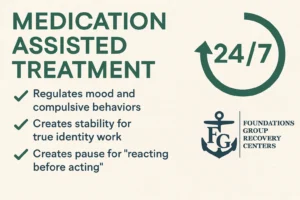
Most people think of MAT as “craving blockers.” And yes, medications like buprenorphine, methadone, and naltrexone do help reduce the physical drive toward substances. But more importantly, they level out the inner turbulence. You can think. You can breathe. You can pause before acting. You get back your inner space.
2. It Interrupts the Loop
When you’re caught in the use-crash-regret loop, it’s almost impossible to focus on healing. MAT gives your body and brain enough stability to begin untangling the why behind the behavior.
3. It Creates a Window for Real Identity Work
This is the most important part. MAT doesn’t numb your identity. It makes room for you to remember what it even is—without the static of withdrawal, chaos, or compulsion clouding it.
It’s not a shortcut. It’s not cheating. It’s like noise-canceling headphones for your nervous system—so you can finally hear your own voice.
What Medication-Assisted Treatment Doesn’t Do
Let’s be real: MAT is powerful, but it has limits. Knowing what it doesn’t do can help set more honest expectations.
- It doesn’t erase emotional pain. You’ll still have to feel your feelings—just not fight your brain while doing it.
- It won’t “solve” your life. MAT gives you a foundation, not a finished house. You still need therapy, support, purpose, routine.
- It doesn’t change who you are. It can change how your body reacts. It can make recovery feel possible. But you’re still you—maybe more than ever.
“But I’m an Artist/Creative/Performer—Will I Still Be Able to Create?”
This is one of the most tender and common fears. Many clients tell us:
“Substances are where I get my ideas.”
“Using helped me access something deep inside.”
“Sobriety sounds like going gray inside.”
The truth? Many people do struggle to create early in recovery—not because they’ve lost their gift, but because their nervous system is healing. The highs and lows that once felt like muses fade for a while.
But then something wild happens.
They write again. They paint again. They perform, dance, code, sing, record.
And this time, they remember it. They shape it. They own it.
What used to come from chaos now comes from clarity.
Our Approach to Medication-Assisted Treatment in Mashpee, MA
At Foundations Group Recovery Centers, we don’t believe in one-size-fits-all MAT. We believe in options, transparency, and your full consent at every step.
Here’s what to expect:
- Full medical and clinical assessment before recommending anything
- Collaboration: you’ll never be told what to do—you’ll be asked what you need
- Access to FDA-approved medications like Suboxone, Vivitrol, and more
- Integration with therapy, groups, trauma support, identity exploration
- A plan that evolves with you—and doesn’t trap you in one way of healing
If you’re looking for medication assisted treatment in Barnstable County, MA, or nearby areas like Falmouth, we’re already helping clients from your community explore MAT safely and privately.
Real Talk: What Clients Have Shared About MAT
“I was terrified I’d feel numb. I actually feel more alive now.”
“I thought I’d lose my personality. What I lost was my panic.”
“I create more now—not because I’m chasing a high, but because I have space to explore.”
These aren’t slogans. These are lived experiences from people who were skeptical, scared, and deeply attached to the version of themselves that existed while using. They didn’t lose themselves. They reclaimed themselves.
What If You’re Not Ready to Commit?
You don’t have to commit to MAT right now.
Here’s how to start:
- Have a no-pressure consultation—ask every question you’re afraid to say out loud.
- Try journaling through your fear. What specifically do you worry MAT will change?
- Talk to someone who’s been there. Real stories often help normalize what clinical info can’t.
- Consider trying a low dose. Not all MAT starts full strength. You can test how your body responds.
You don’t have to be certain to be curious.
FAQs About Medication-Assisted Treatment
Will MAT change my personality?
No. MAT doesn’t rewrite who you are. It helps reduce compulsive behaviors and regulate mood. Most people report feeling more themselves once stable.
Can I taper off eventually?
Yes. Many clients choose to taper after building support systems and emotional regulation skills. Others stay on long-term. You’ll never be pushed either way.
Will it interfere with my creativity?
Temporarily, you may feel less extreme. But over time, your creative rhythm returns—stronger and more sustainable. Your art deserves a healthy vessel.
Is MAT a forever thing?
No. It’s a tool. You and your clinician decide how long it’s right for you.
What are the risks or side effects?
Side effects depend on the medication. Most are manageable and short-term. We monitor closely, adjust as needed, and always center your feedback.
Is MAT accepted in sober communities?
Increasingly, yes. Especially as science catches up to what people in recovery have known for years: there’s more than one path.
You Don’t Have to Lose Yourself to Get Better
If you’ve been afraid that getting help means disappearing—that’s not recovery. That’s erasure. And we don’t do that here.
You can keep your edge, your art, your soul, your spark.
You can be wildly, weirdly, wonderfully you—without the substances that have been holding your pain hostage.
You don’t have to choose between healing and identity.
You can choose both.
Call (844) 763-4966 to learn more about our medication assisted treatment services in Mashpee, MA.
We’ll meet you exactly where you are—and help you stay fully yourself while you grow.