
You’ve done everything you can think of. Called old friends. Searched bedrooms. Sat on couches at 2 a.m. You’ve bargained, threatened, begged, ignored, cried. You feel like a wreck—but you believe in them so fiercely you can’t stop fighting.
But here’s the hard truth you need to hear: you can’t fix your child’s alcohol addiction by yourself. Not because you love them less or because you failed. Because addiction is bigger than what one heart, one home, one parent can manage. But you can be part of the solution, part of the recovery path—if you shift from trying to fix, to insisting on help, setting boundaries, and caring for yourself alongside your child.
When your 20‑year‑old starts using again, it rips at your sense of control, your trust, your faith in tomorrow. But it also cracks open possibility—for change, intervention, reconnection. This is not giving up. It’s waking up to the real work that can carry you both forward.
This guide is for parents like you—tired, hopeful, determined. It’s a map, not a magic wand. It’s a companion, not a miracle. If you’re in Massachusetts or Cape Cod, know this: options exist here, including alcohol addiction treatment in Mashpee, MA, and in nearby towns like Falmouth or Barnstable County.
Let’s walk this hard path together.
1. Why “Love + Logic + Tough Talk” Often Backfires
Your instincts tell you to reason, to negotiate, to exert control. It makes sense—you love, you’re responsible, you want to protect.
But addiction changes how the brain signals reward, craving, impulse. Conversations you once had simply don’t reach where the problem lives anymore. The moment alcohol becomes a coping mechanism, your words may bounce off neural circuitry rewired to seek relief.
So when you say, “If you drink, you’re out,” or, “You’ll destroy your life again,” you may trigger fear, shame, secretiveness. They may rebel or retreat. And you end up escalating—not helping.
That doesn’t make your instincts wrong. It just means this disease doesn’t respond to logic. It responds to structure, medical care, therapy, and consistency.
2. What Alcohol Addiction Treatment Actually Offers (Beyond Detox)
If your child can be persuaded to enter treatment—or if you arrange it—what will it really do for them?
- Medical detox and withdrawal support. Alcohol withdrawal can be dangerous. Treatment centers provide medical management, monitoring, and safety.
- Therapeutic interventions. One-on-one therapy, group counseling, trauma-informed care, relapse prevention.
- Behavioral restructuring. New habits, coping skills, emotional regulation, healthy routines.
- Peer support & community. Recovering peers, group meetings, accountability, shared stories.
- Family involvement. Treatment isn’t just for them—it often includes family education, therapy, and boundary setting.
- Aftercare planning. Transitioning responsibly back to daily life, with outpatient support, check-ins, and relapse safeguards.
When they get treatment, your role changes: not fixer, but partner to healing. You infuse the process with love—but it’s the clinicians, therapists, and the recovery community who carry the heavy load.
3. The Weight You’re Carrying—and Why It Matters
When a child relapses, parents absorb shock, shame, guilt, trauma. Over years, that load builds. You may find yourself:
- Second‑guessing every decision
- Living in hypervigilance
- Blaming yourself, your marriage, your home
- Losing sleep, peace, identity
- Isolating from friends, fearful of judgment
You become part of the dysfunction unless you reclaim your needs. You deserve support—not because you failed, but because this journey demands strength, rest, clarity.
Healing starts in you, even before your child’s healing starts. You can’t pour from an empty cup.
4. Why Control and Enabling Often Collide
You want to prevent harm. So you watch, limit, intervene, “help” them skip work, hide them from legal consequences, cover debts, make excuses to others. In doing so, you reward the very behavior that needs redirection.
This is enabling. The line between helping and rescuing is razor-thin. Addiction capitalizes on that line. The more you absorb consequences, the less incentive there is for them to change.
Setting structure and consequences doesn’t mean you love less. It means you love with boundaries, clarity, and sustainability.
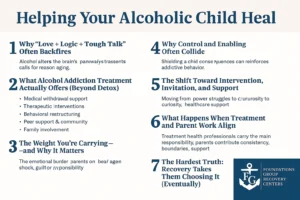
5. The Shift Toward Intervention, Invitation, and Support
Moving from trying to fix to helping them find treatment looks like:
- Stopping moralizing (“you’re bad”) and starting curiosity (“what’s hurting you?”)
- Removing yourself from power struggles (“you’ll go to rehab or else”) and leaning into invitation (“I’ll support you if you try treatment”)
- Separating your emotions from their chaos so your responses aren’t hijacked
- Switching from micromanagement to support for action steps like calling a center, visiting a detox, scheduling intake
- Aligning with caregiving systems (clinics, treatment centers, peer resources) so you’re not doing solo everything
You are not the enemy of your child. You are a potential ally to their recovery—if your role shifts.
6. What Happens When Treatment and Parent Work Align
When a parent partners with a treatment system—rather than fights it—some powerful shifts can happen:
- The message to your child shifts from “You’ve failed me” to “You deserve help.”
- Boundaries held with consistency create safety in chaos.
- You model self-care, emotional regulation, strength in seeking support.
- Trust can be rebuilt slowly—through consistency, openness, shared therapy.
- You recalibrate your relationship from reactive to steady, from fear-based to intention-driven.
You don’t need to control their choice—but you can control how you show up, how you protect yourself, and how you reclaim your life.
7. The Hardest Truth: Recovery Takes Them Choosing It (Eventually)
Even the best treatment doesn’t work if the person inside still resists it. Healing requires internal motivation. Denial, hiding, guilt, shame—those will fight any path forward.
Your job is not to force motivation. Your job is to:
- Offer the pathway through action
- Let your boundaries reflect backed intention
- Make consequences real—not punitive, but aligned to your self-protection
- Be the safe harbor, not the storm
When they begin to lean in, treatment helps them strengthen that internal resolve. Until then, all you can do is remain steady, consistent, firm—but also compassionate to both them and you.
Frequently Asked Questions
Q: What if they refuse treatment again?
A: Refusal is painful, but not final. Many relapse or resist before finding the right entry point. You can continue expressing willingness, offering choices, sharing stories of recovery, offering calls to centers, staging interventions through professionals. Persistence matters more than speed.
Q: Doesn’t this approach push them away?
A: Sometimes, yes, initially. Boundaries may feel to them like coldness or betrayal. But over time, consistency and safety often invite respect, trust, and connection—because chaos loses its grip when it’s no longer rewarded.
Q: Can I get family therapy even if they’re not in treatment?
A: Yes. There are therapists who specialize in family addiction work and codependency who can support you while your child resists. Your growth doesn’t have to wait.
Q: Is inpatient (residential) always necessary?
A: Not always. Some may benefit from outpatient or partial programs. But when relapse is frequent, when safety is unstable, or when prior interventions have failed, residential care offers deeper reset that some cases require.
Q: What about financial and location barriers?
A: Many centers in Massachusetts, including ours in Mashpee, offer sliding scales, accept insurance, and help coordinate travel and logistics. You shouldn’t abandon hope because of cost—ask for aid, ask for advocacy.
What to Do Today (Three Steps You Can Take)
- Call a treatment center now. Don’t wait for “the perfect moment.” Start with intake or consultation—even if your child is resistant.
- Get your own support. Find a parent support group (Al‑Anon, others), a counselor familiar with addiction—someone who holds you.
- Create three nonnegotiable boundaries. Decide now what behaviors you can’t tolerate (stealing, intoxicated driving, verbal abuse), and plan how you will uphold them.
You may feel like you’re walking into a war without armor. But sometimes the bravest thing is knowing you can’t fix them—and deciding you’ll help them heal anyway.
You don’t have to do this alone. You never should have been expected to. Energy spent trying to fix alone is energy stolen from your own strength, clarity, and future.
When you’re ready, call (844) 763‑4966 or visit our Alcohol Addiction Treatment page in Massachusetts to talk to someone who understands. The decision you make today—about boundaries, requesting help, shifting the narrative—can be one of the most powerful acts of love you ever give.